
Yoga classes use many words from Sanskrit and English, such as asana, pranayama and vinyasa. This simple glossary explains the common terms in plain language so you can follow a class with confidence. You do not need to learn them all.
This is general education, not medical advice. If you have an injury, are pregnant or have a health condition, check with your doctor before starting yoga.
Why learn common yoga words?
Knowing a few common terms helps you follow a class, read a guide and feel less lost as a beginner. Yoga uses words from Sanskrit and English. Teachers may mix both, so a class can sound confusing at first. You do not need to learn them all. A handful of terms covers most of what you hear. Our guide to the eight limbs of yoga explains the bigger framework behind many of them.
What does asana mean?
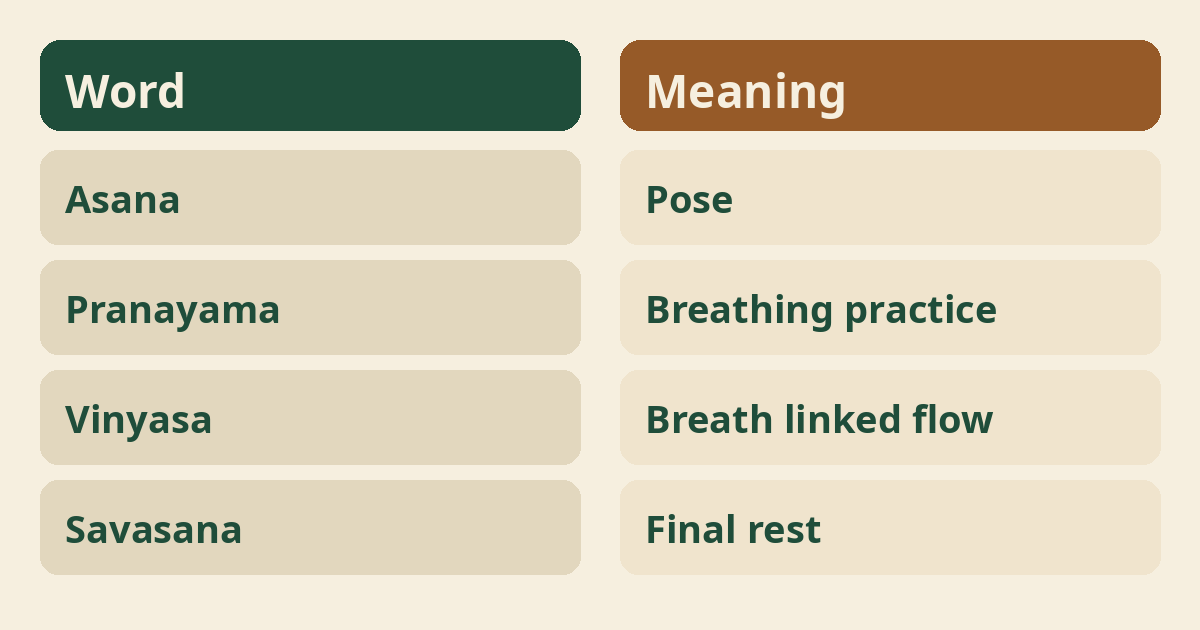
Asana means pose or posture, and it is the word for the physical shapes you practise in yoga. In older texts, the word meant a steady, comfortable seat. Today it covers every pose from standing to lying. When a teacher says move into the next asana, they mean the next pose.
What does pranayama mean?
Pranayama means breathing practice, which is the part of yoga that uses controlled breathing. Our guide to pranayama for beginners explains simple practices. Common examples include slow breathing and alternate nostril breathing.
What does namaste mean?
Namaste is a respectful greeting, often said at the end of class with palms pressed together. It is a polite gesture that means something like I bow to you. It is not required to say it. You can simply smile or nod. Do what feels natural to you.
What does om mean?
Om is a sacred sound often chanted at the start or end of a class. Our guide to om chanting explains how to try it. You can join in, hum along or simply listen.
What does savasana mean?
Savasana is the final rest, where you lie on your back and let the body relax completely. Our guide to savasana explains how to do it well. It is often called corpse pose, though most teachers prefer the Sanskrit word.
What is vinyasa?
Vinyasa means linking movement with breath, and it is also the name of a flowing style of class. Our guide to sun salutation shows a simple vinyasa. Movements follow the breath, so the class feels like a flow.
What is hatha?
Hatha is a general word for physical yoga, and a hatha class is usually slow and gentle. Our guide to hatha yoga explains what to expect. It is a common first class for beginners.
What is restorative yoga?
Restorative yoga is a slow style where you rest in supported poses for several minutes. Our guide to restorative yoga explains the poses and props. It is deeply relaxing.
What is a chakra?
A chakra is an energy centre in traditional yoga philosophy, often described as a wheel along the spine. Chakras come from tradition rather than science. Some teachers mention them in class. You can treat them as part of yoga’s cultural background and take what you find useful.
What is a mantra?
A mantra is a word or phrase repeated silently or aloud to focus the mind. Our guide to how to meditate explains how repeating a word can help attention. A mantra can be as simple as a single calm word.
What is a mudra?
A mudra is a hand position used in some breathing or meditation practices. Many people simply rest the hands on the thighs. Mudras are optional. Try one if it feels pleasant and skip it if it feels distracting.
What is drishti?
Drishti means a focused gaze, a spot you softly look at to stay steady in balance poses. Our guide to tree pose is a good place to try it. Choose a point that does not move, such as a mark on the wall.
What is a bandha?
A bandha is a gentle muscular lock used in some styles of yoga. Beginners do not need to use bandhas. If a teacher mentions them, simply listen and focus on easy breathing. Do not force any lock.
What is a kriya?
A kriya is a cleansing or action practice, and in some traditions it refers to specific breathing and meditation techniques. Our guide to kriya yoga vs hatha yoga explains one such tradition. It is an advanced topic, so go slowly.
What does yoga itself mean?
Yoga is a Sanskrit word often translated as union or connection, linking body, breath and mind. It can also mean discipline. The word describes a wide tradition, not only poses. Our guide to the benefits of yoga shows what many people enjoy about it.
What is a yogi or yogini?
A yogi is a person who practises yoga, and a yogini is the feminine form of the word. You do not need a special title. Anyone who practises can be called a yogi. In many classes, students simply call themselves practitioners.
What is a sequence?
A sequence is the order of poses in a class or home routine. Our guide to a morning yoga routine shows an example. A good sequence warms up, builds and then cools down.
What is a flow?
A flow is a smooth series of poses linked by breath, often in a vinyasa class. You move from one pose to the next without long pauses. Flow classes can feel like a dance. Beginners can start with slower flows.
What do props mean?
Props are tools like blocks, straps and blankets that support your poses. Our guide to yoga props explains each one. Using props is a smart choice, not a sign of weakness.
What does a teacher mean by modify?
To modify means to change a pose to fit your body, using an easier or gentler version. Teachers often offer options. You can choose the one that suits you. Our guide to yoga class etiquette explains how to ask.
What is a warm up or cool down?
A warm up prepares the body with gentle movement, while a cool down slows things before final rest. Both help you move safely. Our guide to yoga for flexibility shows safe ways to stretch. Never skip them when you can.
What if a word confuses you?
Ask the teacher after class or look it up later, since most teachers are happy to explain. You can also watch what others do. Over a few weeks, the words become familiar. Do not worry about getting everything right.
When should you see a doctor?
See a doctor before starting if you have an injury, health condition, pregnancy or any concern. Stop if you feel pain or dizziness. This guide is general education, not medical advice.
What is ujjayi breath?
Ujjayi is a slow breath through the nose with a soft, gentle sound in the back of the throat. It sounds a little like ocean waves. Many classes use it to keep a steady rhythm. Beginners can skip it and just breathe softly. Never strain the throat. If it feels forced, return to normal breathing.
What is a bolster?
A bolster is a firm, long cushion used to support the body in restful poses. You will hear this word in slow classes. A stack of pillows can take its place at home. Our guide to yoga for better sleep shows how supported poses can help you wind down.
What is a hold?
A hold is when you stay in a pose for several breaths instead of moving on right away. Holds build strength, balance and patience. Start with a few breaths and add more over time. Breathe smoothly while you hold and come out if you feel strain.
What does grounding mean?
Grounding means feeling the weight of your body connected to the floor or mat. Teachers use it to help you feel steady. Press the feet or hands gently into the mat. Notice the support beneath you. It is a simple way to feel calm and stable.
What does centring mean?
Centring means gathering your attention and settling the mind at the start of a class. You may sit quietly and breathe. It is a short pause before movement begins. Even a minute helps you arrive and leave the day’s noise behind.
What does engage mean?
To engage a muscle means to gently switch it on, such as drawing the belly in lightly or firming the thighs. Use only as much effort as you need. Overdoing it creates tension. Your teacher will guide you, and the feeling is more like steady support than hard squeezing.
Where to read next
For a calm, beginner-friendly start, Ranjana Sinha’s Begin Where You Are is written for people who want simple steps. Our guide to starting a home yoga practice adds a gentle routine you can follow at home.
Frequently asked questions
What does asana mean?
Pose or posture.
What does pranayama mean?
Breathing practice.
What is vinyasa?
Linking movement with breath, often in a flowing class.
Do I need to learn Sanskrit?
No. A handful of terms is enough.
What does namaste mean?
A respectful greeting, often said at the end of class.
The bottom line
A few words go a long way. Learn them slowly, ask when unsure and enjoy the practice.

