
Restorative yoga is a slow, quiet style where you rest in supported poses for several minutes. Pillows and blankets hold your body so you can relax fully. This guide explains what it is, which poses to try first and how to practise safely at home. Want the full foundation set? See our complete yoga poses for beginners guide.
This is general education, not medical advice. If you have an injury, are pregnant or have a health condition, check with your doctor before starting yoga.
What is restorative yoga?
Restorative yoga is a slow style where you rest in supported poses for several minutes, using pillows or blankets so the body can relax fully. Instead of working muscles, you let props hold you. Each pose is held for about three to ten minutes. The goal is deep rest, not stretching. It is a gentle choice for beginners and for anyone who wants a quiet practice. The National Center for Complementary and Integrative Health describes yoga as a mind and body practice that many people use to relax.
How is it different from other yoga?
Restorative yoga has fewer poses, longer holds and much more support than active styles. A flowing class may have dozens of poses. A restorative class may have four or five. Our guide to hatha yoga explains a slower active style, and our guide to sun salutation shows a flowing one. Restorative yoga is slower than both.
What props do you need?
A mat, two or three pillows or folded blankets, a bolster or firm cushion and a light cover are enough. Household items work well. A rolled towel can support the knees. A scarf or belt can help in some poses. Our yoga mat guide helps you pick a mat that feels comfortable.
How should you set up the space?
Choose a quiet, warm room with soft light and keep your phone out of reach. Warmth matters because you will be still. Wear loose, soft clothes. Have a blanket nearby, since body temperature can drop when you rest. Set a timer with a gentle sound so you do not need to watch the clock.
Supported child’s pose
Kneel, rest your torso on a bolster or stacked pillows, turn your head to one side and breathe slowly for three to five minutes. Switch the head to the other side halfway. Widen the knees to make room for the bolster. If your knees hurt, place a folded blanket behind them. Our guide to yoga for better sleep uses this pose in an evening routine.
Supported bridge
Lie on your back, lift the hips and slide a block or firm cushion under the base of the spine, then rest for three to five minutes. Use a low height at first. Let the arms rest at your sides. Come out slowly and roll to one side. Skip this pose if it causes neck or back pain.
Legs up the wall
Rest your legs up a wall with a folded blanket under the hips for three to five minutes. This is a popular restful pose. Keep the knees soft. Check with a doctor first if you have glaucoma, serious heart or blood pressure conditions, or if it feels uncomfortable.
Reclining bound angle
Lie back over a bolster or pillows, bring the soles of the feet together and support the knees with cushions. Rest your hands on the belly. Stay for three to five minutes. Raise the support under the knees if you feel any strain.
Supported twist
Sit sideways to a bolster, turn and rest your chest and cheek on it, then switch sides after a few minutes. Keep the breath slow. Do not force the twist. Our guide to yoga for back pain explains safe habits for the back.
Side lying rest
Lie on your side with a pillow under the head and one between the knees, and breathe quietly for several minutes. This is a comfortable pose for people who cannot lie flat. Add a pillow under the top arm. It is a good choice late in the day.
Final rest
Lie flat with a pillow under the knees, cover yourself with a blanket and rest for five minutes. Our guide to savasana explains the final rest in detail. If you fall asleep, that is fine.
How should you breathe?
Breathe slowly through the nose and let the out breath be a little longer than the in breath. Do not force it. Our guide to pranayama for beginners explains simple breathing. If you feel dizzy, return to normal breathing.
How long should a session be?
Thirty to forty minutes with four or five poses is a good session, and twenty minutes is fine to start. Hold each pose for about five minutes. Our guide on how often to do yoga suggests a weekly rhythm. One or two sessions a week is a good start.
Is restorative yoga good for stress?
Many people find the quiet and slow breathing helpful for feeling calmer, but it is not a treatment for stress or anxiety. Our guide to yoga for stress relief and meditation for stress give more ideas. If stress feels heavy or lasts, speak to a doctor or qualified professional.
Who might enjoy it?
It suits beginners, older adults, busy people and anyone who wants a gentle, quiet practice. Our guide to yoga after 50 is another gentle option. People recovering from long days often enjoy it. It also pairs well with active workouts.
Can you practise it with an injury?
Speak to a doctor or physiotherapist first, and tell your teacher about any injury. Support can make some poses easier, but pain is a sign to stop. Our guide to yoga with a bad back explains more.
Is it safe in pregnancy?
Check with your doctor first, because lying flat on the back is not advised for some people later in pregnancy. Our guide to prenatal yoga explains special care. This guide is general education, not medical advice.
What mistakes do beginners make?
Using too little support, holding the breath, moving too fast out of poses and checking the clock. Take your time. Add a pillow if you feel any strain. Come out slowly to avoid dizziness.
What if you feel restless?
Restlessness is common at first, so start with shorter holds and let thoughts pass without judging them. Try a body scan or counting breaths. Our guide to how to meditate has simple tips. It gets easier with practice.
How can you combine it with other practice?
Add a restorative session after a busy week or active workout to give your body time to recover. Try it after a run, a long day or a hard class. Our guide to yoga for runners shows another way to support activity.
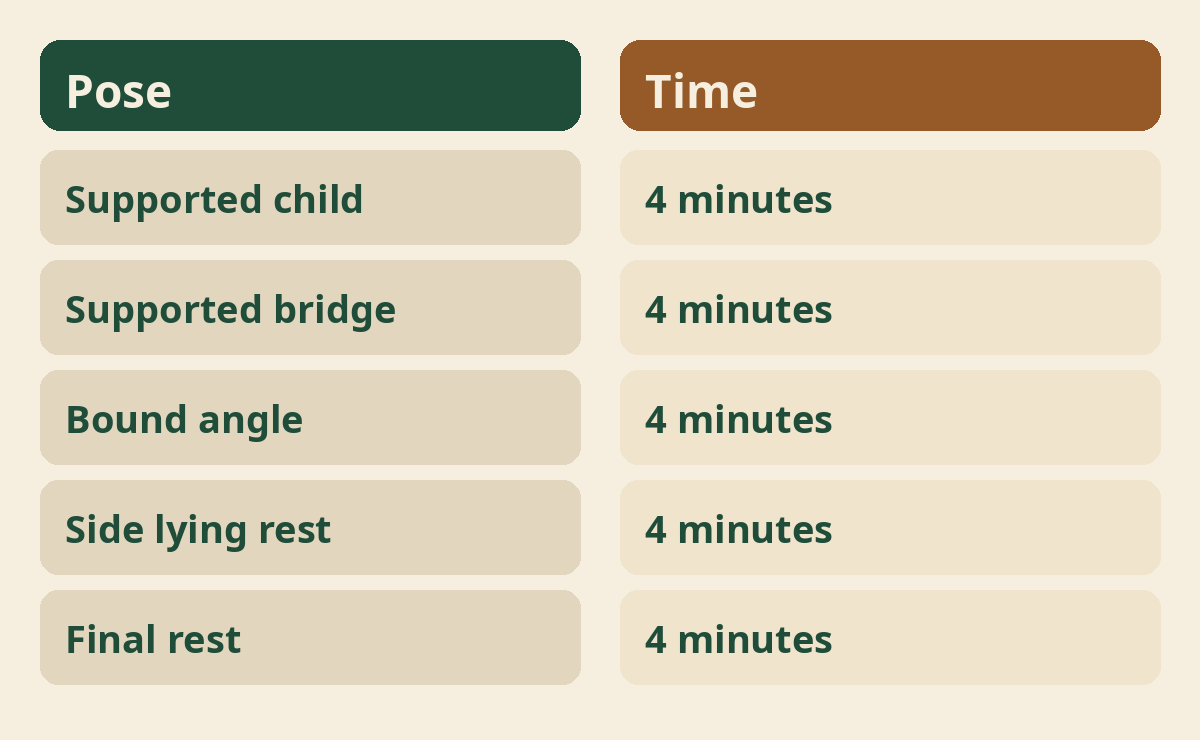
A sample twenty minute session
Spend four minutes each on supported child’s pose, supported bridge, reclining bound angle and a side lying rest, then four minutes of final rest. Repeat the same session each week. Familiar steps make it easier to relax. Adjust the props to feel comfortable.
When should you see a doctor?
See a doctor before starting if you have an injury, health condition, pregnancy or any concern. Stop if you feel pain, numbness, dizziness or breathlessness. This guide is general education, not medical advice.
How do you come out of a pose?
Move slowly, take a breath first, roll to one side and sit up gradually, because quick movement after long rest can cause dizziness. After several minutes of stillness, your blood pressure may dip when you stand. Pause for a few breaths on your side. Use your hands to push up. Stand for a moment before walking.
How do you know if a pose is right?
A good restorative pose feels supported, warm and easy, with no strain, tingling or pinching anywhere. If you notice effort in the neck, hips or back, change the props. Add height, remove height or shift your position. Every body is different, so small tweaks matter more than copying a picture.
What can you do with your mind?
Let your attention rest on the breath or the feeling of support, and gently return when thoughts wander. You do not need to clear the mind. Simply notice sounds, the weight of the body and the slow rhythm of breathing. Over time this quiet attention may feel easier and more natural.
How often can you practise?
Once or twice a week is a good start, and some people enjoy a short session most evenings. Because the practice is gentle, it can be added to a week that already includes other movement. Listen to how you feel afterwards and adjust.
Where to read next
For a calm, beginner-friendly start, Ranjana Sinha’s Begin Where You Are is written for people who want simple steps. Our guide to starting a home yoga practice adds a gentle routine you can follow at home.
Frequently asked questions
What is restorative yoga?
A slow style of yoga where you rest in supported poses for several minutes.
How long do you hold poses?
Usually three to ten minutes.
Do I need props?
Pillows and blankets are enough.
Is restorative yoga good for beginners?
Yes. It is gentle and easy to learn.
Does it count as exercise?
It is mainly rest, so it works best alongside other movement.
The bottom line
Restorative yoga teaches the body to slow down. Use plenty of support, breathe gently and be patient with yourself.

