
Yoga props such as blocks, straps, bolsters and blankets make poses easier, safer and more comfortable. You can start with just a mat, but a few simple props help you learn faster. This guide explains what each prop does and how to use it.
This is general education, not medical advice. If you have an injury, are pregnant or have a health condition, check with your doctor before starting yoga.
What are yoga props?
Yoga props are simple tools such as blocks, straps, bolsters and blankets that make poses easier, safer and more comfortable. Props bring the floor closer or help you hold a shape without strain. They are not only for beginners, because many long time students use them every day. Using a prop does not mean you are doing a pose wrong. It means you are listening to your body. Our yoga mat guide covers the most important item first.
Do beginners need props?
You can start with only a mat, but a block and a strap make many poses much easier to learn. If you are on a budget, household items work well. A firm cushion can stand in for a block. A scarf or belt can act as a strap. Buy props only when you know which ones you use often.
What is a yoga block?
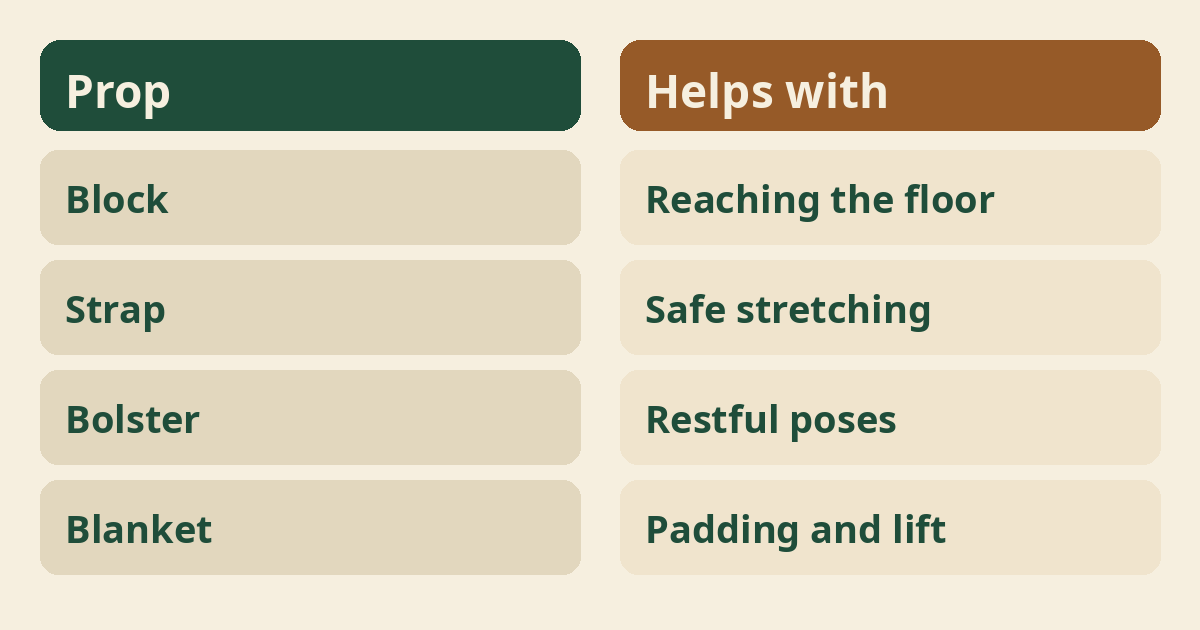
A yoga block is a firm rectangle of foam, cork or wood that you place under your hands, hips or back for support. Blocks come in three heights, so you can choose the one that suits the pose. Foam is light and soft, while cork is firm and steady. Two blocks are enough for most people.
How do you use a block in standing poses?
Place the block under your hand in a pose like a triangle or a forward fold so you do not have to reach the floor. This keeps your chest open and your back long. Without a block, many beginners round the spine to touch the floor. Our guide to warrior pose shows a standing pose where a block can help.
How do you use a block when sitting?
Sit on a block or a folded blanket to lift the hips above the knees, which helps the spine stay long. This is helpful if your hips or back feel tight. Our guide to how to meditate shows a seated posture where lifting the hips can ease the knees.
What is a yoga strap?
A yoga strap is a long, strong band with a buckle that extends your reach and helps you hold stretches safely. Use it around the foot in a seated forward fold or a reclining leg stretch. It lets you keep a straight back rather than forcing yourself forward. A belt or long scarf works as well.
How do you use a strap for flexibility?
Loop it around the foot, hold both ends, and use it to stretch gently without pulling hard. Our guide to yoga for flexibility explains how to build flexibility slowly. Keep the knees soft. Let the strap do the reaching, not your back.
What is a bolster?
A bolster is a firm, long cushion used to support the back, hips or legs in restful poses. It is common in slow, restful practice. Our guide to restorative yoga shows many poses where a bolster helps. A stack of firm pillows can work in place of a bolster.
How do blankets help?
A folded blanket pads the knees, lifts the hips, supports the head and keeps you warm in rest. Blankets are the most useful prop. Fold one into a thick rectangle to sit on. Roll one to place under the knees or neck. Keep two close when you practise.
What about a yoga chair?
A sturdy chair can serve as a prop for support in standing poses or for seated practice. Our guide to chair yoga explains how to practise on a chair. Choose a chair without wheels and place it against a wall for stability.
Do you need a wall?
A wall is a helpful, free prop for balance, support and stretches. Use it for balance in poses like tree pose and for resting your legs. Stand near it and place a hand lightly on it when needed.
What about wheels, eye pillows and sandbags?
These are extras that some people enjoy, but you do not need them when you start. An eye pillow can help you relax in the final rest. Our guide to savasana explains that rest. Try basic props first.
How do you choose good props?
Choose firm, stable props with a non slip surface that feel comfortable to you. Check that blocks do not squash, straps do not slip and blankets are not too slippery. Test props before buying if you can. Cost does not always mean quality.
How do you care for your props?
Wipe foam and cork with a damp cloth, wash blankets and straps as needed, and store them dry. Keep props away from direct sun or heat. Clean props last longer and feel better to use. Check for cracks or wear.
How can props make poses safer?
They reduce strain by letting you stay within your range, which is helpful for stiff or sensitive areas. Our guide to yoga with a bad back explains why support matters. If a pose hurts, add or adjust a prop or come out of it.
Are props useful for tight hips and knees?
Yes. Lifting the hips on a block or blanket often eases tension at the hips and knees. Our guides to yoga for hips and yoga for knees show poses that use support. Pain is a sign to stop and ask a professional.
Can props help with balance?
A wall or chair gives steadiness while your balance improves. Rest a fingertip on the support and keep the other hand free. As you gain confidence, use less support.
What mistakes do beginners make with props?
Using props that are too low, too soft or unstable, or using them as a sign of weakness. Choose the height that lets you breathe easily in the pose. Soft or wobbly props make it harder to feel steady.
Can you make props at home?
Yes. Firm books wrapped in a towel can make a block, and a long scarf, belt or towel can serve as a strap. Make sure homemade props are stable and not slippery. Do not use anything that could slip or break. Replace them with proper props if you practise often.
How do props fit into a routine?
Set up your props before you begin so you do not need to pause and search during the practice. Keep them in one corner with your mat. This makes it more likely that you will start. Our guide to starting a home yoga practice shows how to set up.
A simple starter kit
Start with a mat, one or two blocks, a strap and one or two blankets. This costs little and covers almost every beginner pose. Add a bolster later if you like slow practice.
When should you see a doctor?
See a doctor before starting if you have an injury, health condition, pregnancy or any concern. Stop if you feel pain, numbness or dizziness. This guide is general education, not medical advice.
How do you adjust a prop to fit?
Change the height or position a little at a time until you can breathe smoothly and feel no strain. If your hand does not reach a block, use a higher setting. If a blanket slips, fold it more tightly. Small changes make a big difference. Take a moment to set up before each pose, because a well placed prop saves effort and protects the joints.
Can children or older adults use props?
Yes. Props are helpful at any age, and they are especially useful for stiffness, balance and comfort. Our guide to yoga after 50 shows how support can make practice kinder to the body. Keep props stable and close, and go slowly.
How can you wean off props?
Use them as long as they help, and lower the height gradually as your body opens, if it feels right. There is no need to give them up. Many experienced students use props for life. Keep what helps and let go of what you no longer need.
Where can you buy props?
Sports shops and online stores sell them, but check that they are firm and stable. Look for reviews and a return policy. Choose simple, sturdy items over fancy ones. Used props in good condition are fine too.
Where to read next
For a calm, beginner-friendly start, Ranjana Sinha’s Begin Where You Are is written for people who want simple steps. Our guide to starting a home yoga practice adds a gentle routine you can follow at home.
Frequently asked questions
Do beginners need yoga props?
Not at first, but blocks and a strap make many poses easier.
What is a yoga block used for?
It supports your hands, hips or back so you can keep good form.
Can I use household items as props?
Yes. Firm cushions, books, belts and scarves can work.
Are props cheating?
No. They help you practise safely and comfortably.
Which prop should I buy first?
A mat, then a block and a strap.
The bottom line
Props help you practise with ease. Start with a block, a strap and a blanket, and let them support you.

