Most of us breathe all day without thinking about it. Pranayama is the simple practice of paying attention to that breath and gently guiding it. You do not need to be flexible, young, or experienced. If you can breathe, you can begin.
In yoga, pranayama means breath regulation – the fourth limb of yoga, sitting between the physical postures (asana) and meditation. A few quiet minutes of breathing practice can settle a busy mind and relax a tired body. This guide gives you five beginner-safe techniques, a short daily routine, a four-week progression, and the common mistakes to avoid. Everything here is chosen for real beginners – most of the students Ranjana teaches in Agartala are over 50, and many had never done a minute of yoga before their first class.
What Is Pranayama?
The word comes from Sanskrit: prana (life force or breath) and ayama (to extend or regulate). In plain terms, pranayama is a set of breathing exercises where you slow down, deepen, or pattern your breath on purpose.
Why does deliberately slowing the breath help? Because breathing is the one body function that runs both automatically and under your control. When you breathe slowly and deeply, the body receives a clear signal: you are safe. The heart rate eases, muscles let go, and the mind stops scanning for trouble. You have felt this yourself – a long sigh after a hard moment. Pranayama takes that natural reflex and turns it into a practice you can use every day, on purpose.
Unlike fast breathing practices taught in some advanced traditions, the five techniques below are gentle. They are the ones Ranjana teaches first to new students in Agartala – most of them over 50, many of them complete beginners.
Why Breathing Practice Matters More After 50
By midlife, most of us have spent decades breathing shallowly – short chest breaths at a desk, in traffic, through worry and hurry. Shallow breathing keeps the body slightly on edge, and it feeds the very things that bring people to yoga in the first place: poor sleep, a restless mind, stiff shoulders, low energy by afternoon.
The encouraging part is that breathing responds quickly to practice. Students often tell us the first thing they notice is not flexibility or fitness – it is that they fall asleep more easily, or that they feel less rushed during the day. Five quiet minutes each morning is enough to start that shift. You do not need to believe anything or buy anything. You just need a chair and a few undisturbed minutes.
Before You Begin
- When: Morning is ideal, on an empty or light stomach. Evening works too – just leave 2-3 hours after a meal.
- Where: Any quiet, clean, airy spot. Sit on a chair, a cushion, or the floor with your back comfortably straight.
- How long: Start with 5 minutes. Consistency matters more than duration.
- Safety: Never strain or hold your breath forcefully. If you feel dizzy or uncomfortable, stop and breathe normally. If you have a heart condition, recent surgery, or are pregnant, check with your doctor first.
5 Simple Pranayama Techniques for Beginners
Learn these in order. The first one re-teaches natural breathing; each technique after that builds on it. Give each a few days of practice before moving on – there is no hurry, and nobody is grading you.
1. Deep Belly Breathing (Diaphragmatic Breathing)
The foundation of all pranayama. Most adults breathe shallowly into the chest; this re-teaches the full, natural breath you had as a child.
- Sit tall or lie down. Place one hand on your belly, one on your chest.
- Breathe in slowly through your nose. Let the belly rise while the chest stays still.
- Breathe out gently through the nose and feel the belly fall.
- Continue for 1-2 minutes, keeping the breath smooth and quiet.
Why it helps: Belly breathing uses the diaphragm fully, so each breath brings in more air with less effort. It is the fastest way to settle the body in the moment – useful before sleep, before a difficult phone call, or whenever you notice tension building. Many people find this alone, practised daily, helps them feel calmer within a week.
Watch for: Shoulders creeping up. If your shoulders rise as you inhale, you are back to chest breathing. Keep them soft and let the hand on your belly do the moving.
2. Nadi Shodhana (Alternate Nostril Breathing)
The classic balancing breath, and the most loved technique in Ranjana’s classes. It is slow, rhythmic, and deeply settling.
- Sit comfortably. Rest your left hand on your knee. Bring your right hand up, folding the index and middle fingers.
- Close the right nostril gently with your thumb. Breathe in through the left nostril.
- Close the left nostril with your ring finger, release the thumb, and breathe out through the right.
- Breathe in through the right, close it, and breathe out through the left. That is one round.
- Do 5-8 slow rounds. No holding, no force.
Why it helps: Alternating the nostrils forces the breath to slow down and evens out the two sides of the body. Practitioners value it for balance – it is the technique most often suggested before meditation, before sleep, or when the mind feels scattered between ten worries at once.
Watch for: Pressing too hard on the nose. The touch should be feather-light. If your arm tires, support the elbow with your other hand or a cushion.
3. Bhramari (Humming Bee Breath)
The easiest way to quiet a racing mind. The gentle humming vibration is naturally soothing – students often say this one feels like a head massage from the inside.
- Sit tall and close your eyes. Relax your face and jaw.
- Breathe in through the nose.
- As you breathe out, make a soft, steady humming sound like a bee, lips gently closed.
- Feel the vibration in your face and head. Repeat 5-7 times.
Why it helps: The hum lengthens the exhale automatically – and a long exhale is the body’s own relaxation switch. The vibration also gives the mind something pleasant to rest on, which is why Bhramari works so well when thoughts are spinning. It is a favourite among students who say “I can’t meditate, my mind won’t stop.”
Watch for: Making the hum loud or forced. Soft is better than loud. This is not chanting – think of a bee in the next room, not a motorcycle.
4. Ujjayi (Ocean Breath)
A soft whispering breath that builds focus. It sounds like waves on a shore, made by slightly narrowing the throat as you breathe.
- Breathe in through the nose, gently tightening the back of your throat as if fogging a mirror – but with the mouth closed.
- Breathe out the same way, making a soft ocean sound.
- Keep the breath long, even, and unhurried. Continue for 1-2 minutes.
Why it helps: The slight throat narrowing slows the airflow and gives you audible feedback – you can hear when the breath is smooth and when it is jerky. That sound anchors attention beautifully, which is why Ujjayi is used during yoga postures and whenever steady focus is needed.
Watch for: Tightening too much. The constriction is gentle – maybe 10 percent. If your throat feels scratchy or tired, you are squeezing too hard.
5. Equal Breathing (Sama Vritti)
The simplest pattern of all: make the inhale and exhale the same length. Counting gives the mind one gentle job to do, which is why it works so well before sleep.
- Breathe in through the nose while counting 1-2-3-4.
- Breathe out through the nose counting 1-2-3-4.
- Stay at 4 for a week or two. Later, if it feels easy, move to 5 or 6.
- Continue for 2-3 minutes.
Why it helps: Equal counts smooth out the breath’s natural bumps and give an anxious mind a simple, repetitive task. Many students keep this one for bed: lying in the dark, counting slow fours, sleep usually arrives before the counting gets boring.
Watch for: Speeding up the count to finish sooner. Slow the counting down – roughly one number per second – and let the breath follow the count, not the other way round.
Quick Reference
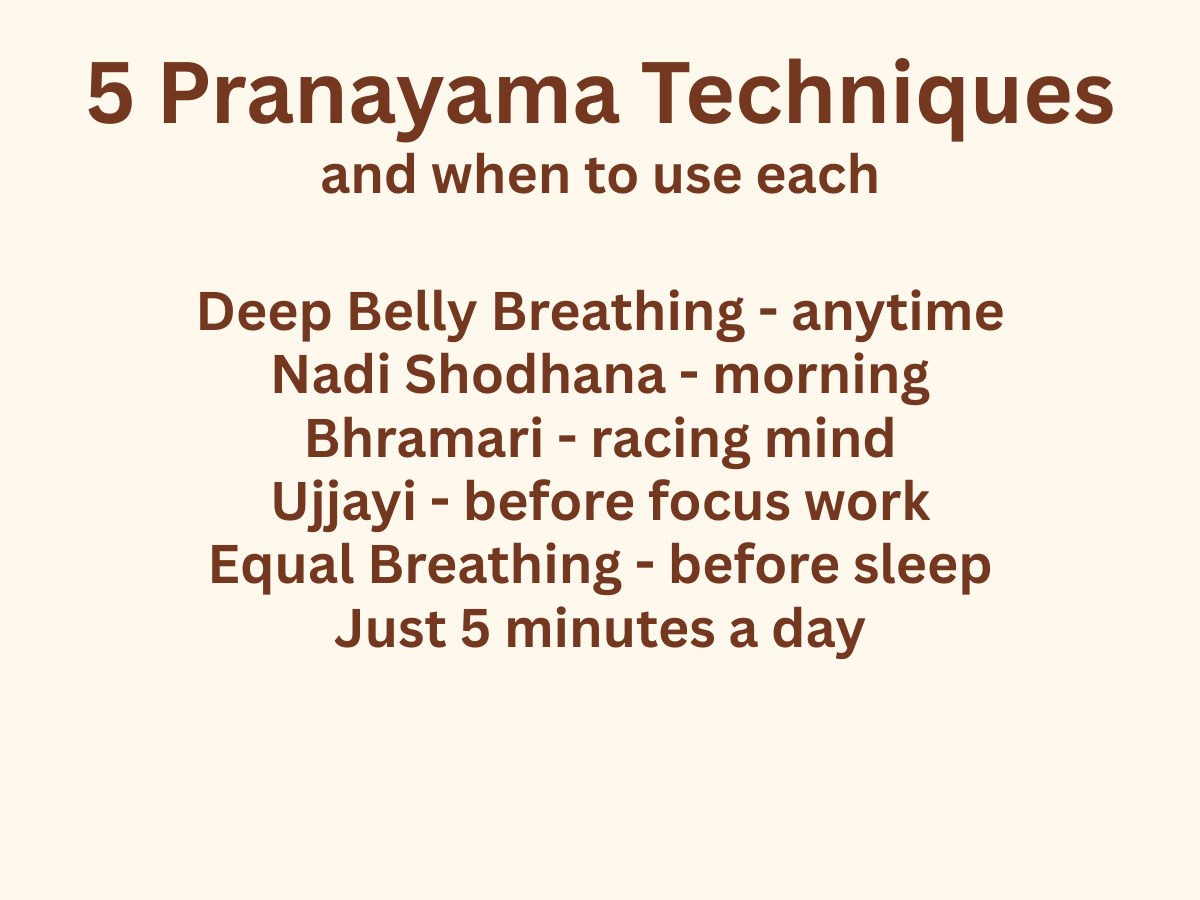
| Technique | Time | Best moment |
|---|---|---|
| Deep Belly Breathing | 1-2 min | Anytime, especially when stressed |
| Nadi Shodhana | 2-3 min | Morning, or before meditation |
| Bhramari | 1-2 min | When the mind is racing |
| Ujjayi | 1-2 min | Before focus work or asana |
| Equal Breathing | 2-3 min | Evening, before sleep |
A Simple 5-Minute Daily Routine
- Sit down, spine tall, shoulders relaxed. Three normal breaths to arrive.
- Deep Belly Breathing – 1 minute.
- Nadi Shodhana – 5 slow rounds.
- Bhramari – 5 hums.
- Sit quietly for half a minute and notice how you feel. That noticing is the real practice.
Do this once a day for two weeks before adding anything more. A small daily practice beats a long occasional one, every time.
A 4-Week Beginner Progression
Once the basic routine feels familiar, grow it slowly. Here is the gentle progression Ranjana uses with new students – roughly one small step per week:
- Week 1: Deep Belly Breathing only, 3-5 minutes each morning. Learn what a full breath feels like.
- Week 2: Add Nadi Shodhana, 5 rounds, after the belly breathing. Total practice: 5 minutes.
- Week 3: Add Bhramari, 5 soft hums, at the end. Notice which of the three you look forward to most.
- Week 4: Try the full 5-minute routine above, and add Equal Breathing at bedtime if sleep is a struggle.
One habit that helps in these four weeks: keep a small diary by your mat. After each session, write one line – the date, how many minutes, and one word about how you feel. Students who do this almost always keep practising; the diary turns an invisible habit into something you can see growing.
After a month, most beginners have a practice that feels like theirs. From there, Ujjayi joins naturally, and the door opens to the deeper breathing practices taught in structured courses. Slow progress is not falling behind – in pranayama, slow is the method.
Common Beginner Mistakes
- Forcing the breath. Pranayama should feel comfortable. Effort and strain work against the practice.
- Holding the breath too early. Breath retention (kumbhaka) is an advanced step. Skip it for now.
- Practising right after eating. Give digestion 2-3 hours.
- Chasing long sessions. Five honest minutes daily outperforms an occasional hour.
- Practising in a stuffy room. Fresh air matters.
- Judging every session. Some days the breath flows, some days it does not. Both are normal. Showing up is the practice.
Practising Safely: Who Should Take Extra Care
Gentle pranayama is safe for most people, but a few situations deserve extra care:
- Heart conditions or high blood pressure: Practise only the slow, relaxed versions, never hold the breath, and confirm with your doctor first.
- Pregnancy: Belly breathing and equal breathing are generally comfortable; avoid any strain, strong abdominal effort, or breath retention, and check with your doctor.
- Recent surgery or respiratory illness: Wait until you are recovered and cleared by your doctor.
- Dizziness or tingling: Usually means you are breathing too deeply or too fast. Stop, breathe normally for a minute, and continue more gently.
The rule underneath all of these: pranayama should never feel like work. If a practice leaves you tired, dizzy, or tight in the chest, you are doing too much. Ease back. The breath is a friend you are getting to know, not a machine you are fixing.
How Pranayama Fits With the Rest of Yoga
In the traditional eight limbs of yoga, pranayama sits fourth – after the ethical foundations and the physical postures, before the inward-turning practices that lead to meditation. The sequence is practical wisdom: a body that has moved a little and a breath that has slowed a little make a mind that can finally sit still.
You do not have to practise all eight limbs, of course. But it helps to know where breathing practice belongs: after gentle movement, before quiet sitting. Even two or three simple stretches before you breathe will make the sitting noticeably easier.
Frequently Asked Questions
How often should a beginner do pranayama?
Once a day is perfect. Five to ten minutes, every day, is far better than a long session once a week. When the practice feels natural, you can add a short evening session.
Is pranayama safe for seniors?
The gentle techniques in this guide are chosen specifically with older beginners in mind – most of Ranjana’s students are over 50. Sit on a chair if the floor is uncomfortable, never strain, and speak to your doctor first if you have a heart, blood pressure, or respiratory condition.
What is the difference between pranayama and meditation?
Pranayama works with the breath; meditation works with attention. They are close friends. A few minutes of pranayama settles the body and mind so meditation comes more easily – that is why yoga places breathing practice just before meditation in the eight limbs.
Can I do pranayama without learning yoga postures first?
Yes. A comfortable seated position is all you need. If you later want to add gentle movement, our chair yoga routine for beginners pairs well with this breathing practice.
What if I feel dizzy while practising?
Stop, breathe normally, and let it pass – it usually fades within a minute. Dizziness almost always means the breaths were too big or too fast. When you continue, make each breath smaller and slower. If dizziness keeps returning even with gentle practice, mention it to your doctor.
Can I practise lying down?
For belly breathing and equal breathing, yes – lying on your back with knees bent is comfortable and effective, especially at bedtime. For the others, sitting upright is better: it keeps the spine tall and the breath free, and it keeps you awake. Falling asleep during Nadi Shodhana is charming but not quite the goal.
How long before I notice a difference?
The immediate effects – a slower heart, a quieter mind – often arrive in the very first session. The lasting changes, like better sleep and a steadier mood, usually show up within two to four weeks of daily practice. That is why the routine above asks for two consistent weeks before you add anything new.
Do I need a teacher for pranayama?
Not for the gentle techniques in this guide – they are safe to learn at home, at your own pace. A teacher becomes valuable when you want to go further: breath retention, longer sessions, or combining breathing with postures and meditation. A good teacher watches your breath, corrects the small habits you cannot see in yourself, and tells you when you are ready for more. If you practise at home for now and join a class or structured course later, that is a perfectly good path – many of our students started exactly that way.
Keep Going
If you would like printable guides, browse our free yoga and meditation PDF library and the free downloads collection – many students keep a printed routine by their mat. If breathwork interests you, you may also enjoy our beginner guide to Kriya Yoga, where breathing is the heart of the practice. And when you are ready for structured guidance, the Fundamental Yoga course walks you through the basics step by step.
Start small. Five quiet minutes tomorrow morning – that is the whole assignment.