
Maybe you bookmarked a dozen yoga videos and still have no idea where to begin. That is normal, because the list of poses feels endless. This library starts small. You will meet the poses most beginners learn first, with plain steps, breathing cues, and safety notes. Pick two or three, move slowly, and build from there at your own pace.
This article offers general education about common yoga poses and is not medical advice. If you have a health condition, an injury, or you are pregnant, please check with your doctor before you begin.
What are yoga poses?
A yoga pose, also called an asana, is a shape you move into with your body and hold while you breathe. Some poses are standing, some are seated, and some are done on the floor. Each one asks you to pay attention to your breath and your body at the same time. You can think of poses as simple building blocks. Once you know a few, you can mix them into short routines that fit your day.
Why do people practice yoga poses?
People practice yoga poses for many different reasons, and there is no single right one. Some want to feel less stiff after sitting all day. Others like the quiet focus it brings, or they want a low-impact way to stay active. Many people say they simply feel calmer afterward. Your reason can change over time, and that is fine.
How do I start with yoga poses?
Start with three or four basic poses, hold each for a few breaths, and stop before anything hurts. Ten minutes is plenty for your first week. Choose a quiet spot where you can stretch your arms out without bumping into furniture. Move slowly into each shape, and come out just as slowly. Think of the first week as getting to know your body, not as a test.
What do I need before my first session?
You need very little: a flat floor, comfortable clothes, and a bit of space. A yoga mat is helpful because it keeps your feet and hands from sliding, but a firm rug works too. Wear something that stretches easily. Practice on an empty or light stomach if that feels better for you. Keep a glass of water nearby and silence your phone for a few minutes.
How should I breathe during yoga poses?
Breathe slowly through your nose and let each breath be smooth, never forced. A good rule is that you should always be able to breathe comfortably in a pose. If you catch yourself holding your breath, ease off the stretch a little. Many beginners like to practice a few rounds of belly breathing before they start moving. It sets a slower rhythm for the whole session.
How do I do Mountain Pose?
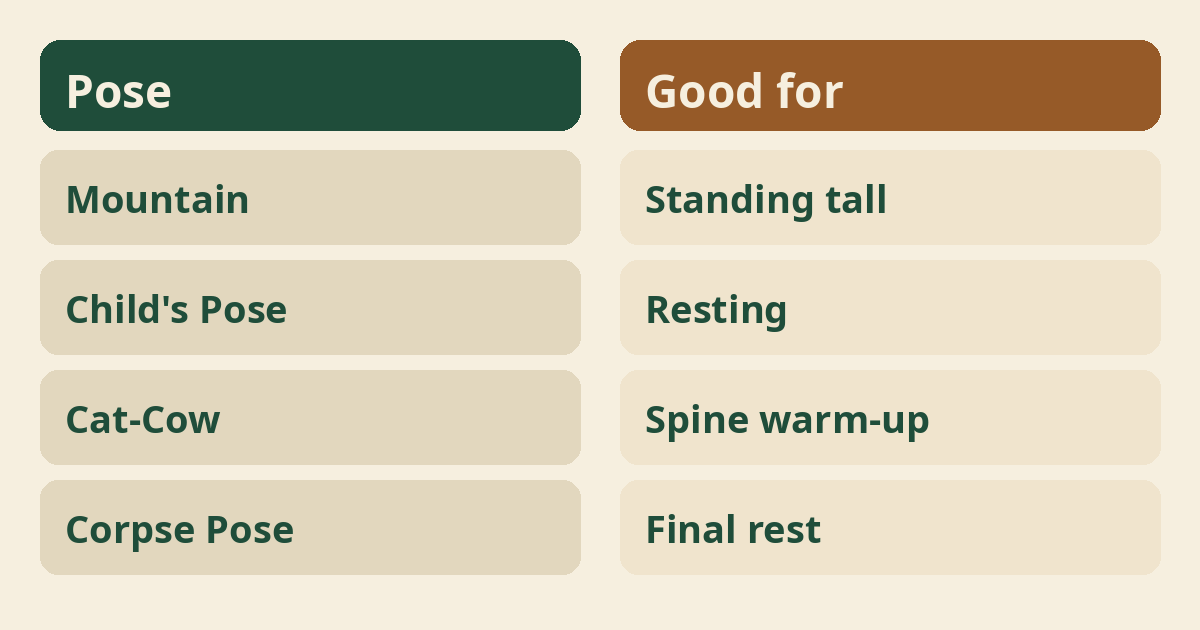
Mountain Pose is simply standing tall with your feet under your hips and your arms relaxed at your sides. Spread your toes, feel your weight settle evenly, and lengthen the top of your head toward the ceiling. Soften your shoulders away from your ears. It looks like nothing, but it teaches the alignment used in many other poses. If you want a closer look, this walk-through of Mountain Pose covers the small details.
How do I do Child’s Pose?
Child’s Pose is a resting shape where you kneel and fold forward over your thighs. Bring your big toes together, let your knees open to the width of your mat, and rest your forehead on the floor or a pillow. Stretch your arms forward or let them lie by your feet. Breathe into your back. When you feel tired mid-practice, Child’s Pose is a kind place to pause.
How do I do Cat-Cow?
Cat-Cow is a flowing move on hands and knees where you round and arch your spine with your breath. Place your hands under your shoulders and your knees under your hips. As you inhale, let your belly drop and lift your chest a little. As you exhale, round your back toward the ceiling. Go slowly and keep the motion small. Many people use Cat-Cow as a warm-up for the spine.
How do I do Downward-Facing Dog?
Downward-Facing Dog is an upside-down V shape made with your hands and feet on the floor and your hips lifted. Start on hands and knees, tuck your toes, and press your hips up and back. Keep your knees bent as much as you like. Spread your fingers wide and let your head hang. If your wrists feel sore, come down and rest. This pose takes time, so do not rush it.
How do I do Cobra Pose?
Cobra Pose is a small backbend where you lie on your belly and lift your chest using your back and arms lightly. Place your hands under your shoulders and keep your elbows close to your sides. Press your pubic bone down and lift only as high as feels comfortable. Keep your neck long, looking at the floor just ahead. Lower down slowly after a few breaths. A low lift is just as useful as a high one.
How do I do Warrior II?
Warrior II is a wide-legged standing pose with one knee bent and your arms reaching out to the sides. Step your feet about a leg’s length apart, turn your front foot forward and your back foot slightly in. Bend your front knee over your ankle and stretch your arms at shoulder height. Gaze over your front hand. Your legs may feel busy at first, which is common. Start with a shallow bend and deepen it over time.
How do I do Tree Pose?
Tree Pose is a one-legged balance where you place one foot on your ankle or calf and bring your hands together. Never place your foot directly on the side of your knee. Rest it low, or keep your toes on the floor like a kickstand. Fix your eyes on one still point to stay steady. Wobbling is part of it. If you want to build steadiness, these balance ideas for new students give you easy ways to practice.
How do I do Bridge Pose?
Bridge Pose is done lying on your back with your knees bent and your hips lifted toward the ceiling. Place your feet hip-width apart, close enough that your fingertips can almost touch your heels. Press into your feet and lift your hips a few inches. Keep your knees pointing forward, not falling out. Lower down one bone at a time. Many people find it a pleasant way to wake up the legs and back of the body.
How do I do Seated Forward Fold?
Seated Forward Fold is a stretch where you sit with your legs out and lean forward from your hips. Bend your knees as much as you need, and sit on a folded blanket if your lower back rounds. Reach toward your shins rather than your toes. Lead with your chest, not your head. You are aiming for a mild pull behind the legs, never sharp pain. Breathe out as you fold forward.
How do I do Butterfly Pose?
Butterfly Pose is a seated pose where the soles of your feet touch and your knees fall open to the sides. Sit tall, hold your ankles, and let your knees drop as far as they comfortably go. Do not push them down. If your hips are tight, lift your seat on a cushion. A slow rocking motion can feel nice. You can find more cues in this guide to Butterfly Pose.
How do I do Garland Pose?
Garland Pose is a deep squat with your feet wide, your knees open, and your palms together at your chest. Stand with feet a little wider than your hips, turn your toes out, and sink your hips low. Rest your elbows against your inner knees. If your heels lift, tuck a rolled towel beneath them. Squatting is a natural human shape, and Garland Pose lets you practice it with support.
How do I do Puppy Pose?
Puppy Pose is a half-fold where your hips stay over your knees while your chest melts toward the floor. Begin on hands and knees, then walk your hands forward and lower your chest. Keep your hips high above your knees. Rest your forehead on the mat or a block. Your arms will feel a long stretch along the sides. It is a popular middle ground between Cat-Cow and Child’s Pose, and Puppy Pose suits many first-timers.
How do I do Thunderbolt Pose?
Thunderbolt Pose is a simple kneeling position where you sit back on your heels with a tall spine. Kneel with your knees together and your feet pointing straight back. Rest your hands on your thighs and breathe calmly. If your knees or ankles complain, put a folded blanket between your calves and thighs. Some people use it for quiet breathing time. Read more about Thunderbolt Pose if kneeling is new to you.
How do I do Easy Pose and a seated twist?
Easy Pose is a cross-legged seat, and a seated twist is a turn of your upper body while you sit tall. Sit on a cushion with your shins loosely crossed. Place your right hand behind you and your left hand on your right knee, then rotate slowly as you exhale. Look over your shoulder if it feels fine for your neck. Twist from your middle, not by pulling hard with your arms. Switch sides after a few breaths.
How do I end with Corpse Pose?
Corpse Pose is lying flat on your back with your arms and legs relaxed so your body can rest. Let your feet fall open and your palms face up. Close your eyes if you like. Release any effort in your face, jaw, and hands. Stay for three to five minutes. Many people feel that this final rest is the most important part, so try not to skip it, even when you are short on time.
Which poses suit tight hips?
Hip-friendly beginner poses include Butterfly, Garland, and Puppy, because they open the hips in small, controlled steps. Hips often get stiff when we sit a lot. Pick one or two of these poses and hold each for several slow breaths. Do not bounce. If you want a longer list built around this area, take a look at simple poses for the hips and choose a favorite.
Which poses suit a stiff neck and shoulders?
Poses that move the shoulders and upper back, like Cat-Cow and Puppy, can feel good when your neck and shoulders are tight. Add slow shoulder rolls and a side neck stretch while seated. Keep every move small and pain-free. Avoid cranking your head around. For more ideas, this guide to moves for the neck and shoulders offers short options you can do between tasks.
Which poses work for people who sit at a desk?
Seated twists, shoulder rolls, and standing folds are easy to do near a desk without any special gear. Stand up every so often, reach your arms overhead, and fold forward with soft knees. Even two minutes can feel like a reset. Keep your breath slow. If you work long hours, a short routine from yoga at your desk may fit into your day more easily than a full class.
Which poses help with flexibility?
Forward folds, hip openers, and slow lunges are common choices for people who want to feel more flexible over time. Flexibility tends to change gradually, and results vary from person to person. Hold each stretch for several breaths, stay below the point of pain, and repeat often. Warm muscles stretch more comfortably, so move a bit first. Our page on building flexibility gives a calm plan to follow.
How long should I hold each pose?
Most beginners do well holding a pose for three to five slow breaths. That is roughly 20 to 30 seconds. If a pose feels good and steady, you can stay a little longer. If you feel shaking, sharp pain, or numbness, come out right away. There is no prize for the longest hold. Short, calm holds repeated across the week usually teach your body more than one big effort.
How many days a week is enough?
Two or three short sessions a week is a realistic start for most beginners. Consistency matters more than length. You can always add a day once the habit feels natural. Rest days are useful too, especially if you feel sore. If you want help choosing a rhythm, this note on how often to practice explains how people tend to build a schedule.
What are the most common beginner mistakes?
The most common mistakes are pushing too hard, holding the breath, and copying a photo instead of listening to your body. Photos show an end shape, not the comfort level it took to get there. Another mistake is skipping the warm-up. Some people also rush from pose to pose. Slow down, keep your breath moving, and bend your knees whenever a stretch feels too sharp. A pose that hurts is not a better pose.
Do I need props?
Props are optional, but a block, a strap, and a folded blanket can make many poses more comfortable. A block under your hand brings the floor closer. A strap extends your reach. A blanket pads your knees or lifts your hips. You can use a firm pillow, a belt, and a stack of books for the same jobs. For a full rundown, see which props are worth having.
Who should be careful with yoga poses?
Anyone with an injury, a long-term health condition, high or low blood pressure, or pregnancy should talk to a doctor first. Joint problems, balance concerns, and recent surgery are also reasons to ask for advice. If you have back trouble, read about yoga with a bad back and share it with your doctor. Pregnant readers may want to see how prenatal yoga differs from a regular class before starting.
Is yoga a medical treatment?
No, yoga is not a medical treatment, and it does not replace care from a doctor or therapist. It is a form of movement and mindful breathing that many people use alongside regular healthcare. Do not stop any medicine or advice you have been given because of yoga. If something feels wrong, stop and speak with a qualified professional. Think of yoga as a supportive habit, not as a fix for any condition.
What benefits might people notice?
Many people find that regular yoga helps them feel more relaxed, a little more flexible, and more aware of their bodies, though results vary. Some also report better focus or a calmer mood after a session. Others simply enjoy the quiet time. Each body responds differently, and nobody can promise a specific outcome. For a balanced overview from a public health source, see National Center for Complementary and Integrative Health. Treat any claim that sounds too good to be true with care.
How can yoga poses fit into a stressful week?
A short, slow sequence can be a small pause in a busy week, and many people say it helps them feel calmer. Try Child’s Pose, a seated twist, and Corpse Pose after work. Keep the lights low if you can. Let your breath get longer on the exhale. For an easy plan, take a look at yoga for stress relief and pick the parts that suit your evening.
What does a simple first routine look like?
A good first routine strings together five poses you already know, with slow breaths between each. Try Mountain Pose, Cat-Cow, Downward-Facing Dog with bent knees, Child’s Pose, and Corpse Pose. Hold each for about five breaths. The whole thing takes about ten minutes. Do it two or three times in your first week. Add one new pose each week so the routine grows without feeling like a chore.
How do I progress once the basics feel easy?
Progress by adding time, adding poses, or adding a small challenge, one at a time. You might hold poses a few breaths longer, try Warrior II or Tree Pose, or practice twice as often. Change only one thing at once so you can tell what works for you. Keep a few notes about how you feel afterward. Progress in yoga is not only about reaching deeper. It also means moving with more ease.
Do I need a teacher?
A teacher is not required, but a good one can help you with alignment and keep you safe. Many beginners learn at home from videos and later join a class. If you try a studio, tell the teacher about any injuries before you begin. Look for someone who offers options and does not push. A small class or a one-on-one lesson can give you more attention. Trust your own sense of comfort.
What mindset helps most?
A kind, curious mindset helps most, because yoga is about noticing, not performing. Skip comparing yourself with people online. Your stretch will not look like theirs, and it does not need to. Celebrate small wins, like touching a little closer to your shins or holding a breath longer. Some days will feel stiff and others easy. Both are part of learning, and both count as practice.
How do I know when to stop or back off?
Stop or back off whenever you feel sharp pain, dizziness, tingling, or pressure that does not feel right. A mild stretch is expected, but pain is a signal to ease out of the pose. Come out slowly and rest. If the feeling continues, speak with your doctor. Never force a joint into position. Listening to your body is not a weakness. It is the main skill yoga trains.
How do I stay motivated?
Link yoga to something you already do, like your morning coffee or your evening wind-down, and keep sessions short. Small, repeatable habits stick better than big plans. Lay your mat where you can see it. Practice at the same time on the same days. Missing a session is fine, so just start again. Many beginners find that ten minutes a few times a week is enough to keep the habit alive.
Where to read next
For a calm, beginner-friendly start, Ranjana Sinha’s Begin Where You Are is written for people who want simple steps. Our guide to starting a home yoga practice adds a gentle routine you can follow at home.
Frequently asked questions
Which yoga poses should I learn first?
Most beginners start with Mountain Pose, Cat-Cow, Child’s Pose, Downward-Facing Dog, and Corpse Pose.
Is it okay to feel sore after my first session?
Mild muscle tiredness is common, but sharp or lasting pain is a sign to rest and check with your doctor.
Can I practice if I cannot touch my toes?
Yes, you can bend your knees, use a strap, or reach for your shins instead.
What should I wear to practice?
Pick comfortable clothes that stretch easily and let you move freely.
Is ten minutes really enough to start?
For most beginners, ten calm minutes a few times a week is a perfectly good way to begin.
The bottom line
Pick two poses from this library today, breathe slowly, and let the rest come in its own time.

