
The 8 limbs of yoga are an eight-part path described in the Yoga Sutras of Patanjali: yama (ethical restraints), niyama (personal observances), asana (posture), pranayama (breath practice), pratyahara (turning attention inward), dharana (concentration), dhyana (meditation) and samadhi (deep absorption). They are not eight steps to finish in order. They are eight areas of life that support each other.
If you only know yoga as stretching on a mat, this can come as a surprise. Posture is just one limb out of eight. The rest cover how you treat people, how you look after yourself, how you breathe, and how you train your mind. This guide walks through each limb in simple words and gives you one small thing to try for every one.
Where do the 8 limbs come from?
The list comes from a short text called the Yoga Sutras, traditionally credited to a teacher named Patanjali. Scholars place the text somewhere in the early centuries of the common era, and the exact date is still debated. The eight limbs are named in verse 2.29 (see the Yoga Sutras of Patanjali overview for background on the text and its dating). In Sanskrit the path is called ashtanga, which simply means “eight limbs” (ashta means eight, anga means limb).
One note to avoid confusion: “Ashtanga yoga” is also the name of a modern, physically demanding style of yoga taught by K. Pattabhi Jois. The eight-limbed path in the Sutras is the older, wider idea. The modern style borrows the name.
Are the limbs steps or a map?
People often read them as a ladder: master the first, then move to the second. Most teachers today describe them differently. Think of a tree with eight branches that grow together. Someone who is working on breath is also, quietly, working on honesty and contentment. You do not have to “finish” yama before you try meditation.
A useful way to hold it: the first two limbs are about how you live, the next two are about your body and energy, and the last four are about your mind.
Limb 1: Yama (how you treat the world)
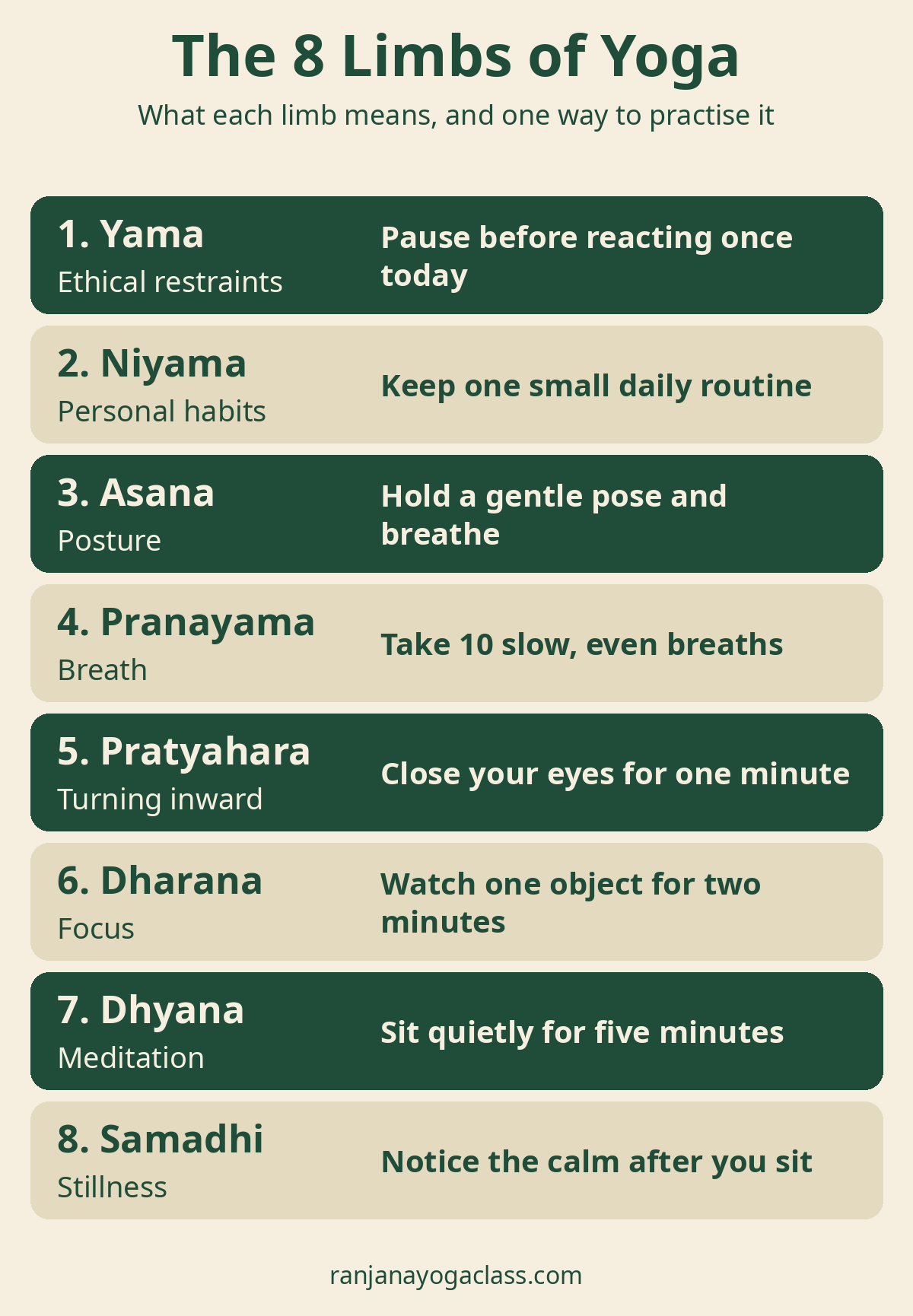
Yama means restraint. Patanjali lists five:
- Ahimsa – non-harming, in action, speech and thought.
- Satya – truthfulness.
- Asteya – not taking what is not yours, including other people’s time and credit.
- Brahmacharya – moderation of energy and appetite. Teachers read this in different ways, from celibacy to simple balance.
- Aparigraha – not grabbing or hoarding.
Try this: pick one yama for a week. Ahimsa is a good first choice. Notice how you speak to yourself when you make a mistake, and soften it once a day.
Limb 2: Niyama (how you treat yourself)
Niyama means observance. These are the habits you keep for yourself:
- Saucha – cleanliness, of body and surroundings.
- Santosha – contentment with what you have today.
- Tapas – steady effort, the discipline to show up.
- Svadhyaya – self-study, including reading and honest reflection.
- Ishvara pranidhana – surrender to something larger than your own ego. This can be understood religiously or simply as humility.
Try this: for tapas, choose a practice so small you cannot fail, such as five minutes of stretching after you brush your teeth, and keep it for two weeks.
Limb 3: Asana (posture)
In the Sutras, asana is described very briefly. The famous line says the posture should be steady and comfortable. There is no list of poses in the text. The big catalogue of poses we know today developed later and in many forms.
So the question for any pose is not “how deep can I go?” It is “can I stay here, steady and at ease?”
Try this: hold a simple pose such as Mountain Pose or a seated cross-leg for one minute. Look for the point where effort and ease are both present. If you are new, our guide to starting a home yoga practice gives a gentle routine.
Limb 4: Pranayama (breath practice)
Prana is life energy, and ayama means extending or regulating. In practical terms, pranayama is the deliberate shaping of the breath: slowing it, lengthening the exhale, or breathing through one nostril at a time. It sits between body and mind because the breath is the one automatic function you can also control.
Some techniques are safe for most people. Others, like fast forceful breathing, are not suitable for everyone, such as people with high blood pressure, heart conditions or pregnancy. If you have a medical condition, check with your doctor first. The US National Institutes of Health has a plain safety overview of yoga. Our beginner pranayama guide starts with the gentlest techniques.
Try this: breathe in for a count of four and out for a count of six, for two minutes. Stop if you feel dizzy.
Limb 5: Pratyahara (turning the senses inward)
Pratyahara is the least known limb. It means withdrawing attention from outside input so that the mind is not pulled around by every sound, screen or smell. It does not mean ignoring the world. It means choosing where attention goes.
A modern, practical form is a short break from your phone. Another is simply closing your eyes in Savasana and letting sounds pass without following them. Our piece on Yoga Nidra for sleep is a guided way into this limb.
Try this: sit for three minutes with the phone in another room. Notice how often your mind reaches for it.
Limb 6: Dharana (concentration)
Dharana is holding the mind on one object: a breath, a candle flame, a sound, a mantra. The mind will wander. That is normal. The practice is the moment you notice and come back.
Try this: count ten breaths. If you lose count, start again from one without judging. Most beginners rarely reach ten at first, and that is fine.
Limb 7: Dhyana (meditation)
When concentration becomes effortless and continuous, the Sutras call it dhyana. It is less like trying to focus and more like a steady flow of attention. You cannot force it. You can only build the conditions: regular practice, a quiet place, and a calm body from the earlier limbs.
Try this: after your ten-breath practice, drop the counting for one minute and simply rest in the sensation of breathing.
Limb 8: Samadhi (absorption)
Samadhi is described as the state in which the sense of separate self fades and the mind is completely absorbed in its object. It is the traditional goal of the path. For most of us, it is better held as a direction, not a target. Reading about it is no substitute for steady practice, and no honest teacher will promise it to you in a month.
How the limbs work together in a normal week
You do not need a perfect plan. A simple weekly pattern might look like this:
- Daily (5 minutes): one breath practice (limb 4) and one minute of quiet (limbs 5-6).
- Three times a week (20 minutes): a gentle asana session (limb 3).
- One focus for the week: a single yama or niyama (limbs 1-2), written on a sticky note.
- Once a week: a longer sit of 10 minutes (limbs 6-7).
That one week already touches seven of the eight limbs.
Common mistakes
- Treating yoga as only poses. Asana is useful, but it is one limb.
- Skipping the ethics because they feel abstract. Yama and niyama are meant to be practical: how you speak, how you work, how you rest.
- Rushing to meditation. Calming the body and breath first usually makes sitting easier.
- Chasing samadhi. Chasing an experience tends to produce frustration. Keep the practice small and regular.
- Taking a single translation as final. Translations of Sanskrit terms differ. If a word is unclear, read two or three sources.
Frequently asked questions
Do I have to follow all 8 limbs to practise yoga?
No. Most people begin with posture or breath and add the others over time. The limbs describe the whole path, not a requirement for your first class.
Is the 8-limb path religious?
The Sutras come from an Indian philosophical tradition, and “surrender” in the niyamas can be read devotionally. Many people practise the limbs in a secular way, treating them as ethics, attention training and self-care.
Which limb should a beginner start with?
Whichever you will actually do. Many beginners find breath (pranayama) or a short daily posture practice the easiest entry point.
Are the 8 limbs the same as Ashtanga yoga?
They share a name. The eight limbs are the path in the Yoga Sutras. Ashtanga yoga is a modern physical style that takes its name from it.
How long does it take to move through all eight limbs?
There is no timeline. They are practised together and revisited for life.
Can I learn the limbs without a teacher?
You can start from books and guides. A qualified teacher helps most with breathwork and meditation, where small errors matter.
A last word
The 8 limbs are a useful way to see that yoga is wider than a mat. You can start this week with something small: one kind act, one slow breath, one quiet minute. If you want a gentle place to begin, try the home practice guide and add one limb at a time.
Written by Ranjana Yoga Class. This article is for general education and is not medical advice. If you have a health condition or are pregnant, speak to your doctor before starting breathwork or new postures.

