
Maybe your energy crashed after the thyroid diagnosis, or the medicine helps but you still feel flat, stiff, and wired at the same time. Many people in that spot look at yoga for thyroid support because it is low-cost, kind to the body, and easy to start at home. This guide shows you how to begin safely, with slow poses, steady breathing, and clear limits. It works alongside your medical care, not instead of it. Brand new to yoga? Start with our complete yoga for beginners guide, then come back here.
This guide is general education, not medical advice for your specific situation. If you live with a thyroid condition or take thyroid medicine, check with your doctor before starting any new exercise, including yoga.
What is yoga for thyroid health?
Yoga for thyroid health is a calm style of practice built around calm movement and breathing for people living with thyroid issues. It uses slow poses, rest, and simple breathwork instead of hard workouts. There is no jumping, no heat, and no pressure to perform. You move at your own pace and stop whenever you need to. The goal is to support how you feel day to day while your doctor manages the thyroid gland itself.
What does the thyroid gland do?
The thyroid gland is a small butterfly-shaped gland in your neck that helps control energy, weight, and body temperature. It sits at the front of your throat, just below the voice box. It releases hormones that tell nearly every cell how fast to work. When it runs too slow, you may feel tired, cold, and foggy. When it runs too fast, you may feel wired, hot, and restless. A doctor finds and manages these problems with blood tests and medicine.
What are common thyroid issues?
The two most common thyroid issues are an underactive thyroid, called hypothyroidism, and an overactive thyroid, called hyperthyroidism. An underactive thyroid often brings fatigue, weight gain, dry skin, and feeling cold. An overactive thyroid often brings a racing heart, weight loss, shakiness, and trouble sleeping. Each pattern needs its own medical plan, which is why a proper diagnosis comes before anything else.
Why do people with thyroid issues try yoga?
Many people with thyroid issues try yoga because fatigue and stress make hard exercise feel out of reach. Yoga meets you where you are instead of asking you to keep up. You can practice lying down, sit in a chair, and rest mid-session without any fuss. That low barrier is why it fits so many lives, especially lives already crowded with appointments, medicine schedules, and tired days.
Can yoga help the thyroid gland directly?
Yoga is not proven to change thyroid hormone levels, so view it as support for how you feel, not as a fix for the gland. You may see claims online that certain poses press or massage the thyroid gland into working better. There is no solid proof behind those claims. What yoga can realistically offer is calmer stress, easier movement, and better rest. Your blood tests and your medicine plan remain the true measure of thyroid health.
Is yoga a treatment for thyroid problems?
No, yoga is not a treatment for hypothyroidism, hyperthyroidism, or any other thyroid condition. Think of it as a companion habit, like decent sleep and regular walks. It belongs next to your medical care, never in place of it. Keep taking your medicine exactly as prescribed, and keep your lab appointments. If your symptoms change, call your doctor before changing anything on your own.
What benefits do people report?
Many people find that regular, easy yoga leaves them calmer, looser, and sleeping a little better, though results vary from person to person. Stress sits heavily on a body already dealing with thyroid issues, and softening stress can make symptoms feel more manageable day to day. Some people notice steadier mood and more patience with their own limits. For a balanced overview of what research does and does not show about yoga, see National Center for Complementary and Integrative Health.
Can yoga help with thyroid-related stress?
A calm practice can be a practical way to unwind when thyroid issues leave you feeling on edge. Slow movement paired with slow breathing tells the body it can stand down. Many people with thyroid problems describe a constant hum of tension that never fully switches off. A short daily practice gives that tension somewhere to go. If stress is your main struggle, the routine in yoga for stress relief for beginners is built for exactly that.
Can yoga help with thyroid fatigue?
Yoga cannot remove thyroid fatigue, but a short, easy practice can help you move without draining the little energy you have. Yoga lets you stay in motion at a level your body can actually afford. Many people find that a few quiet minutes of movement lifts the fog a little, even on heavy days. The key is keeping sessions short enough that you finish with energy left over.
Can yoga help with weight changes from thyroid issues?
Yoga burns fewer calories than hard cardio, so see it as one small part of a bigger picture, not a weight fix. Thyroid-related weight change is driven mainly by hormones, and hormones are your doctor’s territory. What yoga can do is support better sleep, steadier mood, and more daily movement, all of which help the bigger effort. Be wary of any program that promises yoga will melt thyroid weight away.
Can yoga help with stiffness and flexibility?
Yes, slow stretching is one of the most reliable ways to ease the stiffness many people with thyroid issues feel in the morning. Muscles and joints often feel rusty when the thyroid runs slow, especially after sleep. A few minutes of easy movement warms them up without strain. Over weeks, many people notice they reach, bend, and turn more freely. If mobility is a goal for you, yoga for flexibility for beginners walks through a safe starting routine.
Should I talk to my doctor before starting?
Yes, a quick word with your doctor is a smart first step before any new exercise, yoga included. This matters most if your diagnosis is recent, your medicine dose just changed, or your symptoms are not yet stable. Your doctor can tell you whether anything in your situation calls for extra care. Most doctors are glad to hear a patient wants to move more, as long as the plan is sensible.
Who should be extra careful?
Anyone with a diagnosed thyroid condition, recent neck surgery, heart concerns, or new symptoms should take extra care and check with a doctor first. The same goes if you feel dizzy often, faint easily, or have a heart rhythm issue, which can come with an overactive thyroid. Pregnancy also changes the picture and needs its own guidance. It just means your version of yoga should match your situation.
What if I have hypothyroidism?
With an underactive thyroid, easy movement can help stiffness and low mood, but you need to pace yourself around real fatigue. Start shorter than you want to, because the cost of overdoing it shows up the next day. Some days the best practice is five minutes of breathing and rest, and that still counts as showing up. Build slowly and let your energy, not a schedule, set the pace.
What if I have hyperthyroidism?
With an overactive thyroid, keep the practice extra slow and skip anything that pushes your heart rate hard. Your system is already running hot, so fast flows, heated rooms, and strong breathing techniques can feel like too much. Restorative floor poses and quiet breathing are the safer home base. Pay attention to your pulse during practice and stop if it races or you feel shaky. If your doctor has asked you to limit exertion, follow that limit until it changes.
What if I am pregnant with a thyroid condition?
Pregnancy plus a thyroid condition is a case for your doctor and a qualified prenatal teacher, not for a general routine. Standard classes often include poses that do not suit pregnancy. If your doctor clears you for movement, a prenatal class is the right setting. The differences are explained in prenatal yoga versus regular yoga.
What if I also have a bad back?
A bad back does not rule yoga out, but it does mean choosing poses carefully and skipping deep bends. Many people with thyroid issues also carry back pain from years of low activity or poor sleep. Keep movements small, bend from the hips rather than rounding the spine hard, and use props generously. For a fuller safety rundown, read can you do yoga with a bad back before you begin.
How do I start yoga with low thyroid energy?
Start with ten quiet minutes of easy floor poses and slow breathing, three times a week. Pick a time when your energy is steadiest, which for many people is late morning rather than dawn. Short and regular beats long and rare every time. You are building a habit, not chasing a workout.
How do I set up a practice space?
Clear a spot on the floor with a mat or blanket and one pillow, somewhere you will not be interrupted. A simple setup lowers the effort of starting, and low effort matters when energy is scarce. You do not need a studio corner or special gear. A patch of floor beside your bed works fine.
What props make practice easier?
A bolster or firm pillow, a folded blanket, and a sturdy chair cover almost everything a beginner needs. Props let the body rest inside a pose instead of holding it with effort, which matters when fatigue is part of your week. A blanket under the knees saves aching joints, and a pillow under the head keeps the neck neutral. If you want to go further, yoga props for beginners explains blocks, straps, and bolsters in plain terms.
Step 1: Begin with easy breathing
Sit or lie down and breathe slowly through your nose for two minutes. Let the belly rise as you breathe in and soften as you breathe out. Keep the breath quiet and unforced, like breathing during sleep. For a fuller walkthrough, belly breathing for beginners is a kind first skill for anyone whose energy runs low.
Step 2: Warm up the spine
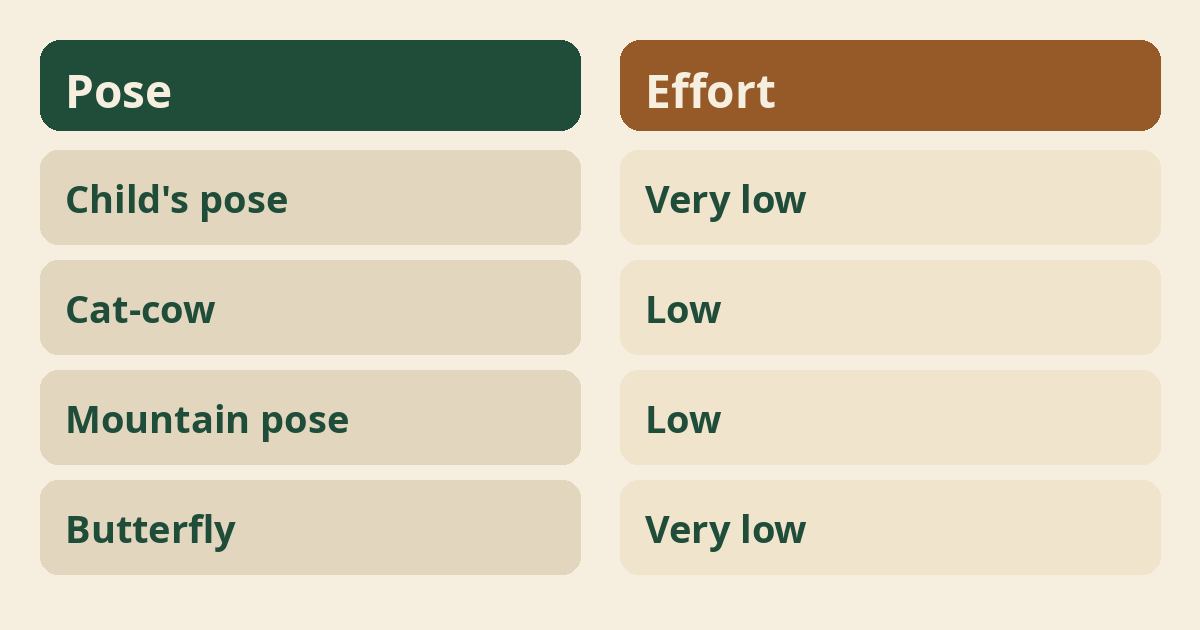
Move the spine slowly through a few rounds of cat and cow on hands and knees. Round your back as you breathe out, then let it soften into a small arch as you breathe in. Keep the movement lazy and smooth, matched to the breath. Go half speed if you feel stiff or lightheaded, and pad your knees with a folded blanket. The full version is in cat-cow pose for beginners.
Step 3: Add one standing pose
Stand tall in mountain pose for five slow breaths to wake up posture and balance. Place your feet hip-width apart, let your arms rest by your sides, and keep your chin level. It looks like doing nothing, but it teaches the steady alignment every other pose uses. The full breakdown is in mountain pose for beginners, and yoga for balance for beginners helps if steadiness is a struggle.
Step 4: Open the hips gently
Sit with the soles of your feet together and let your knees fall open for a minute of easy breathing. This is butterfly pose, and it asks almost nothing of a tired body while giving the hips a soft stretch. Sit on a folded blanket if your back rounds, and support your knees with pillows if they hover. Never push the knees down. The full guide is in butterfly pose for beginners, and yoga for hips for beginners has more options for stiff hips.
Step 5: Finish with rest
End every session lying on your back for three to five quiet minutes. Let your arms and legs rest heavy, and let your breathing find its own rhythm. This rest is where many people feel the practice settle into the body. Roll to one side before sitting up, and come up slowly so your head stays clear.
Which poses are kindest to a tired body?
Restful poses like child’s pose and supported floor poses ask the least of a tired body. In child’s pose you kneel, fold forward, and rest your forehead down while the back and hips get a soft stretch. Hold it for a minute or two and breathe slowly, with a pillow under your chest if the floor feels far away. The full version is in child’s pose for beginners.
What is puppy pose and why try it?
Puppy pose is a soft chest and shoulder opener that stays easy on the neck. From hands and knees, walk your hands forward and let your chest sink toward the floor while your hips stay over your knees. It releases the shoulders without loading the throat, which makes it a good fit for this practice. The step-by-step version is in puppy pose for beginners.
Is thunderbolt pose useful here?
Thunderbolt pose is a simple kneeling seat that many people find comfortable for breathing practice. You kneel with your hips resting on your heels and your spine tall. It is one of the few seated positions that keeps the back upright without effort, so it works well for two minutes of quiet breathing. Put a folded blanket between your calves and thighs if your knees complain. The details are in thunderbolt pose for beginners.
Which poses should I avoid with thyroid issues?
Skip deep neck strain, long headstands and shoulder stands, and fast heated flows unless your doctor and teacher say they are fine for you. Poses that press hard into the throat load the exact area where the thyroid gland sits, and they are not a sensible starting point. Strong backbends that crank the neck open deserve the same caution. The calm floor poses in this guide give you everything a beginner practice needs.
What if my neck and shoulders feel tight?
Light neck and shoulder stretches can ease the tension many people carry in that area, as long as the movements stay small. Roll the shoulders slowly, tip the ear toward the shoulder without pulling, and keep every range easy. Never force the neck, and skip any move that sends a pinch or zap down the arm. The routine in yoga for neck and shoulders keeps every movement small and controlled, which suits sensitive necks well.
How does breathing fit thyroid-friendly yoga?
Slow nasal breathing is the safest and most useful breathwork for most people with thyroid issues. Breathe in and out through the nose, keeping the pace easy and even. Skip strong or fast breathing styles at the start, since they can leave you lightheaded or wired, which is the last thing an overactive thyroid needs. Two minutes at the start and end of a session is enough.
How long should each session be?
Ten to twenty minutes per session is plenty when you are starting out. Short sessions are easier to keep, and keeping the habit is what brings any benefit. Add a few minutes only when the short version feels easy for a couple of weeks. End every session while you still feel okay, not after you are spent.
How often should I practice?
Three to five short sessions a week is a realistic rhythm for most beginners with low energy. Daily practice is fine too if the sessions stay short and calm. What matters is a rhythm your body can sustain alongside appointments, work, and tired days. Missing a day is normal and means nothing; just begin again tomorrow. For a fuller look at building a routine, see how often should you do yoga and shape it around your own energy.
Can I do yoga at a desk on busy days?
Yes, a few minutes of seated stretches and slow breathing at your desk is a real practice. Some days the mat is simply not happening, and that is fine. Roll your shoulders, turn gently in your chair, and take ten slow breaths. The routine in yoga at your desk for beginners was made for exactly those days.
What common mistakes should I avoid?
The biggest mistakes are pushing too hard, holding the breath, and quitting because one tired day felt like failure. Yoga with a thyroid condition rewards patience more than effort. Do less than you think you can, especially in the first month. Keep breathing through every pose, because held breath turns an easy stretch into strain.
How do I progress over time?
Add time or one new pose every week or two, only when the current routine feels comfortable. There is no race and no finish line. A slow build keeps the habit kind, and a kind habit is the one that lasts for years. Progress in this practice is measured in consistency, not in difficult poses.
Do I need a teacher?
A teacher is helpful but not required if you keep the practice simple and listen to your body. If you do join a class, tell the teacher about your thyroid condition before it starts. A good teacher will offer chair versions and slower options without making it a thing. Look for classes described as restorative, easy, or for beginners, and leave anything that feels like a workout class in disguise.
How should I think about mindset?
Think of yoga as a small daily kindness to yourself, not a test you can fail. Some weeks your body will do more, some weeks less, and both are normal with a thyroid condition. The practice is not about achieving poses; it is about giving yourself a few quiet minutes on purpose. Showing up gently, again and again, is the whole skill.
When should I stop and call my doctor?
Stop and call your doctor if yoga brings chest pain, a racing or pounding heart, faintness, or any new or worsening symptom. Normal practice should leave you settled, not shaken. A little muscle tiredness the next day is fine; dizziness, heart symptoms, and breathlessness are not. Trust the signals your body sends, and let your medical team guide the next step. No pose is worth ignoring a warning sign.
Where to read next
For a calm, beginner-friendly start, Ranjana Sinha’s Begin Where You Are is written for people who want simple steps. Our guide to starting a home yoga practice adds a gentle routine you can follow at home.
Frequently asked questions
Can beginner yoga replace my thyroid medicine?
No, yoga never replaces thyroid medicine, and any change to medicine should happen only with your doctor.
I feel exhausted most days, so where do I even begin?
Begin with two minutes of slow breathing lying down, and add one easy pose when that starts to feel doable.
Are neck stretches safe for someone with a thyroid condition?
Small, slow neck movements are usually fine, but avoid deep pressure on the throat and ask your doctor if you are unsure.
Will yoga change my hormone levels?
There is no solid proof that yoga changes thyroid hormone levels, so keep your expectations on comfort, calm, and easier movement.
What time of day works best with thyroid fatigue?
Practice whenever your energy feels most stable, which for many people is late morning rather than early or late in the day.
The bottom line
Start small, stay kind to yourself, and let yoga be the calm corner of your day while your doctor looks after the rest.

