You have heard the word “vinyasa” in a class video or from a friend, and it sounded fast, athletic, and maybe a little intimidating. In reality, vinyasa simply means linking movement with breath, one pose flowing into the next. Beginners can absolutely learn it, at their own pace, with easy poses and plenty of rest. This guide explains what vinyasa yoga is, how a class works, and how to start a safe, simple practice at home with no experience at all.
What is vinyasa yoga?
Vinyasa yoga is a style of yoga where poses are connected in a smooth sequence, and each movement is matched with an inhale or an exhale. The word comes from Sanskrit and is often translated as “to place in a special way.” In practice, it means you do not hold one pose for a long time and then stop. You move, breathe, and keep moving, so the whole session feels like a slow, steady flow.
Teachers build different sequences every class, which is why vinyasa is sometimes called “flow yoga.” One class might focus on hips, another on balance, another on gentle stretching. What stays the same is the link between breath and movement. If you are brand new, our yoga for beginners guide covers the very first steps before you try a flow.
How is vinyasa different from other styles?
Beginners often mix up the main yoga styles, so here is a simple comparison:
- Hatha yoga moves slowly, with pauses between poses. It is often the gentlest starting point. See our complete hatha guide for beginners for a full breakdown.
- Vinyasa yoga keeps you moving from pose to pose with the breath. It feels more continuous and a little more active.
- Yin yoga holds floor poses for several minutes at a time and targets deep stretching. It is slow, quiet, and very still.
- Ashtanga yoga follows a fixed set sequence that never changes, practiced the same way each time.
None of these is “better.” They are simply different ways to practice. Many beginners start with hatha or a slow vinyasa class and explore from there.
If you are drawn to slower, more precise practice, our Iyengar yoga for beginners guide covers the alignment-focused style that uses blocks and straps. And if you prefer a fixed, traditional sequence you can grow with for years, see Ashtanga yoga for beginners.
Is vinyasa yoga good for beginners?
Yes, with one condition: choose a class or video labeled “beginner,” “gentle,” or “slow flow.” Vinyasa has a reputation for being fast because many studio classes move quickly. But the style itself is not the problem. Speed is. A beginner vinyasa class uses simple poses, explains every transition, and gives you time to rest whenever you need it.
You do not need to be flexible, strong, or fit to begin. You only need a mat, comfortable clothes, and the willingness to move slowly. Many people find that a few weeks of regular practice makes everyday movements, like bending to tie shoes or reaching a shelf, feel easier. Research on yoga in general suggests it may help with flexibility, balance, and relaxation, though results vary from person to person, and it is not a treatment for any medical condition.
What does “linking breath and movement” actually mean?
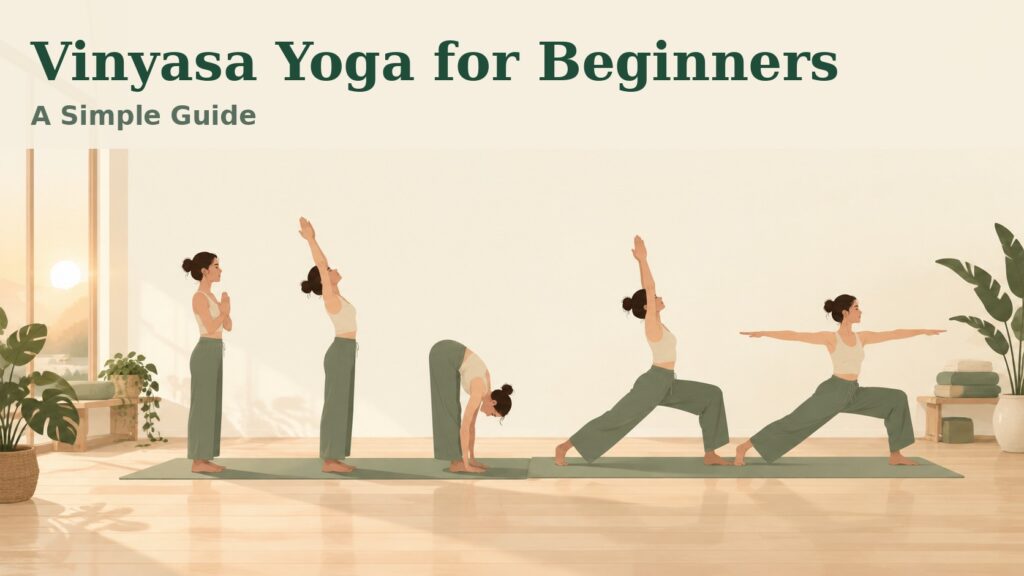
It is simpler than it sounds. In a beginner vinyasa class, the teacher might say, “Inhale, reach your arms up. Exhale, fold forward. Inhale, look up halfway. Exhale, step back.” Every movement has a matching breath. You inhale to open or lengthen, and you exhale to fold, twist, or release.
This breathing pattern does two useful things. First, it gives your busy mind one clear job, which many people find calming. Second, it stops you from holding your breath during effort, a common beginner habit. If you want to practice the breathing side on its own, ujjayi breath for beginners is the classic vinyasa breathing style, and belly breathing is an even simpler place to start.
What is a vinyasa class actually like?
A typical beginner class lasts 45 to 60 minutes and follows a loose pattern:
- Arrival and breath (5 minutes). You sit or lie down, notice your breathing, and let the day slow down.
- Warm-up (10 minutes). Gentle movements for the neck, shoulders, spine, and hips.
- Main flow (20 to 30 minutes). Standing poses linked together, often built around sun salutations, repeated a few times so you can learn the pattern.
- Cool-down (10 minutes). Slow stretches on the floor.
- Final rest (5 minutes). Lying still in savasana, doing nothing at all.
At home, you can copy this same shape with a shorter 20-minute version: two minutes of breathing, five minutes of warm-up, eight minutes of simple flow, and five minutes of lying down rest.
Which poses show up in almost every vinyasa class?
Vinyasa classes repeat a small family of poses. Learn these eight and most beginner classes will feel familiar:
- Mountain pose – standing tall, the starting point of every flow.
- Standing forward fold – a soft bend with relaxed knees.
- Plank pose – a strong straight line, with knees down as an easy option.
- Cobra or a gentle backbend – lifting the chest a little while lying on the belly.
- Downward-facing dog – the famous upside-down V shape, with bent knees allowed.
- Warrior poses – strong standing shapes that build leg strength and focus.
- Child’s pose – the resting pose you can return to at any moment.
- Cat-cow – a slow spine warm-up done on hands and knees.
Notice that every one of these has an easier version. Bending the knees, lowering to the floor, or shortening the hold are normal parts of the practice, not signs of failure.
What is the “vinyasa” transition teachers keep mentioning?
In many classes, the word “vinyasa” also names one specific transition: moving from plank, lowering down with control, rising into cobra or upward dog, and pressing back to downward-facing dog. Teachers say “take your vinyasa” to mean “move through that sequence.”
Here is the beginner secret: you are always allowed to skip it. Rest in child’s pose instead, or lower your knees and move slowly. Even experienced students skip it when tired. Skipping the hard transition is not cheating. It is how you practice for years without injury.
How do you start vinyasa yoga at home?
A simple four-week plan works well for most beginners:
- Week 1: Two sessions of 15 to 20 minutes. Learn mountain pose, forward fold, cat-cow, and child’s pose. Practice matching one breath to one movement.
- Week 2: Three short sessions. Add plank with knees down, cobra, and downward dog with bent knees.
- Week 3: Three sessions of 20 to 30 minutes. Link the poses into a slow sun salutation and repeat it three to five times.
- Week 4: Three sessions. Add warrior 1 and warrior 2, and finish each session with five quiet minutes in savasana.
If you are unsure how often to practice, our guide on how often you should do yoga gives honest, non-pushy answers.
Do you need to be fit or flexible first?
No. This is the most common beginner worry, and it has the clearest answer. You do not stretch to get ready for yoga. Yoga is how you become more comfortable moving. Saying “I am too stiff for yoga” is like saying “I am too dirty for a shower.”
That said, honesty matters: vinyasa is movement, and movement uses energy. If you have a health condition, joint problems, blood pressure concerns, or you are pregnant, talk with your doctor first and tell the teacher before class. Most poses can be adapted with chairs, walls, and props.
What are common beginner mistakes in vinyasa?
- Moving too fast. Slow is strong. If you cannot keep breathing calmly, slow down.
- Locking the knees and elbows. Keep a small, soft bend in the joints.
- Comparing yourself to others. The person on the next mat may have practiced for ten years. Your only job is your own mat.
- Skipping the rest. Savasana at the end is where the practice settles. Do not leave early.
- Pushing into pain. Stretching can feel intense, but sharp, stabbing, or joint pain means back off at once.
How might vinyasa make you feel over time?
Everyone is different, but beginners often report the same pattern. The first week feels awkward. By the third week, the sequence starts to feel familiar, and the breath begins to lead the movement on its own. Many people say they sleep more easily on practice days and feel less stiff in the morning. Studies on yoga suggest regular practice may support flexibility, balance, mood, and stress management, but it is not a medical treatment, and your experience may be different. The fairest test is simple: practice gently for a month and notice how you feel.
How does vinyasa fit with the rest of yoga?
Vinyasa is one doorway into a much larger house. The breathing you learn here carries into pranayama practice, and the calm focus carries into meditation. Many students who start with movement eventually enjoy the quieter side of yoga just as much. There is no correct order. Start where it feels easiest to begin.
Once you have the flow basics down, you can explore the quieter and stronger ends of the spectrum: yin yoga for beginners slows everything to long, restful holds, while power yoga for beginners turns the same poses into a real workout.
Frequently asked questions
Is vinyasa yoga too hard for a complete beginner?
No, as long as you choose a beginner or slow-flow class and rest whenever you need to. The poses are simple; only the pace makes it feel hard, and you control the pace.
How many times a week should a beginner do vinyasa?
Two or three short sessions a week is plenty at first. Consistency matters far more than length or intensity.
Do I need any equipment for vinyasa yoga?
A mat with decent grip is enough. A yoga block and a strap are nice extras, but books and a belt work fine as substitutes.
Can vinyasa yoga help with weight or fitness?
Vinyasa is moderate physical activity, so it can be part of an active lifestyle. It is not a quick fix, and results depend on food, sleep, and overall habits.
What should I do if I cannot keep up with the class?
Pause in child’s pose and rejoin when you are ready. Teachers expect this, and nobody is watching. Resting is part of the practice.