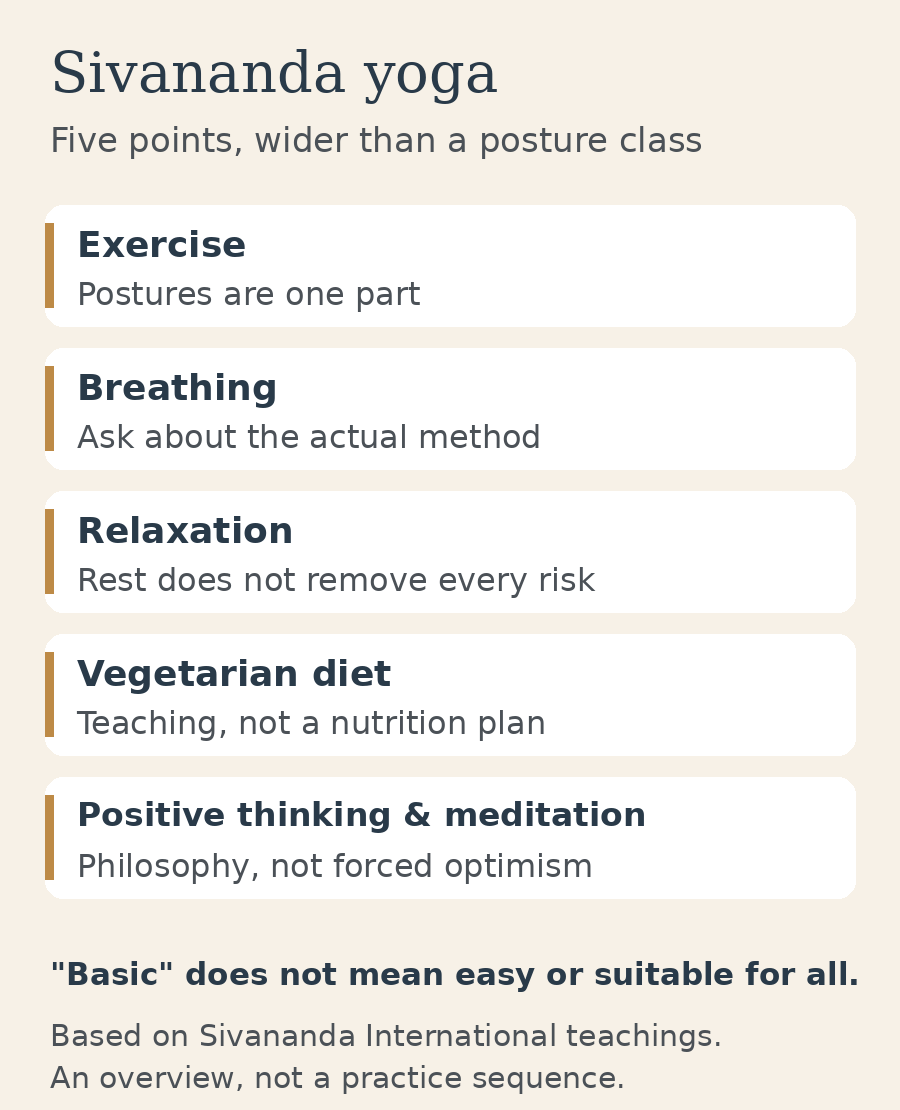
Sivananda yoga combines posture practice with breathing, relaxation, a vegetarian approach to food, and positive thinking and meditation. These are its five points of yoga. The approach is rooted in a spiritual tradition rather than being designed only as a fitness routine.
A familiar feature is a sequence of twelve basic postures. However, the word basic describes their place in the teaching system, not a promise that every posture is easy or appropriate for a beginner. The sequence includes inversions and other movements that need careful guidance.
This guide explains the five points, what a session may involve and what to ask before participating. It describes the tradition without repeating its health claims as established medical facts or suggesting that everyone should copy its full sequence.
The teaching background
Sivananda International describes Swami Vishnudevananda as bringing the teachings of his guru, Swami Sivananda, into a five-point framework. Those points form the foundation of the Sivananda Yoga Vedanta Centres’ teaching.
The organization also connects the approach with four paths: Karma, Bhakti, Raja and Jnana yoga. These concern action or service, devotion, meditation and knowledge. The postures are therefore one part of a wider understanding of yoga.
This background helps explain why a session may include Sanskrit terms, chanting or philosophical discussion alongside physical practice. Ask what is included if you are looking for a particular kind of experience. A familiar posture sequence does not necessarily mean a purely exercise-based class.
The five points at a glance
| Traditional point | How to read it |
|---|---|
| Proper exercise | Asana is part of the system, not the whole approach. |
| Proper breathing | Find out which techniques are taught and whether they suit you. |
| Proper relaxation | Rest is included, but the whole class may still be demanding. |
| Proper diet | A vegetarian teaching, not an individual nutrition plan. |
| Positive thinking and meditation | A spiritual framework, not a demand to deny difficult feelings. |
The five points are proper exercise, proper breathing, proper relaxation, proper diet, and positive thinking and meditation. The organization uses the word proper as part of its teaching framework; it should not be read as a medical judgment about everyone else’s activities or food choices.
Asana is the posture component. Pranayama refers to breathing practice. Savasana is associated with relaxation, while the food teaching emphasizes a vegetarian diet. The final point brings together Vedanta and meditation.
You can understand these categories without treating every explanation on a teaching website as scientifically established. Statements about subtle energy and spiritual development belong to the tradition’s philosophy. Claims about preventing or treating disease require separate, credible clinical evidence.
Postures: familiarity without pressure
The official twelve-posture list includes demanding inversions such as headstand and shoulderstand alongside forward bends, backbends, a twist, a balance and standing postures. These names describe the traditional framework, not a sequence to copy from a blog.
Several of these movements place substantial demands on strength, balance, mobility or the neck. NCCIH specifically advises yoga newcomers to avoid extreme practices such as headstands and shoulderstands. A posture’s place in a basic sequence does not override that advice.
Ask how a beginner is introduced to the practice and what happens when a posture is unsuitable. A teacher should be able to explain an alternative, a preparatory step or a rest. You do not need to complete twelve positions to earn the right to participate.
Breathing: find out what is being taught
Pranayama is one of the five points and is included in the Toronto Sivananda centre’s description of a typical class. Different breathing practices make different demands, so it helps to ask for the names and instructions before starting.
Do not assume that forceful breathing or breath retention is appropriate simply because a class includes relaxation. NCCIH advises beginners to avoid forceful breathing. Pregnancy and health conditions may require additional guidance from a healthcare professional and an appropriately experienced teacher.
If an exercise makes you dizzy, distressed or short of breath, stop rather than trying to keep up. Return to ordinary breathing and seek appropriate help for concerning symptoms. A difficult sensation is not proof that a technique is cleansing or working.
Relaxation is part of the structure
Savasana, often called corpse pose, is associated with the relaxation point. Independent writer Lucy Greeves describes rest periods between postures as a recognizable feature of a traditional Sivananda class.
These pauses distinguish the experience from a continuously moving practice, but rest does not make the whole sequence automatically gentle. A session can include both quiet intervals and physically demanding movements.
If lying flat is uncomfortable or unsuitable, discuss another position. You can also ask whether blankets or other supports are appropriate. Relaxation should not require enduring pain, remaining in a position that conflicts with medical advice or being unable to change your mind about how you participate.
Understanding the vegetarian teaching
Sivananda International includes a vegetarian diet within its five-point approach. It presents food through a yogic framework concerned with physical life, the mind and spiritual practice.
That describes the tradition; it is not an individualized nutrition plan. Traditional categories for foods should not be converted into claims that a particular ingredient causes depression, that a diet guarantees health or that food choices determine someone’s spiritual worth.
If you are considering changing your diet, take account of your nutritional needs, allergies, medical conditions and relationship with food. A qualified healthcare professional or dietitian can help when needed. There is no reason to make abrupt restrictions just to prepare for a yoga session.
Positive thinking and meditation
The final point connects meditation with Vedanta, a philosophical tradition. Sivananda International describes it in terms of unity of consciousness and a calm mind. These are teaching aims, not guarantees of how every student will feel.
Positive thinking should not be interpreted as a requirement to deny grief, anxiety, illness or ordinary difficult emotions. Experiencing distress does not mean you have failed at yoga or caused your own circumstances by thinking incorrectly.
Ask how meditation is introduced and whether shorter periods or different positions are available. If an exercise is unsettling, pause. Yoga and meditation should not replace needed mental health care, and a spiritual explanation should never be used to dismiss a person’s symptoms.
What a session may look like
The Toronto centre describes a typical class as including breathing exercises, warm-ups such as sun salutations, the twelve basic postures and deep relaxation. Its teaching description emphasizes an ordered sequence with variations developed as students learn.
That is useful orientation, but it does not establish the exact content, pace or duration of every class taught under the name. A beginner course, a general session and an advanced practice can differ considerably.
Ask how often participants move between standing and the floor, how long positions are held and whether alternatives are explained as the group goes. If you are learning remotely, make sure you understand how to rest or stop without waiting for individual attention.
Spiritual content and personal choice
The official teaching describes yoga in terms of the individual soul and pure consciousness. The independent Welldoing account also notes the possibility of Sanskrit mantras or prayers, while observing that teachers vary in how they include religious aspects.
There is nothing wrong with asking directly about those elements. You may want to learn about them, participate in some parts or choose a different setting. Knowing what to expect is more respectful than assuming all yoga sessions share the same spiritual content.
A teacher can explain a practice and offer options without pressuring you to adopt a belief. Your right to decline chanting, touch or a particular instruction remains intact. Consent should be specific and changeable throughout a session.
Choosing a suitable starting point
Ask whether a course is intended for people who are new to yoga and how the teacher introduces demanding postures. The title of a class cannot establish whether it fits your current abilities or health needs.
Useful questions include what training the teacher has, how they adapt for injuries or access needs and when they recommend professional advice. A general teaching qualification is different from clinical expertise with a particular diagnosis.
Look for clear answers about alternatives and scope. You should not be expected to disclose private medical information to the whole group. Share relevant needs through an appropriate private conversation, and ask what the teacher needs to know to support safe participation.
Keep safety separate from tradition
NCCIH describes yoga as generally safe for healthy people when performed properly with qualified guidance, while noting that injuries can happen. Existing injuries, severe high blood pressure, glaucoma, balance difficulties and pregnancy are among the situations that may require changes.
Do not use the traditional sequence as a checklist that must be completed regardless of those needs. Stop for pain, dizziness or difficulty breathing, and seek medical advice for concerning symptoms. Neither a slower pace nor a spiritual purpose makes an unsuitable movement safe.
The official posture descriptions include wide-ranging health claims. They explain how the organization presents its teaching, but they should not be treated as proof that a headstand improves memory, a shoulderstand regulates the thyroid or a pose prevents disease. This guide does not recommend postures for those purposes.
A grounded way to explore Sivananda yoga
Start by understanding the whole approach: five points, a recognizable posture framework and a spiritual context. Then choose a level and teacher that can explain how the practice will fit you.
After a session, consider what was clear, what was manageable and where you needed another option. Ask questions before increasing difficulty. There is no need to turn a tradition into a performance target or compare yourself with an experienced demonstration.
Sivananda yoga may appeal to someone who wants posture, breathing, relaxation and philosophy within one teaching framework. Let informed choice and appropriate guidance shape your participation, while keeping medical care, personal boundaries and realistic expectations in place.