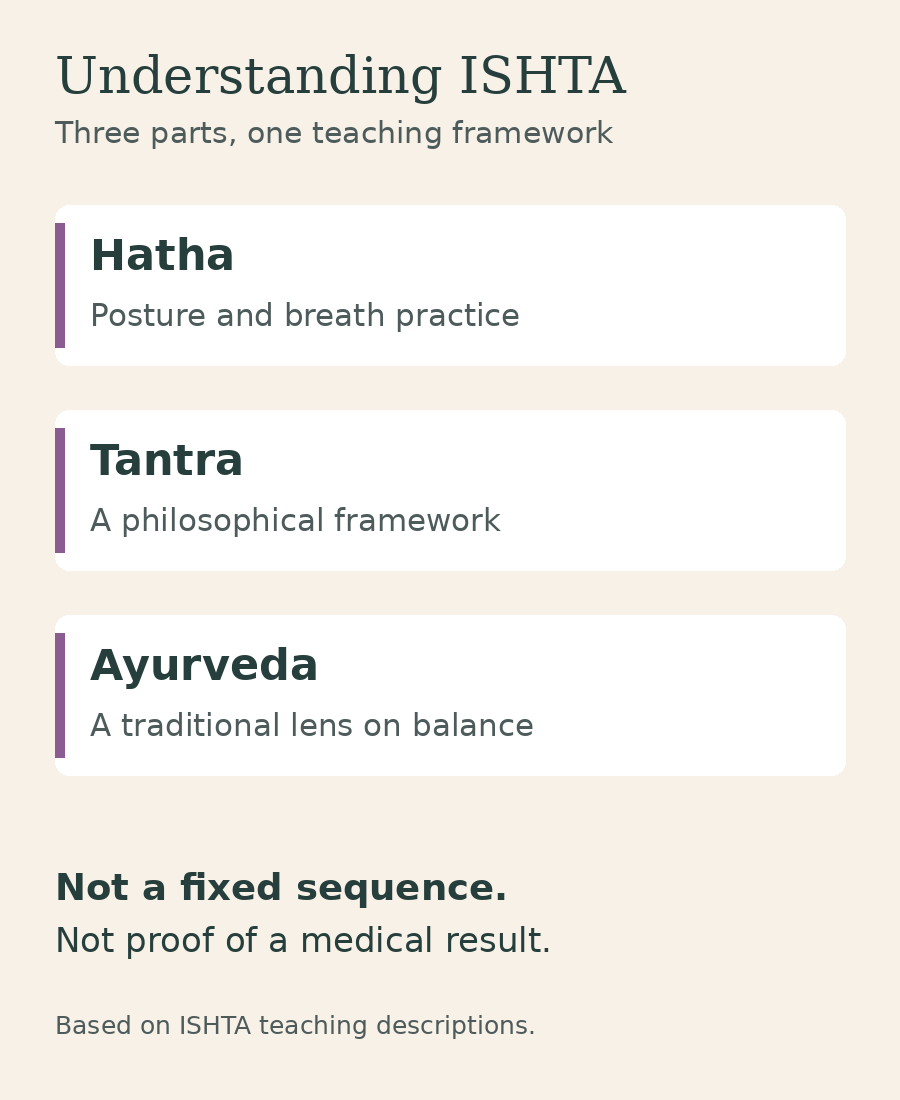
ISHTA yoga is a teaching approach that brings together Hatha, Tantra and Ayurveda, with an emphasis on the individual. Its name is an acronym for Integrated Science of Hatha, Tantra and Ayurveda. The organization also connects the word with a practice that resonates with the individual spirit.
For someone considering it, the important point is that ISHTA is broader than a sequence of postures. Movement, breathing and meditation can be taught within a shared philosophical framework, while the way a student participates can vary.
This guide explains the name, the teaching background and what to ask before beginning. It separates descriptions of a tradition from medical evidence, and it does not offer a universal routine or promise a particular spiritual experience.
What makes the approach individual?
ISHTA’s own account says that students learn to draw on different yoga practices in ways that suit their individual paths. In a Yoga Journal interview, Alan Finger describes individual difference as central to the approach rather than treating one practice as correct for everyone.
This is a teaching principle, not a guarantee that every class will be individually designed. A group session still has a shared structure. Ask how alternatives are offered and whether the teacher can respond to your experience within that setting.
Personalization also needs honest information. Your previous experience, comfort with breathing practices, access needs and reasons for practicing can affect what is appropriate. You do not have to perform a difficult pose to demonstrate that you belong.
The background of ISHTA yoga
The official lineage account identifies Mani Finger and his son Alan Finger as the creators of ISHTA in South Africa. It describes an approach shaped by the different teachers and traditions encountered in their family home and ashram.
Alan Finger’s Yoga Journal interview provides a first-person account of organizing those teachings into a system. It is useful for understanding the founder’s perspective, but personal stories of recovery or transformation are not controlled evidence of medical benefit.
You do not need to accept every biographical or spiritual claim to understand the practical approach. The relevant background is a deliberate combination of teachings, with individual suitability as an organizing idea. Learning the history can provide context without turning a lineage into a claim of clinical authority.
Hatha: the physical part of practice
The ISHTA School of Yoga describes posture work as part of a practice that also includes breathing, meditation and relaxation. The main ISHTA organization’s description includes breath-based flow and attention to alignment.
That does not establish a single fixed sequence. A class may use familiar yoga postures, but the pace, transitions and amount of standing or floor work depend on the session. Read its description instead of assuming that the ISHTA name means either a gentle stretch or a strenuous workout.
Alignment guidance should help you understand a movement, not pressure you into reproducing a shape. Ask for a smaller range, a different position or a pause when needed. A demonstration is information, not an obligation to copy everything you see.
Tantra: understanding the teaching context
Within ISHTA, Tantra is part of the philosophical framework. The South African school’s explanation describes it in terms of layers of experience and an underlying sense of self, while the official lineage account identifies Tantric influences in the approach’s development.
These are descriptions of a spiritual tradition. References to subtle energy, consciousness or the inner self should not be presented as established measurements of anatomy or as proof that a practice treats disease.
If the language is unfamiliar, ask what an instruction means in practical terms and whether it is optional. A teacher can explain a traditional idea without requiring you to report a special sensation or agree with every metaphysical claim. Your questions and boundaries still matter.
Ayurveda: another part of the framework
Ayurveda appears in the ISHTA acronym and in its explanation of individual balance. It is a traditional Indian medical system, as described by the National Center for Complementary and Integrative Health, rather than a synonym for ordinary stretching or relaxation.
Learning about this background is different from receiving medical care. Traditional categories do not replace a diagnosis, and a yoga class should not become a reason to change prescribed medicines or dismiss symptoms that need assessment.
There is also a difference between discussing a philosophy and taking an Ayurvedic product. NCCIH warns that some preparations can contain toxic amounts of lead, mercury or arsenic. Do not assume a supplement is safe because it is described as natural or associated with a yoga tradition. Discuss products with your healthcare professional.
Different classes under the same name
The official class descriptions show why choosing by lineage alone is not enough. ISHTA Basics is presented as a class with detailed cues and a gentle approach. Beginner / Intermediate is described as slow flow with foundational poses. By contrast, ISHTA Power is described as strong and fast-paced, while the advanced offering includes arm balances and inversions.
That is a wide range of demands within one teaching organization. Read the level and format, then ask about the actual movements. The table summarizes those descriptions; it is not a guarantee of individual suitability or a recommendation to try every format.
| Class label | What to clarify |
|---|---|
| ISHTA Basics | How will the teacher explain starting positions, transitions and alternatives? |
| All Levels | How are options taught when students have different experience? |
| Flow + Restore | How demanding is the flowing part before supported rest begins? |
| Meditation | Which preparation, breathing, visualization or mantra practices are included? |
| Power or advanced | What previous practice is expected, and is another level a better starting point? |
A relaxing finish does not make the preceding movements automatically suitable. Likewise, an all-levels label does not mean every student must attempt the same version. Ask how you can pause, change position or leave a practice out.
In a remote session, check how alternatives will be explained and whether feedback is possible. A recording cannot respond to your movement or notice that you are struggling. Do not continue simply because the video continues.
Breathing is not a test of endurance
Breathing has an important place in ISHTA’s descriptions, but there is no need to begin with advanced techniques. Learning to notice the breath is different from forcing a pattern or trying to maintain an uncomfortable hold.
NCCIH advises newcomers to avoid forceful breathing practices. Ask the teacher what an exercise involves before attempting it, especially if you have a health condition, are pregnant or have previously felt unwell during breathing exercises.
You should be able to return to ordinary breathing, rest or leave out a technique. Feeling dizzy, distressed or short of breath is not a requirement for progress. Stop and seek appropriate help for concerning symptoms rather than interpreting them as evidence of an energy release.
Meditation is part of the wider practice
ISHTA places meditation alongside physical practice rather than treating yoga as posture alone. The founder’s interview discusses consciousness and self-study as part of the tradition’s aims.
Those aims should be distinguished from a promise about what you will feel. A beginner may notice distraction, restlessness or no dramatic change at all. There is no need to claim an experience of bliss or special insight to satisfy an expectation.
Ask how the meditation will be introduced and what alternatives are available. A supported seat, a shorter period or keeping the eyes open may be worth discussing when stillness feels difficult. If practice causes distress, pause and speak with an appropriate professional when needed.
Is it suitable for a beginner?
The main ISHTA website describes teaching for a range of experience levels, including beginners. That is the organization’s description of its offering, not evidence that every ISHTA-labelled session suits every newcomer.
Choose by the actual level and content. Ask whether the teacher explains transitions, offers alternatives and leaves time to understand the instructions. A class described as advanced should not be treated as a beginner option simply because the overall approach values individual needs.
Beginner-friendly teaching makes it possible to ask questions without embarrassment. You should know how to rest and what to omit. If you feel you must push through discomfort to keep up, reconsider the session rather than deciding that the problem is a lack of dedication.
Questions to ask the teacher
Ask about training in ISHTA and experience working with needs similar to yours. A tradition’s name and a teacher’s title do not establish clinical qualifications or expertise with a particular health condition.
Useful questions include how posture work and meditation are balanced, whether any breathing techniques involve retention and how adjustments are handled. If touch is offered, consent should be clear and changeable; agreeing once does not remove your right to say no later.
Also ask what to do between sessions. Written notes should be clear enough that you do not have to guess a movement or breathing pattern. General yoga education has limits, and a responsible teacher can explain when a healthcare professional’s input is needed.
Keep health claims in proportion
The word ‘Science’ is part of the acronym, but its presence does not mean that every traditional explanation has been validated by modern clinical research. A teaching system’s own description explains its philosophy, not the effectiveness of every claimed application.
NCCIH notes that yoga research involves different kinds of practice, which makes results difficult to compare. Evidence about yoga generally cannot automatically be converted into proof for an ISHTA class, a specific meditation or a particular individual.
Be cautious about promises to cure illness, reset hormones or replace psychological treatment. Yoga can be discussed as an activity within a wider care plan, but diagnosis and treatment decisions belong with the appropriate healthcare professionals. Do not delay assessment because a practice is described as balancing.
Safety and realistic expectations
NCCIH considers yoga generally safe for healthy people when performed properly under qualified guidance, while noting that injuries can happen. Existing injuries, pregnancy, balance problems and other health conditions may require changes or professional advice.
Personalization is useful only when it is put into practice. Tell the teacher if an instruction causes pain or feels inaccessible. Progress can mean understanding a comfortable option, recognizing when to stop or finding a manageable practice, rather than achieving a more elaborate posture.
ISHTA offers a particular way to connect movement, breath and meditation with a wider philosophy. Approach it with curiosity, clear questions and your own boundaries intact. The right starting point is a session whose content you understand and can participate in without pressure.