Dru yoga combines flowing movement, breathing, relaxation and meditation. Its teaching often emphasizes soft joints, attention to the spine and moments of stillness within movement. It can appeal to people who want a thoughtful flow without assuming that every session must be fast or athletic.
One of its best-known features is a group of practices called Energy Block Release sequences, usually shortened to EBRs. The name belongs to Dru’s teaching vocabulary. Understanding that vocabulary is useful, but it is important to separate its spiritual ideas from claims about health.
A good introduction explains what you may do in class, how the movements can be adapted and what questions to ask. Gentle-looking movement can still need careful instruction, especially if you have an injury or another health concern.
What is distinctive about Dru yoga?
Dru’s teaching materials describe roots in hatha yoga and a combination of familiar postures with flowing sequences, breathing practices, hand gestures, visualization and relaxation. Attention is given to how one movement develops into another instead of treating every posture as an isolated shape.
The official teaching page connects the name Dru with the Sanskrit word dhruva and with the idea of stillness. That helps explain the method’s interest in finding a steady point of attention within movement. It is a philosophical image, not a requirement to feel a particular sensation.
Its recognizable features include the EBR sequences, softly flexed joints and attention to spinal movement. Teachers may also use affirmations or describe chakras and koshas, traditional concepts associated with energy centres and layers of experience.
Those terms tell you something about the class culture. They do not establish that invisible blockages in joints or organs have been medically identified. You can understand the method’s intentions without treating every explanation in its promotional material as a scientific fact.
What are Energy Block Release sequences?
EBRs are linked movement practices used within Dru yoga. Official and practitioner descriptions connect them with breathing, awareness and themes such as steadiness or openness. Some sequences have numbers, while others are known by names.
Dru Australasia presents EBR 1 as a foundation sequence. That is a useful point of orientation when reading class descriptions, but it does not mean that you should learn a whole sequence from a short written overview. The movements and alternatives still need to be taught clearly.
In Dru’s philosophy, the sequences are described as releasing energy blocks. Keep that explanation attributed to the method. It is different from showing that a movement removes toxins, treats disease or releases trauma from an organ.
A practitioner may find a sequence absorbing or pleasant, but individual experience cannot prove the wider claims made for it. If you do not feel an energetic shift, there is no need to search for one or assume you have failed to practise correctly.
Soft joints do not mean a collapsed posture
Dru teachers commonly cue joints to remain soft rather than rigidly locked. This is one of the method’s recurring movement ideas. The useful question is how much movement or support is right for your body in the particular posture.
Softness is not the same as letting the body hang without control. Nor is it a universal instruction to bend every joint as far as possible. Ask the teacher to explain the intended position and an alternative if a cue feels unstable or uncomfortable.
This matters when copying a flowing demonstration. A movement may look small while requiring balance or coordination. Choose a range you can control rather than treating softness as permission to move vaguely or push through discomfort.
The spine and the flow of movement
Dru’s teaching gives special attention to the spine, including movements described as a spinal wave and spinal twist. It also emphasizes core stability. These ideas help distinguish its movement vocabulary from a class focused mainly on holding separate shapes.
A cue to begin movement from the spine belongs to that teaching approach. It should not be read as a complete biomechanical description of every action or proof that stiffness causes illness. Learn the cue through explanation rather than trying to create the largest wave or deepest twist you can.
If you have back pain, a previous spinal injury or symptoms affecting your arms or legs, a class name cannot establish that these movements are appropriate. Discuss your needs with a qualified healthcare professional and instructor. A smaller or different movement may be necessary.
| Term you may hear | Useful question |
|---|---|
| Activations | Which preparatory movements will we do, and can I do them with support? |
| Energy Block Release | Which linked movements are involved, and how are alternatives taught? |
| Soft joints | Can you explain the position without asking me to feel unstable? |
| Dru point | Where are the pauses, and may I pause at other times? |
| Deep relaxation | May I choose a different resting position or keep my eyes open? |
This vocabulary describes features to discuss, not a sequence to follow or a medical assessment.
What happens in a Dru yoga class?
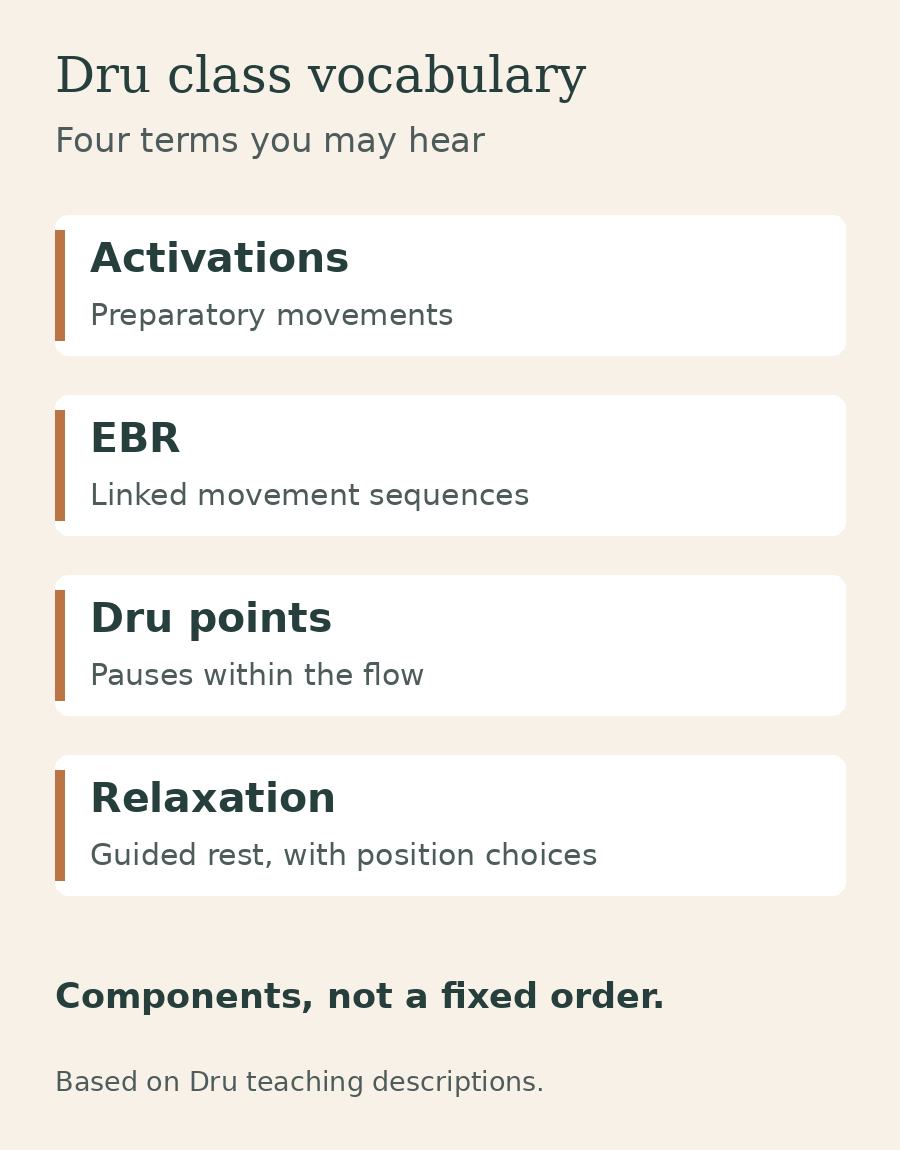
Descriptions from Dru’s own teaching site and independent overviews commonly begin with activations, meaning preparatory movements. These are followed by EBRs, postures or other linked sequences, with breathing, relaxation and sometimes meditation included.
The exact content varies. Some classes may be quiet and gentle, while other Dru formats contain stronger movement. Do not assume that every teacher uses the same sequence, the same music or an identical amount of floor work.
Guided relaxation is an important part of the method’s description. You may be invited to rest and listen to spoken instructions after the movement. Ask about alternatives if lying on the floor is uncomfortable or unsuitable for you.
For an online class, find out which props are needed and prepare enough clear space. Position the screen so you can hear and see instructions without repeatedly turning away from a movement. A flowing class is easier to follow when the practical setup is settled first.
Visualization, affirmations and stillness
Dru materials describe visualization and positive affirmations as parts of the practice. A teacher might use an image or a short statement alongside movement or relaxation. These are optional ways of directing attention, not tests of whether you are thinking correctly.
If an image or phrase does not suit you, ask whether you can focus on a neutral physical sensation instead. You should not feel required to adopt a belief or report a positive feeling in order to remain part of the class.
The term Dru points refers to moments of stillness within the flow. You can understand this simply as pausing and noticing before moving again. It does not require an unusual state, and the quality of the experience may change from one session to another.
Who might enjoy the approach?
Dru may interest someone who likes coordinated movement and breathing, clear themes and a substantial relaxation component. Its spiritual language may also appeal to people who want more than a purely exercise-based class.
That description is a starting point for choosing, not a guarantee of fit. If you prefer a secular lesson, dislike guided imagery or need very detailed posture instruction, ask how the teacher handles those preferences before joining.
Beginners should look for a class that explicitly teaches foundations and offers alternatives. A gentle or all-levels label does not assess your balance, mobility, health or experience. The teacher’s explanation of the actual demands is more useful than the broad label.
Be careful with health promises
Some Dru-related pages make claims about detoxification, healing disease, releasing trauma or changing energy in organs. These statements should not be repeated as established medical facts. Spiritual explanations and testimonials are not the same as clinical evidence.
The National Center for Complementary and Integrative Health notes that yoga research includes many different practices. General findings about yoga cannot prove every claim made for a particular Dru sequence or show that it is the right treatment for an individual condition.
A class can be valuable because you enjoy its movement, attention or rest without needing to promise a cure. If you are seeking help for persistent pain, distress or another health problem, keep decisions about diagnosis and treatment with appropriate healthcare professionals.
Similarly, tingling, dizziness, discomfort or strong emotion should not automatically be labelled an energy block leaving the body. Stop or change the practice when needed. Seek suitable help for concerning symptoms rather than continuing because a description calls them natural.
Questions to ask before starting
Ask whether the class is introductory, how much standing and floor work it includes and which EBR or sequence will be taught. Find out whether there are simpler choices, whether relaxation can be done in another position and whether props are needed.
Ask about the teacher’s training in Dru and how they support your particular access needs. If hands-on assistance is offered, you can decline it or request verbal guidance. Consent can change during a session.
Pregnancy, existing injuries, glaucoma, severe high blood pressure, balance difficulties and other health conditions may call for professional advice or modifications. NCCIH advises beginners to avoid extreme postures and forceful breathing. A flowing style does not remove those precautions.
Begin with movements you understand and can control. Rest if breathing becomes strained, and stop for pain or dizziness. Dru yoga’s emphasis on flow and stillness is most useful when it leaves room for informed choices, realistic expectations and care for your own limits.