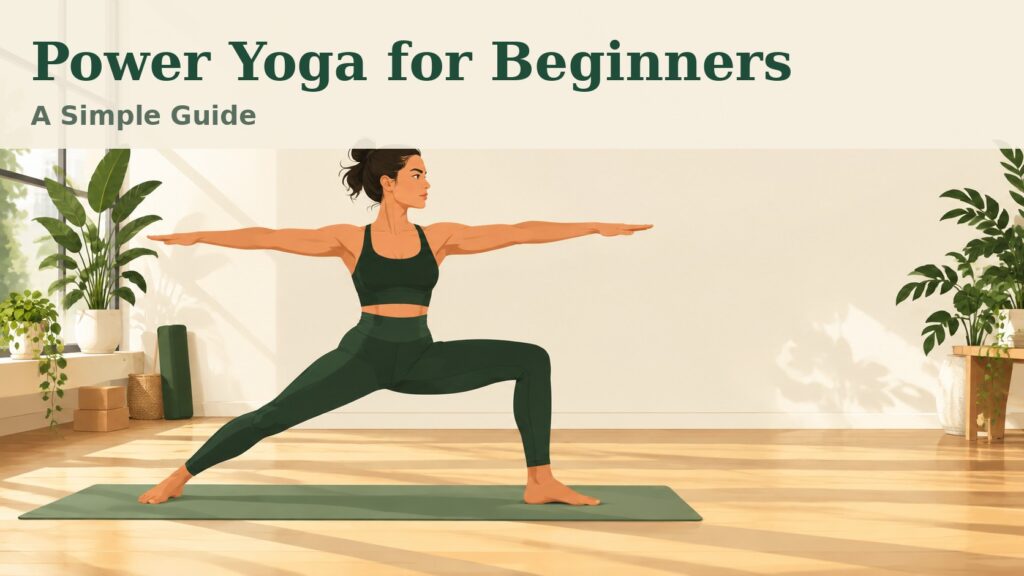
Power yoga sounds like it was named to scare beginners away. The truth is kinder: power yoga is simply a more energetic, fitness-focused version of vinyasa, and beginners can approach it safely by starting slow, choosing easy options, and resting often. This guide explains what power yoga is, how it differs from other styles, and how to try it without overdoing it on day one.
What is power yoga?
Power yoga is an active style of yoga that links poses with breath, like vinyasa, but with more strength work, longer standing sequences, and a quicker pace. It grew popular in the 1990s as a gym-friendly version of Ashtanga yoga. There is no fixed sequence: teachers design their own classes, usually building heat, working the legs and core, and finishing with a stretch and rest.
Think of it as yoga with the volume turned up a little. The poses are the same family you meet in any beginner class. The difference is pace, repetition, and how long you stay in the strong shapes.
How is power yoga different from vinyasa?
The two styles overlap so much that many studios use the names loosely. If a difference exists, it is this: vinyasa can be gentle or strong depending on the teacher, while power yoga always aims to be a workout. Expect more planks, more warriors, more chair poses, and fewer long breaks. If you are new to flowing styles altogether, read vinyasa yoga for beginners first, then come back here.
Is power yoga okay for beginners?
Yes, with honest pacing. A complete beginner can join a power class if they treat it like a buffet, not a race: take the easy options, skip the hard transitions, and rest in child’s pose whenever breathing gets rough. The poses themselves, like mountain, warrior, and downward dog, are beginner shapes. Intensity comes from repetition, and you control that.
If you prefer a gentler on-ramp, a few weeks of hatha yoga or slow vinyasa builds the same foundations with less sweat.
What does a power yoga class look like?
- Warm-up (5 to 10 minutes): breath work, cat-cow, gentle sun salutation movements.
- Standing strength (20 to 25 minutes): sun salutations with chair pose, warriors, lunges, and balance work like tree pose.
- Core and arms (10 minutes): planks, side planks, slow lowering push-ups, boat pose.
- Cool-down (10 minutes): hip openers, forward folds, twists.
- Rest (5 minutes): savasana.
How do you make power yoga easier as a beginner?
- Bend the knees. In folds, downward dog, and chair pose, soft knees protect the back and hamstrings.
- Drop to the knees in plank. A knees-down plank with good form beats a sagging full plank every time.
- Skip the jump-backs. Step back and step forward instead. Teachers offer this in every class.
- Take child’s pose early. Resting for thirty seconds lets you finish the whole class instead of quitting halfway.
- Use your breath as the speedometer. If you cannot breathe steadily through the nose, slow down. Ujjayi breathing helps set a calm rhythm.
How often should a beginner do power yoga?
Two or three sessions a week, with a rest day or a gentle day between, suits most beginners. Muscles adapt during rest, not during the workout. Mixing one power session with slower practices like yin yoga or restorative yoga is a balanced week many teachers recommend. Our guide on how often to do yoga goes deeper.
Who should be careful with power yoga?
Because power yoga is real exercise, anyone with heart or blood pressure concerns, joint injuries, dizziness issues, or pregnancy should check with a doctor first. Heat raises the stakes too: a power class in a hot room is harder on the body, so beginners are better off in a normal-temperature class, drinking water before and after.
What results can you realistically expect?
Done regularly for a month or two, most beginners notice better stamina, steadier balance, and stronger legs and core. Power yoga is moderate-to-vigorous physical activity, so it can support an active lifestyle and general fitness. It is not a shortcut for weight loss or a treatment for any condition, and results depend on sleep, food, and consistency far more than on any single class. The best sign it is working is simple: ordinary things, like stairs and long walks, start feeling easier.
Frequently asked questions
Is power yoga the same as gym yoga?
Roughly, yes. Power yoga is the athletic, fitness-led branch of yoga. It keeps the breath-and-movement heart of yoga but drops the fixed sequences and most of the chanting.
Can I do power yoga if I am out of shape?
Yes, but scale it: knees down, step instead of jump, rest often. Two weeks of scaled classes feels very different from day one.
How many calories does power yoga burn?
Estimates vary widely by body and class, so treat any number as a rough guess. It is a genuine workout, but food habits matter more for weight than any single session.
What should I bring to a power yoga class?
A grippy mat, a water bottle, and a small towel. You will sweat, and a slippery mat makes standing poses frustrating.
Is power yoga safe for my knees and wrists?
With good options, usually yes: keep knees soft, align them over the toes in lunges, and spread the fingers wide in plank shapes. Sharp pain is always a stop signal, and a doctor should check ongoing joint problems.