
There is no fixed time to learn Kriya yoga. Most people can understand the basics in a few weeks, but building a steady, comfortable practice usually takes many months, and deeper study is a matter of years. The pace depends on your teacher, your daily time and how calm your mind already is. This guide explains each stage in plain words so you can set realistic expectations.
This is general education, not medical advice. If you have a heart, lung or blood pressure condition, are pregnant, or feel unsure, speak with your doctor before trying any breathing practice.
How long does it take to learn Kriya yoga?
Learning the outline of Kriya yoga takes weeks, learning to practise it calmly takes months, and mastering it is described as a lifelong path. Nobody can honestly promise a date. “Kriya yoga” is used for more than one set of practices, so the answer changes with what you are learning. Some people mean the three habits named in the Yoga Sutras. Others mean a technique taught within a particular lineage.
A fair way to think about it is in stages. Each stage has its own pace, and you can stay at any stage for as long as you need. Skipping ahead rarely helps. If you are new to the topic, start with our guide to Kriya yoga for beginners.
What are the stages of learning Kriya yoga?
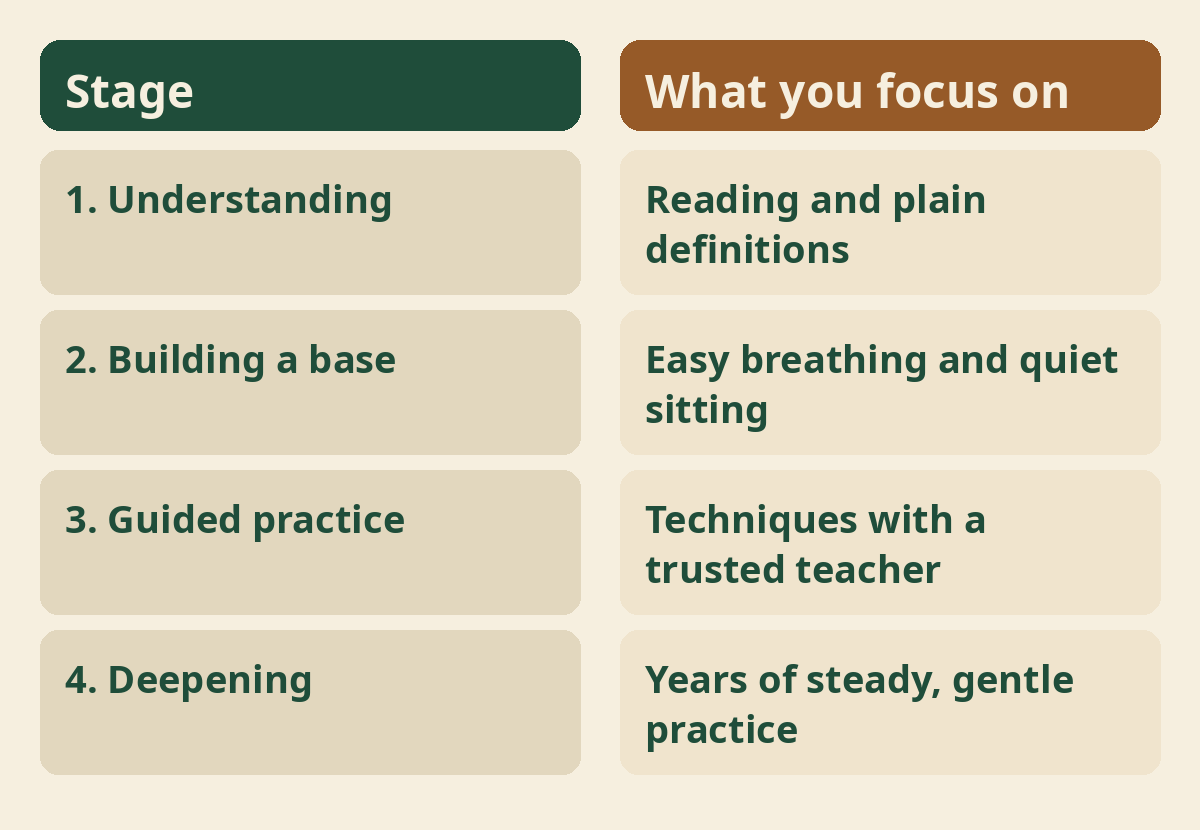
The learning path has four broad stages: understanding the idea, building a base, learning guided practice, and deepening over time. These stages are a simple map, not an official rule. Real life is less tidy, and people move back and forth.
- Understanding. You read, ask questions and learn what the word means in the tradition you are drawn to.
- Building a base. You settle into a daily habit of gentle breathing and quiet sitting.
- Guided practice. You learn specific techniques with a trusted teacher, if your tradition teaches them that way.
- Deepening. You practise for years and let the habit mature.
How long does the first stage take?
Understanding the basics usually takes a few weeks of reading and reflection. This stage is about words, not techniques. You learn that Kriya means “action” or “practice”, that it connects to the eight-limbed path, and that the term has several meanings. Our guide to the eight limbs of yoga gives you the wider map, and our article on the difference between Kriya yoga and pranayama clears up the most common confusion.
There is no need to memorise Sanskrit. A clear, plain understanding is enough to begin.
How long does it take to build a base?
Most people need about two to six months of regular practice to feel settled in a daily routine. This is a rough range, not a promise. The goal is simple things done steadily: a few minutes of easy breathing, a few minutes of quiet sitting and a regular time of day.
This stage matters more than it looks. A person who can sit comfortably for ten minutes and breathe without strain is far better prepared for anything advanced. If sitting still feels hard, that is normal. Read our notes on common obstacles to meditation and on how long to meditate.
What can you practise in the meantime?
A gentle breath practice and a short sitting practice are the best preparation. Here is a simple routine that suits most healthy adults.
- Sit on a chair or cushion with your spine tall and your shoulders loose.
- Breathe naturally and watch the breath for one minute.
- Breathe in through the nose for a count of four, then out for a count of four to six.
- Repeat for five rounds without strain.
- Sit quietly for three to five minutes, noticing sounds and sensations.
- Stop at once if you feel dizzy, tense or anxious, and return to normal breathing.
Practise this at about the same time each day. Regular short sessions work better than rare long ones.
Do you need a teacher to learn Kriya yoga?
For general breathing and meditation, a good book or class can be enough, but specific Kriya techniques are usually taught by a teacher within a tradition. A teacher can watch your posture, adjust the pace and notice when something is not suiting you. That feedback is hard to get from a page.
Be careful about who you learn from. A trustworthy teacher is open about what is taught, welcomes questions and takes health conditions seriously. Avoid anyone who pressures you to pay, join or keep things secret. Our article on whether Kriya yoga is safe for beginners lists warning signs worth knowing before you commit.
Why does it take so long?
It takes time because the practice changes habits of attention, and habits change slowly. A technique can be explained in minutes. Being able to use it when you are tired, busy or upset is a different skill. Training attention is like training a muscle. Gentle, repeated effort works better than force.
Another reason is that a calm body supports a calm mind. Sleep, food, movement and stress all affect how a session feels. Some days will feel easy and others will not, and both are part of the process.
What affects how fast you progress?
Four things matter most: regularity, guidance, patience and your starting point.
- Regularity. Ten minutes daily beats an hour once a week.
- Guidance. A good teacher can save you from slow mistakes.
- Patience. Forcing the breath or the mind tends to backfire.
- Starting point. People who already meditate or do yoga often feel comfortable sooner.
Comparing yourself with others rarely helps. Two people can follow the same plan and feel very different results in the first months.
How many minutes a day should you practise?
Five to fifteen minutes a day is a sensible range for most beginners. Start at the low end and add a minute or two only when the practice feels easy. Long sessions do not speed things up, and they can cause strain or frustration. If your day is busy, a short, calm session is still worth doing.
Many people like to practise in the morning, before the day gets noisy. Our guide to morning meditation shows how to build that habit, and our article on starting a home yoga practice offers a simple structure.
Is there research on how long it takes?
No study gives a set timeline for learning Kriya yoga. Research on yoga and meditation is broad, and the National Center for Complementary and Integrative Health summarises what is known about yoga effectiveness and safety and about meditation and mindfulness. These pages are a good place to check what is and is not supported. Any timeline you read from a teacher or a book is experience, not a measured fact.
What are common signs you are rushing?
Rushing often shows up as strain, restlessness or impatience. Watch for these signs.
- You feel dizzy, tight or anxious during or after practice.
- You hold your breath or push it harder than feels natural.
- You skip basics because you want an advanced technique.
- You feel pressure to reach a result by a certain date.
If you notice any of these, slow down, shorten the session and return to easy breathing. If symptoms continue, speak with a doctor.
How do you know you are making progress?
Progress usually shows up as small, ordinary changes rather than dramatic experiences. You may notice that sitting feels easier, that your breath is smoother or that you settle faster after a stressful moment. You may also simply keep the habit going, which is a real achievement.
Try keeping a short note after each session: how long you sat, how the breath felt and what your mind was doing. After a few weeks the notes show a pattern you cannot see day to day. Avoid chasing special experiences. They are not a measure of success, and chasing them tends to disturb the calm you are trying to build.
Common myths about learning time
- “You can learn Kriya yoga in a weekend.” You can learn about it in a weekend. Learning to practise it calmly takes longer.
- “Longer sessions mean faster progress.” Steady short sessions are safer and often more effective.
- “If it is hard, you are doing it wrong.” Difficulty is normal at the start. Strain and pain are not.
- “You must follow one fixed timeline.” People differ, and your pace is your own.
Where to read next
If you enjoy learning from books, Ranjana Sinha’s Begin Where You Are is written for people who want a calm, plain starting point, and The Journey of Yoga Through Time explains where these ideas came from. Our list of free yoga books and resources is another place to look.
Frequently asked questions
How long does it take to learn Kriya yoga as a beginner?
Understanding the basics takes a few weeks. Feeling settled in a daily routine usually takes several months. Deeper practice is a long-term path with no fixed end date.
Can I learn Kriya yoga in one month?
You can learn what it is and begin a gentle breathing habit in a month. Practising Kriya techniques with confidence usually takes longer.
Do I need a teacher to learn Kriya yoga?
For general breathing and meditation, not always. For specific Kriya techniques, many traditions teach them only through a teacher.
How many minutes a day should a beginner practise?
Five to fifteen minutes a day is enough. Start small and add time slowly.
Is Kriya yoga hard to learn?
The ideas are simple. The habit is the hard part, because it needs patience and regular practice.
What should I learn before Kriya yoga?
Gentle breathing, comfortable sitting and basic meditation. These form a base that makes everything else easier.
The bottom line
Kriya yoga cannot be learned on a schedule. Take a few weeks to understand it, several months to build a calm daily habit, and years to deepen it. Go gently, stay regular and ask for guidance when you need it.

