
The alarm goes off and your body feels like it spent the night folded in a suitcase. Stiff back, tight shoulders, a mind already listing the day’s tasks. Morning yoga is a short, simple practice done after waking that helps many people loosen up and feel steadier before the day begins. You do not need experience, special gear, or much time. This guide covers what to do, how long to spend, and how to keep the habit going.
This article is general education, not medical advice or a personal health plan. If you have a health condition, an injury, or you are pregnant, check with your doctor before you start.
What is morning yoga?
Morning yoga is any short yoga practice you do soon after waking up. It usually mixes easy poses, slow movement, and calm breathing. Sessions can be as short as five minutes or as long as half an hour. You can practice on a mat, a rug, or a clear patch of floor beside your bed. The goal is not a hard workout but a kind start to the day.
Why do people practice in the morning?
Many people find mornings the easiest time to keep a habit. The house is quiet and the day’s demands have not started yet. A short practice can help shake off the stiffness that comes with sleep. Some people say it sets a calm tone that carries into work and family life. Results vary, and the best time is always the one you will actually keep.
Is morning yoga good for beginners?
Yes, mornings can suit beginners very well. Bodies are often stiffer after sleep, which is normal and not a problem. You simply move slower and stay within easy ranges. Short beginner sessions fit naturally into a morning slot before work or school. Many new students like starting the day with one small win already done.
How do you start a morning yoga habit?
Start small and attach yoga to something you already do. Roll out your mat right after brushing your teeth, for example. Keep sessions short at first, around five to ten minutes. A tiny daily habit beats a long session you keep skipping. Most people find it takes a few weeks before the routine feels automatic.
Step 1: Set up the night before
Lay out your mat and clothes before you go to bed. This removes the morning friction that kills new habits. Choose a quiet corner with enough room to stretch your arms out wide. Keep any props you use within easy reach. When everything is waiting for you, starting takes almost no willpower.
Step 2: Wake up and drink water
Have a glass of water before you step on the mat. Your body loses water overnight, and a glass helps you feel more awake. Give yourself a minute or two to fully come around. Try not to check your phone, since messages pull your mind straight into the day. Keep this short transition slow and simple.
Step 3: Start with easy movements
Begin with slow movements rather than deep stretches. Roll your shoulders, turn your head from side to side, and sway a little. Circling your wrists and ankles wakes up the joints. Cold morning muscles respond better to motion than to long holds. Save any deeper stretching for after a few minutes of this warm-up.
Step 4: Add a short pose sequence
After warming up, move through a few simple standing and floor poses. Pick four to six poses you know and feel safe doing. Hold each one for three to five slow breaths. Move from pose to pose without rushing. A short sequence done with care beats a long one done in a hurry.
Step 5: Close with quiet breathing
End every session with one to two minutes of stillness. Sit comfortably or lie down on your back. Let your breath return to its natural pace. Notice how your body feels compared with when you started. This quiet minute is what many people grow to value most about mornings on the mat.
A simple 10-minute morning sequence
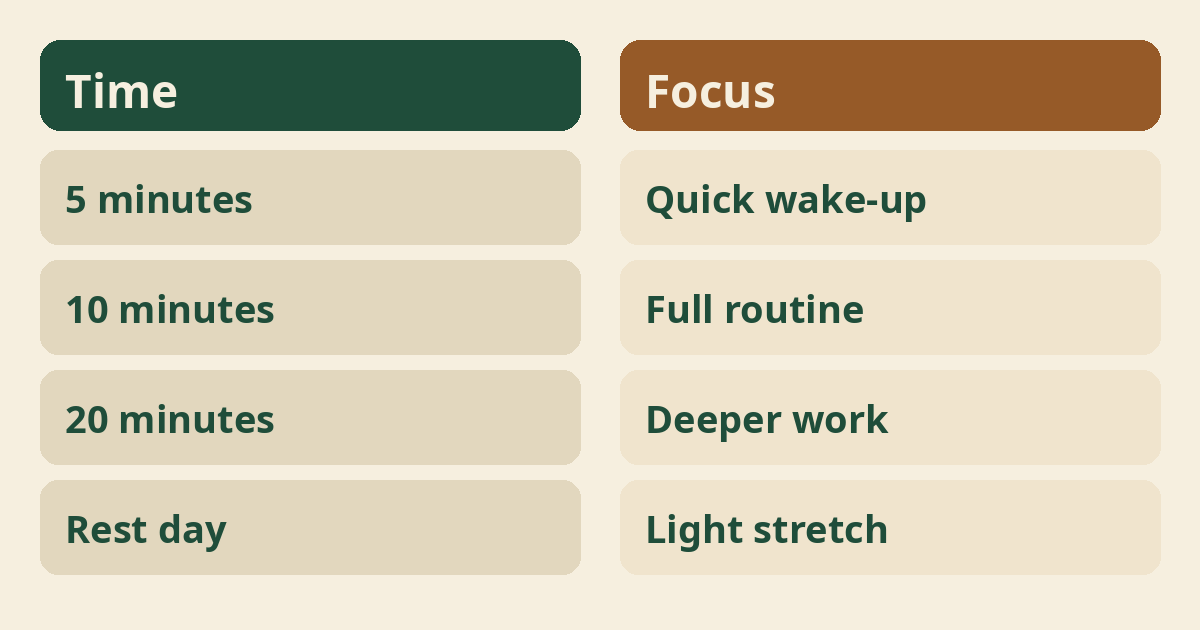
A balanced session warms up, moves, and then settles down. Try this order: one minute of easy joint movements, two minutes of cat and cow, one minute in child’s pose, three minutes of standing poses, two minutes of seated poses, and one minute of quiet breathing. Adjust the timing to what you have. Even a shorter version counts as a real practice.
Start standing with mountain pose
Mountain pose is the simplest way to begin any morning practice. You stand tall with your feet grounded and your arms relaxed. It looks like doing nothing, but it teaches posture and steady breathing. Many beginners rush past it, which is a shame. The guide on mountain pose for beginners shows exactly how to set it up and what to feel for.
Wake up the spine with cat and cow
Cat and cow are two linked movements that loosen a stiff morning spine. You round your back and then arch it, matched with your breath. Done on hands and knees, they suit most beginners well. Move slowly, especially on cold mornings. The full walkthrough in cat cow pose for beginners covers hand placement and breathing rhythm.
Rest between poses in child’s pose
Child’s pose is a resting pose you can return to at any point. Kneel, fold forward, and let your forehead rest toward the floor. It gives your back and hips a mild stretch while you breathe. If a session ever feels like too much, come here and slow down. You can learn the setup and common adjustments in child’s pose for beginners.
Open tight morning hips
Hips often feel stiff after hours of lying still, and easy hip openers can help. Seated and low lunging poses are a good place to start. Never force the stretch, since hips open over weeks, not days. A cushion under the knees can make these poses far more comfortable. The routines in yoga for hips for beginners are built for exactly this kind of morning stiffness.
Ease the neck and shoulders
Sleep positions can leave the neck and shoulders tight, and slow stretches may ease that. Drop your ear toward one shoulder, roll your shoulders back, and take your time. Skip fast or jerky neck circles. Many people carry desk tension here too, which mornings can catch early. The moves in yoga for neck and shoulders fit neatly into the start of any session.
How should you breathe in morning yoga?
Breathe through your nose, slowly and evenly, for most of the practice. Let your belly soften and expand as you inhale, then settle as you exhale. If you lose the rhythm, pause and start again. Slow breathing is also what helps many people feel calmer before a busy day. New to this? Belly breathing for beginners is the best place to learn the basic pattern.
How long should a morning session be?
Ten to fifteen minutes works well for most beginners. Five minutes still counts on rushed days. Longer sessions of twenty to thirty minutes are fine once the habit is set. Chasing length before consistency is a common trap. Pick a duration you can repeat every day without dreading it.
How often should you practice?
Short daily practice tends to build the habit fastest. Three to five mornings a week is a solid target if daily feels like too much. Rest days are fine and your body will tell you when it needs one. What matters most is the pattern over months, not any single week. There is a fuller breakdown in how often you should do yoga if you want help setting a rhythm.
Should you eat before morning yoga?
Most people feel best doing light practice before breakfast. A full stomach makes twisting and folding uncomfortable. If you feel weak or dizzy, have something small first, like half a banana or a few sips of a smoothie. Drink water either way. After a big meal, wait at least an hour or two before a fuller practice.
What if you are not a morning person?
You do not have to love mornings to practice in them. Keep the session short enough that it never feels like a punishment. Some people start by practicing just two mornings a week. If mornings truly never work, a lunchtime or evening habit still gives you the same kind of benefits. The habit matters more than the hour on the clock.
Can you do morning yoga in bed?
A few easy movements can start in bed before you get up. Knee hugs, slow twists, and ankle circles all work under the covers. Anything standing or balancing needs a floor, though, since a mattress is too soft to be stable. Think of bed movements as a warm-up, not the whole practice. Then move to the mat for the rest.
What props help a morning practice?
A mat, a couple of blocks, a strap, and a blanket cover almost everything a beginner needs. Blocks bring the floor closer when hamstrings are tight. A strap helps you hold a stretch without straining. A folded blanket cushions knees and lifts hips in seated poses. Household items work as stand-ins, and yoga props for beginners shows what to grab and how to use it.
What should you wear?
Wear anything stretchy and comfortable that lets you move freely. Pajama pants and a t-shirt are honestly fine for a home practice. Avoid anything so loose it slides over your face in forward folds. Bare feet give the best grip on a mat. There is no dress code when the only audience is your own living room.
Will morning yoga help with stiffness?
Many people find that regular morning movement helps them feel less stiff over time. Results vary from person to person, and change tends to come slowly. Short daily practice usually beats occasional long sessions for this. Warm movements first, deeper stretches later. If stiffness is your main goal, the routines in yoga for flexibility for beginners give a safe path to build on.
Can morning yoga improve balance?
Simple standing poses give your balance a daily check-in. Mornings are a good time for this because the mind is fresh and less distracted. Stand near a wall or chair when you start, since balance varies day to day. Wobbling is part of learning, not a failure. When you want more structure, yoga for balance for beginners walks through beginner-friendly progressions.
Does morning yoga help with stress?
Many people say a short morning practice helps them feel calmer going into the day. Slow breathing and unhurried movement give the nervous system a quiet start. It is not a fix for serious stress or anxiety, and those deserve proper care. But as a daily habit, it can be one useful tool among several. There is more on this in yoga for stress relief for beginners.
Can you continue the practice at work?
A short morning session pairs well with small movement breaks during the day. If your morning practice loosened your shoulders, a few desk stretches can keep them that way. You do not need a mat or a change of clothes for these. Two minutes between meetings is enough. The ideas in yoga at your desk for beginners are made for exactly that.
What benefits do people notice?
People commonly report feeling looser, calmer, and more awake after a few weeks of regular morning practice. Some notice better posture and easier movement through the day. Others mainly value the quiet time before everything starts. These are personal reports, not guaranteed results, and they vary widely. For an overview of what research does and does not show about yoga, the National Center for Complementary and Integrative Health is a solid plain-language source.
Is morning yoga a treatment?
No, morning yoga is not a medical treatment, and it does not cure, treat, heal, or prevent any condition. It is a form of light exercise and relaxation that many people enjoy. It can sit alongside proper medical care, never replace it. If something hurts or a condition is getting worse, that is a doctor conversation. Keep yoga in the wellness lane where it belongs.
Who should check with a doctor first?
Anyone with a health condition, a recent injury, or chronic pain should talk with a doctor before starting. The same goes if you have had surgery, joint replacements, heart conditions, or balance problems. Pregnancy changes what is safe, too. A doctor can tell you what to avoid and a good teacher can adapt the rest. This step is quick and it makes the whole practice safer.
Can you do morning yoga with a bad back?
Many people with cranky backs practice carefully, but a doctor should clear it first. Morning backs are often the stiffest of the day, so extra warm-up time matters. Skip deep forward folds until you know how your back responds. Mild movement helps some people feel better, but pain is a stop signal, not a challenge. The guidance in yoga with a bad back explains which shapes to approach with care.
What about morning yoga during pregnancy?
Pregnancy changes balance, joints, and energy, so regular routines need adjusting. Lying flat on the back and deep twists are usually off the table at certain stages. A doctor or midwife should approve any practice first. Prenatal classes are built around these changes from the ground up. The comparison in prenatal yoga versus regular yoga explains the main differences clearly.
What mistakes do beginners make in the morning?
The biggest mistake is treating a cold morning body like a warm evening one. Skipping the warm-up, forcing deep stretches, and rushing the breath all follow from that. Another common one is aiming for an hour-long practice and quitting by day four. Comparing yourself to flexible people online also kills motivation fast. Keep it short, warm up, and only compare yourself to last month.
How does a morning practice progress?
Progress usually shows up as ease, not fancy poses. After a few weeks, the warm-up feels less creaky and the routine feels natural. You can then hold poses a breath or two longer or add one new pose at a time. Some people extend the session; others keep it short and steady forever. Both are real progress, and there is no finish line to chase.
Do you need a teacher for morning yoga?
You can start a simple home practice on your own, but a teacher helps a lot early on. Even a few classes, in person or online, can correct habits you cannot see in yourself. A teacher also helps you adapt poses around injuries or conditions. After that, many people keep a home morning routine and check in with a class occasionally. Think of teaching as a boost, not a requirement.
What mindset helps a morning practice stick?
Treat each morning as a fresh start with nothing to prove. Some days the body cooperates and some days it does not, and both are normal. Missing a day does not break anything; just begin again tomorrow. A practice you enjoy at six minutes beats a perfect plan you abandon. Kind and consistent wins over intense and short-lived every time.
Is morning yoga safe for older adults?
Many older adults practice morning yoga safely with a few sensible adjustments. Slower warm-ups matter more as bodies get stiffer with age. A chair nearby gives support for standing and balance poses. Getting up and down from the floor can be the hardest part, and chair-based versions solve that. A doctor’s go-ahead is wise before starting, especially with joint or heart concerns.
Can you practice in a small space?
Yes, a morning practice needs very little room. A strip of floor the length of your body is enough for most beginner poses. Standing poses stay in one spot, and floor poses stay on the mat. Clear away anything you might knock over with an outstretched arm. Small homes and shared rooms are no barrier at all.
Where to read next
For a calm, beginner-friendly start, Ranjana Sinha’s Begin Where You Are is written for people who want simple steps. Our guide to starting a home yoga practice adds a gentle routine you can follow at home.
Frequently asked questions
Can I do morning yoga right after waking up?
Yes, just give yourself a minute to fully wake, drink some water, and start with slow movements.
Is it better to practice before or after breakfast?
Most people feel more comfortable practicing before breakfast or after only a small snack.
What if I only have five minutes?
Five minutes of simple poses and calm breathing is a real session and absolutely worth doing.
Do I need a yoga mat at home?
A mat helps with grip, but a carpeted floor works fine for most beginner poses.
Will a morning practice make me flexible quickly?
Flexibility usually builds over weeks and months of regular practice, not within a few sessions.
The bottom line
Start small tomorrow morning, keep it easy, and let the habit grow on its own.

