
A yoga journal is a notebook where you write short notes about your practice and how you feel before and after it. You do not need nice handwriting or special skills, and a few lines after each session are enough. Over time, your notes can show patterns, keep you steady, and make your practice feel more like your own. This guide shows you simple, gentle steps to begin, with no pressure at all.
This article is general education about yoga and writing, and it is not medical advice. If you have a health condition, an injury, or you are pregnant, please check with your doctor before you start or change your practice.
What is a yoga journal?
A yoga journal is a notebook for recording your yoga practice and your thoughts about it. It can hold poses you tried, how long you practiced, and how you felt. Some people add drawings or short quotes. There is no wrong way to keep one.
Why do people keep a yoga journal?
Most people keep one to notice progress and stay consistent. Writing slows you down and makes you pay attention. Many people find they remember what worked in class and what to ask their teacher. Results vary from person to person.
What do you need to start?
You need a notebook and a pen, nothing more. Pick a notebook you like to open. A small one is easier to keep near your mat. If you prefer your phone, a notes app works too.
Paper or app: which is better?
Choose whichever one you will actually use. Paper feels calm and has no notifications. An app is easy to search later. Try one for two weeks, then switch if it does not suit you.
How do you start your first entry?
Start with the date and one sentence about how you feel right now. That is the whole first entry. Add what you plan to practice if you like. Keep it small so that starting never feels heavy.
Step 1: Write the date and time
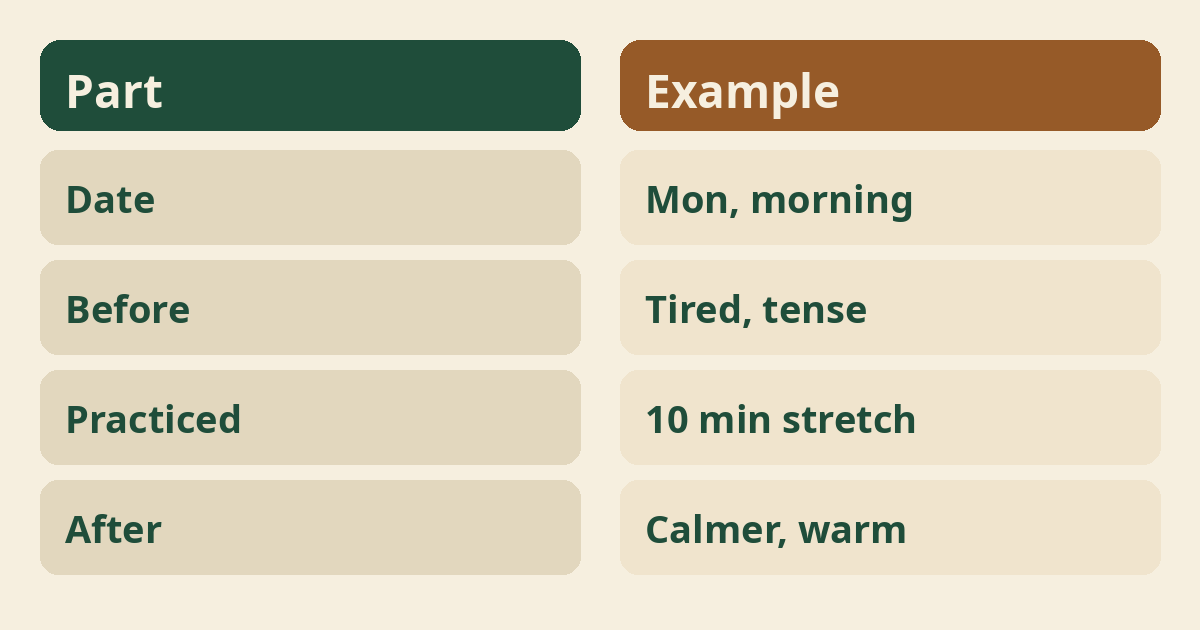
Begin each entry with the date and the time of day. This helps you see when you practice most easily. You may notice that mornings feel different from evenings. It takes five seconds.
Step 2: Note how you feel before
Write two or three words about your body and mind before you begin. For example, “tight shoulders, tired, a bit restless.” Be honest and plain. You are not judging, only noticing.
Step 3: List what you practiced
Write down the poses or the class you did. A short list is fine, such as “mountain pose, cat-cow, child’s pose.” You can read about cat-cow pose and child’s pose if you want to learn more about them.
Step 4: Record how long you practiced
Note how many minutes you spent on your mat. Ten minutes counts. Seeing small numbers add up can be encouraging, especially on days when you feel you did very little.
Step 5: Note how you feel after
Write a few words about how you feel when you finish. Compare them to your first notes. Some people feel calmer, some feel warm, and some feel the same. All of these are fine to write down.
Step 6: Add one thing to try next time
End with one small idea for your next session. It might be “hold the pose a little longer” or “use a block.” This gives you a gentle plan and makes the next session easy to begin.
What should you write about breathing?
Write whether your breath felt easy, short, or held. Breath is a useful thing to notice in yoga. If you want a simple place to begin, try belly breathing and note how it felt afterward. Never force the breath.
How long should you write?
Two to five minutes is plenty. A short habit lasts longer than a long one. If you have more to say, enjoy it. If not, three lines are still a real entry.
How often should you write in it?
Write after each yoga session, even if it is short. If you practice a few times a week, you will write a few times a week. To plan your practice itself, see how often should you do yoga.
Should you write before or after practice?
Both can help, but after practice is the easiest habit to keep. A quick note before gives you a starting point. A note after captures what you felt. If you only have time for one, choose after.
What are common mistakes?
The most common mistake is writing too much and then quitting. Others include judging yourself harshly, comparing with others, and skipping days and feeling guilty. Keep your entries kind and short. A missed day is just a blank page.
Is it okay to skip days?
Yes, skipping days is normal and does not ruin anything. Life gets busy. Pick the notebook up again when you can. You can even write a line about why you missed, which can be useful to read later.
What props or extras help?
A pen you like and a place to keep the notebook near your mat are enough. If you use blocks, straps, or blankets in practice, you can note which ones helped. See yoga props for beginners for ideas.
What prompts can you use?
A prompt is a short question that helps you start writing. Try “What felt easy today?”, “Where did I feel tight?”, or “What am I grateful for?” Pick one prompt and answer it in a line or two.
How do you track your body?
Note where you feel stretch, tension, or ease in simple words. Write “left hip tight” or “shoulders loose.” If something hurts, write it down and speak with your doctor or a qualified teacher. Do not push through pain.
Can you track flexibility in a journal?
Yes, you can note how far you reach, but keep it gentle. Some people write how a pose felt rather than how deep it was. For a flexible practice, see yoga for flexibility. Progress is rarely a straight line.
Can you track balance and focus?
Yes, you can note how steady you felt in standing poses. Write whether you wobbled, and whether your mind wandered. This is helpful with poses like mountain pose and others in yoga for balance.
Can you use it to track your mood?
Yes, many people note their mood before and after practice. A single word is enough, such as “tense,” “calm,” or “scattered.” Over weeks you may see a pattern. This is only a personal record, not a measurement of health.
What are the possible benefits?
Many people find a yoga journal helps them feel more aware and more consistent. Some say it makes practice feel more personal, and others say it helps them remember teacher tips. Results vary, and a journal is not a replacement for care from a professional. For general information about yoga, see National Center for Complementary and Integrative Health.
Is a yoga journal a treatment?
No, a yoga journal is not a treatment for any condition. It is a notebook for your own observations. It does not diagnose or replace medical care. If you have symptoms or concerns, please speak with your doctor.
Who should be careful?
Anyone with an injury, a health condition, or a pregnancy should check with a doctor first. This is about the yoga itself, not the writing. A doctor can tell you what is suitable for you. For pregnancy, see prenatal yoga vs regular yoga.
What if you have a bad back?
Speak with your doctor before practicing, then use your journal to note what feels comfortable. Gentle practice may suit some people and not others. Read can you do yoga with a bad back for general information, and always follow your doctor’s advice.
How do you work with a teacher?
Bring your notes to class and ask questions from them. A teacher can answer “why did this feel tight?” better when you have written details. Also write down cues you liked, such as “lengthen the spine.”
How does it help with stress?
Writing a few lines can give your mind a calm place to land. Many people find that a quiet minute with a pen helps them slow down after practice. Results vary. For gentle ideas, see yoga for stress relief.
How do you keep a journal at a desk?
Keep it in a drawer and write a line after a short stretch break. Desk breaks work well with short notes such as “neck tight, felt better after stretch.” See yoga at your desk for easy ideas.
How do you see progress?
Read back through your entries once a month. Look for small changes, such as longer sessions, easier breathing, or a steadier mood. Progress may be quiet. Notice it kindly and do not rush it.
How do you move forward as you grow?
As you gain confidence, add new poses and note how they feel. Try one new pose a week and write about it. You might explore butterfly pose or yoga for hips. Go slowly and stay within your comfort.
What mindset helps most?
A kind, curious mindset works better than a strict one. Think of your journal as a friend, not a report card. There are no grades. Write what is true today, and let it be enough.
Can you add drawings or quotes?
Yes, add anything that makes the notebook yours. Sketch a pose, paste a leaf, or copy a line you like. A journal that looks and feels like you is more likely to be opened again.
How do you build the habit?
Pair writing with something you already do, such as tea after practice. Keep the notebook and pen together. Start with one week. Small habits grow best when they feel easy and pleasant.
What if you do not know what to write?
Write one true sentence, even if it is “I do not know what to write.” That counts. Blank moments pass. Prompts, a list of poses, or one word about your mood can get you moving again.
Where to read next
For a calm, beginner-friendly start, Ranjana Sinha’s Begin Where You Are is written for people who want simple steps. Our guide to starting a home yoga practice adds a gentle routine you can follow at home.
Frequently asked questions
Do I need to be good at yoga to keep a journal?
No, a journal is for beginners and experienced people alike.
How long should an entry be?
A few lines are plenty, and two to five minutes is a good guide.
Should I write by hand or on a phone?
Use whichever you will keep doing, since both work.
Can I share my journal with my teacher?
Yes, if you wish, though you can also keep it private.
What if I notice pain while writing about practice?
Stop that movement and speak with your doctor or a qualified teacher before continuing.
The bottom line
Pick up a notebook today, write one honest line about how you feel, and let your practice grow from there.

