
Twelve hours on your feet, shoulders tight from leaning over beds, mind still running through patient lists at midnight. This is the reality of long hospital shifts, and it wears the body down. Yoga for doctors is a simple way to release that tension in a few quiet minutes, at home or even in an on-call room. This guide shows you how to begin, with short sessions that fit around real rotas.
This article is for general education only and is not medical advice. If you have an injury, a health condition or pain that persists, please speak with a qualified clinician before starting.
What yoga for doctors is
It is short, calm yoga shaped around a doctor’s working week. Sessions run five to twenty minutes and focus on the areas hospital work strains most: the lower back, neck, shoulders and hips. You need no equipment beyond a mat or a towel on the floor.
Why doctors try it
Most doctors start because their body feels older than it is. Long ward rounds stiffen the hips, and hours at a screen tighten the neck. Many also want a quiet ritual that helps them switch off after intense days.
Who this guide is for
This guide suits any doctor who has never done yoga or has done very little. It assumes no flexibility, no balance and no free evenings. Everything here works in scrubs-adjacent clothing and small spaces.
How to start
Start smaller than feels sensible, and you are more likely to keep going. Pick one quiet corner at home and one time of day you can protect most days. Ten minutes after you get home, or ten before bed, is enough.
Step one, claim a small space
Your first step is simply clearing a mat-sized patch of floor. It can sit beside your bed or behind a sofa. A ready space removes the biggest barrier on tired evenings: the effort of setting up.
Step two, pick a fixed time
Anchor your practice to something that already happens every day. After your post-shift shower or just before sleep both work well. A fixed anchor means you never have to decide, only to begin.
Step three, warm up slowly
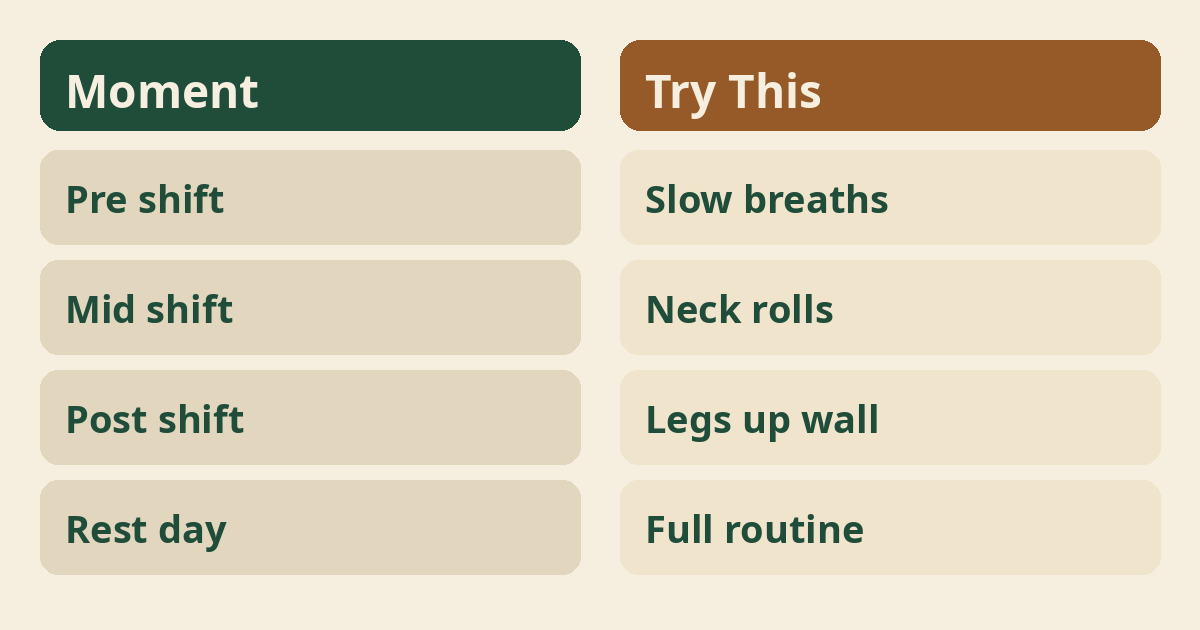
Begin every session with one or two minutes of easy movement. Roll your shoulders, turn your head side to side, and sway gently from your hips. Cold muscles and stiff joints respond better when you ease in.
Step four, learn a few poses
Choose three or four beginner poses and repeat them until they feel familiar. Standing, seated and resting poses are enough for months of practice. Mountain pose is a good first stand, teaching you to feel your feet and stack your spine after hours of stooping.
Step five, end with rest
Always finish lying down for at least two quiet minutes. This rest lets your breathing slow and tells your nervous system the day is done. Many doctors find this final pause is the part that helps sleep most.
Breathing basics
Slow breathing through the nose is the heart of every session. Try making your out-breath a little longer than your in-breath. This simple shift calms a racing mind faster than any stretch, which is why belly breathing pairs so well with shift work.
How long to practice
Ten minutes is a full session for a busy doctor. Short daily practice beats a rare long class for building a habit. On quieter days you can stretch it to twenty minutes, but never let a long target stop a short practice.
How often to practice
Aim for most days, and count five minutes as a win. Consistency matters more than length, especially across on-call weeks. If you miss days during a heavy rota, simply restart without making up lost time.
Before or after a shift
Both work, and each helps in a different way. Morning practice loosens a stiff body before rounds. Evening practice helps you decompress and sleep, which many doctors value more.
Poses for tired legs
Legs-up-the-wall is the classic answer for legs that have stood all day. Lie on your back and rest your calves on a chair or your heels against a wall. Two to five minutes here eases heavy, aching legs after a long ward day.
Poses for a tired back
Slow spinal movements relieve the stiffness that builds during rounds. Moving between cat and cow on hands and knees warms the whole spine in under a minute. Follow with a low twist while lying down to release the lower back.
Poses for neck and shoulders
Charting and screens leave most doctors with a tight neck. Slow ear-to-shoulder tilts and shoulder rolls bring quick relief. A dedicated set of neck and shoulder stretches takes five minutes and fits between patients if you have a private corner.
Yoga at your desk
You can practise useful yoga without leaving your chair. Seated twists, chin tucks and wrist stretches all work at a workstation. A short desk yoga routine is a practical tool for clinic days when home practice will not happen.
A simple ten minute routine
A balanced short session moves the spine in every direction. Try two minutes of breathing, three of cat and cow, two of a standing forward fold, two of legs-up-the-wall and one of quiet rest. That is a complete practice.
Props that help
Props make poses easier, not less effective. A cushion under the hips, a folded blanket under the head and a belt used as a strap all reduce strain. The guide to yoga props for beginners shows how household items do the same job as shop-bought kit.
Common mistakes
The biggest mistake is treating yoga like another performance to ace. Doctors are used to pushing, so they push into stretches and skip the rest. Ease off, move slowly, and let the practice feel almost too easy at first.
Practising when exhausted
On your most tired days, choose restful poses only. Legs-up-the-wall, a supported forward fold and child’s pose ask almost nothing of you. Five gentle minutes on a hard day keeps the habit alive for the good days.
The right mindset
Think of yoga as maintenance for your working body, not a workout. You are not chasing flexibility milestones or perfect poses. You are giving a tired back and a busy mind ten minutes of care, and that is the whole goal.
Who should be careful
Anyone with an injury, recent surgery or ongoing pain should check with a clinician first. Pregnancy, joint replacements, uncontrolled blood pressure and heart conditions also change what is safe. A short conversation first is always worth it.
Is yoga a treatment
No, yoga is not a treatment for any medical condition. It is a general wellbeing practice that may ease everyday tension and stress. It never replaces assessment, diagnosis or care from a qualified professional.
Possible benefits
Many people find regular yoga leaves them looser, calmer and sleeping better, though results vary from person to person. Some report less back and neck discomfort and a clearer head after stressful shifts. Research bodies such as National Center for Complementary and Integrative Health describe yoga as generally safe for healthy adults when practised sensibly.
Stress and sleep
A slow evening practice tells the body the shift is over. Lengthened exhales and restful poses are the most useful tools here. Many doctors build a short stress relief routine into their wind-down and find nights come easier.
Breathing between patients
One minute of slow breathing can reset you mid-shift. Step into a quiet room, drop your shoulders and take six unhurried breaths. It costs nothing, needs no mat, and many find it steadies them before a difficult conversation.
How to progress
Progress means feeling better, not achieving harder poses. After a month of short sessions, you might add one new pose or a few more minutes. Increase slowly, and keep the practice comfortable enough that you actually want to do it.
Working with a teacher
A beginner class or a few private sessions can speed things up. A good teacher spots habits you cannot feel yourself, like clenching the jaw or hiking the shoulders. Tell them about your shifts and any old injuries so they can adapt poses for you.
Flexibility over time
Flexibility grows quietly as a side effect of regular practice. You do not need to touch your toes for yoga to work. A steady flexibility practice simply makes everyday movements, like bending to a low bed, feel less effortful.
Staying consistent
Habit beats motivation for shift workers, because motivation dies at 2 a.m. Keep your mat visible, your time anchored and your bar low. Guidance on how often to practise can help you set a rhythm that survives night float weeks.
If your back already hurts
Existing back pain calls for extra care, not total avoidance. Favour slow movements and restful poses, and skip deep forward folds at first. Reading about yoga with a bad back helps you choose wisely, and a clinician’s input comes first.
Making it stick long term
The doctors who keep yoga are the ones who keep it small. Ten minutes most days, adjusted around rotas, adds up to hours of care each month. Protect that small slot the way you protect sleep, and it will carry you through long careers and longer shifts.
Where to read next
For a calm, beginner-friendly start, Ranjana Sinha’s Begin Where You Are is written for people who want simple steps. Our guide to starting a home yoga practice adds a gentle routine you can follow at home.
Frequently asked questions
Do I need to be flexible to start yoga as a doctor?
No, yoga builds flexibility gradually and every pose can be adapted to a stiff body.
What if I only have five minutes after a shift?
Five minutes of slow breathing and one restful pose like legs-up-the-wall is a complete mini session.
Will yoga fix the back pain I get from ward rounds?
Yoga is not a treatment, but many people find gentle movement eases everyday stiffness; see a clinician for persistent pain.
Is morning or evening practice better around shifts?
Either works, so choose the time you can protect most days, often a short evening wind-down.
Do I need special gear or studio classes?
No, a mat or towel and a small clear floor space at home are enough to begin.
The bottom line
Start tonight with ten quiet minutes, and let your body feel the difference a small daily pause can make.

