You want to try meditation, but the descriptions seem to pull in opposite directions. One course says to notice the present moment. Another describes letting the mind settle inward without concentration. Are these different instructions, different goals or simply different words?
Transcendental Meditation, often shortened to TM, is a specific named teaching program. Mindfulness is a wider term for present-moment awareness and practices that develop it. They are therefore not two brands offering an identical product. Understanding that difference makes the practical comparison much clearer.
This guide explains the labels, not the TM technique itself. It does not provide a TM mantra, replace personal instruction or recommend either approach as treatment for a health condition.
The short answer
The TM organization describes its method as a way for the mind to settle inward without deliberate concentration or control. Its official questions and answers explain that a certified TM teacher personally selects a sound, or mantra, as part of teaching the technique.
Mindfulness, as the NHS describes it, involves paying attention to what is happening inside and outside ourselves, moment by moment. Mindfulness meditation sets aside time for that awareness, while everyday mindfulness can take place during ordinary activities.
A useful distinction is therefore a specific teacher-taught method versus a broader quality of attention and family of practices. It is not a division between people who can think and people who have learned to switch thinking off.
At a glance
| Question | TM | Mindfulness |
|---|---|---|
| Scope | A specific named method | A wider quality and practice term |
| Emphasis | Settling inward, as its teachers describe it | Present-moment awareness without judgment |
| Sound | A teacher-selected mantra | No universal mantra requirement |
| Learning | Personal instruction through certified TM teachers | Many teachers, programs and resources |
| Format | A defined course and regular practice | Everyday awareness or formal meditation |
What TM means in this comparison
Here, TM means the Transcendental Meditation program associated with Maharishi Mahesh Yogi, not every practice that uses a repeated sound. Its organization presents a particular method, an instruction route and follow-up teacher support.
The official FAQ describes initial personal instruction followed by guided sessions. It also describes a regular twice-daily practice. These details distinguish the program from casually choosing a word and repeating it whenever you feel like it.
A public overview can help you decide what to ask about, but it should not pretend to teach a method that its organization teaches personally. If you are considering TM, ask a certified teacher what the full course includes, how practice is checked and what support is available afterward.
What mindfulness means
Mindfulness does not identify one organization or a single fixed course. NCCIH describes it as maintaining attention or awareness on the present moment without making judgments. Programs can combine mindfulness practice with discussion, other activities or clinical approaches.
The NHS describes noticing sensations, thoughts and feelings, including during daily life. That is broader than sitting with closed eyes. Formal mindfulness meditation is one setting for developing awareness, not the only possible setting.
For the distinction between the wider words, see our mindfulness versus meditation guide. In this comparison, it is especially important to ask which actual mindfulness course is being compared with the defined TM program.
A mantra is not automatically TM
The TM FAQ describes its mantra as a personally selected sound, not an affirmation based on a statement’s meaning. It also emphasizes that the sound is used within its particular method rather than as an object of forced concentration.
Many traditions and secular exercises use repeated words or sounds. The existence of repetition alone does not make all of them Transcendental Meditation. A phrase chosen from an app, a chant learned in a devotional setting and a sound taught within TM should not be presented as interchangeable.
Our mantra basics guide discusses ordinary and traditional repetition more broadly. That guide is not a substitute for TM instruction, and this article does not assign a mantra or reproduce a private teaching sequence.
Does mindfulness require effort while TM does not?
The TM organization uses the word effortless to describe its method and contrasts it with deliberate concentration. This is useful for understanding how its teachers describe their approach. It is not proof that every person will find TM easier than every mindfulness practice.
Mindfulness is also not intended to mean straining, fighting thoughts or holding attention perfectly still. The NHS explains that the aim is not to make thoughts disappear, but to recognize them as mental events that come and go. A teacher may discuss returning attention without treating wandering as failure.
Descriptions such as effort, allowing and attention can mean different things in different teaching settings. Ask what the teacher expects you to do when thoughts arise. A clear explanation is more useful than ranking methods by a single appealing word.
Compare the actual commitment
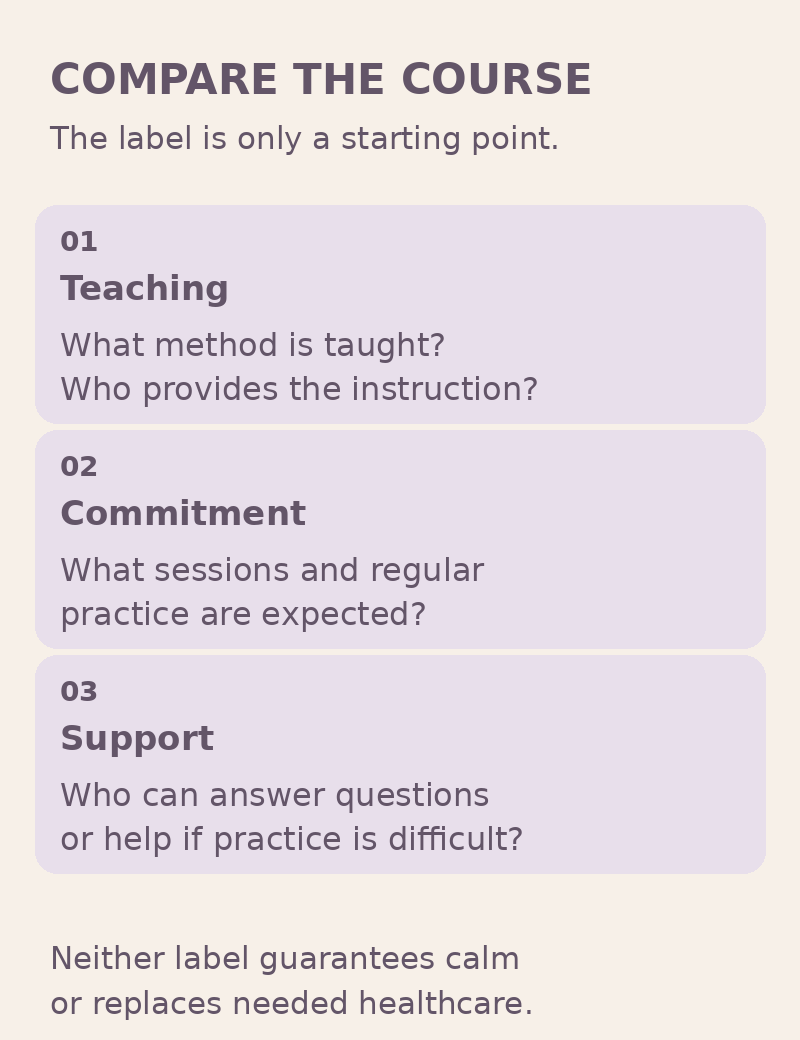
A brief mindfulness introduction and a structured TM course are different commitments. So are an informal mindful activity and a clinical mindfulness-based program. The name alone does not explain how much attendance, home practice or teacher contact is expected.
Before joining, ask about the session structure, practice expectations, total charges if applicable and what follow-up includes. Check the provider’s current terms rather than assuming that every form of meditation is either free or expensive.
Consider what you want to learn. If you want TM specifically, look for the program’s certified instruction route. If you want an introduction to awareness in everyday life, look for a resource that clearly teaches that. Neither decision requires calling the other approach inferior.
What does the research establish?
NCCIH notes that meditation research includes many different practices, with studies that vary in quality. Results can be difficult to interpret and may be described too optimistically. General enthusiasm about meditation is not evidence that one named method works best for everyone.
A systematic review in the International Journal of Environmental Research and Public Health examined mantra-based meditation, including TM and other approaches. It found promising effects on some mental health measures, but stressed study bias, limited clinical samples and a shortage of long-term follow-up.
Importantly, a review of a wider mantra-based category is not the same as a direct comparison of one TM course with one mindfulness course. You cannot use its findings to declare a universal winner or assume that every repeated-sound exercise has the same effects.
The TM organization’s descriptions of special states and benefits explain its own position. They should be read separately from independent evidence about clinical outcomes. A large study count, testimonial or account of brain activity cannot by itself tell an individual what they will experience.
Safety and health questions
NCCIH says relatively few studies have examined potentially harmful effects of meditation, so definite safety claims are not possible. The NHS also notes that mindfulness is not suitable for everyone and can make some people feel worse. Quiet practice is not automatically risk-free.
The mantra-based meditation review found that only a small number of included studies explicitly reported safety information. That gap matters: limited reporting cannot establish that adverse effects never happen.
If you have a medical or mental health condition, trauma history or previous distress during meditation, speak with a qualified healthcare professional before starting. Discuss relevant concerns with the teacher too, while keeping the teacher’s role separate from medical care.
Stop a practice that causes distress and seek appropriate support rather than forcing yourself to reach a promised state. Do not use either approach to delay assessment, replace needed care or change prescribed medicine without your prescriber’s guidance.
Common questions
Can I learn TM from a comparison article?
No. This is an explanation of differences. The TM organization teaches its method through certified teachers, including personal instruction and follow-up.
Is every mindfulness course secular?
No. Mindfulness has Buddhist roots and also appears in secular programs. Ask about the actual course’s context rather than assuming every provider teaches the same framework.
Must either approach make my mind blank?
Do not use a blank mind as a test of success. Mindfulness includes noticing thoughts, while TM teachers describe their method in terms of settling rather than deliberately controlling thinking.
The useful choice
TM is a specific method with a defined instruction route. Mindfulness is a broader term spanning awareness, formal practice and different programs. Compare the teaching, commitment, evidence and support of the options you are actually considering. No label guarantees calm or makes health advice unnecessary.