You see one course described as mindfulness and another as Vipassana. Both mention observing thoughts, sensations and the present moment. Does that mean they teach the same thing, or is one a more advanced version of the other?
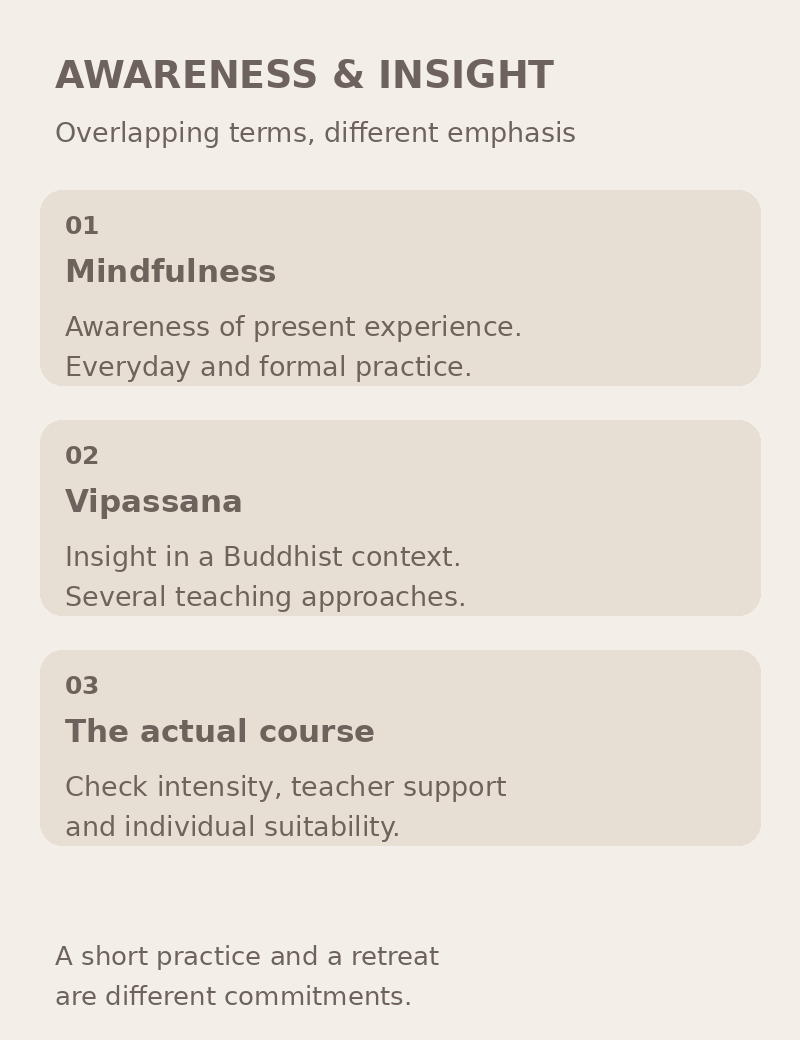
The clearest starting point is that these are overlapping terms, not two sealed boxes. Mindfulness can refer to a quality of awareness, a practice or a structured program. Vipassana is commonly translated as insight and is also used for particular approaches to Buddhist insight meditation. The actual meaning depends on the teacher and context.
The main difference
Mindfulness concerns how experience is attended to. The NHS describes it as paying attention to what is happening inside and outside ourselves, moment by moment. It can be developed during everyday activities and through formal meditation.
Vipassana points toward insight or clear seeing. Tricycle’s explanation places it within Buddhist practice and describes mindfulness directed toward understanding experience. The Buddhist Centre likewise describes insight as connected with wisdom, while stressing that calm, mindfulness and insight are not sharply separated practices.
So mindfulness can be part of Vipassana, and Vipassana is not simply the opposite of mindfulness. A useful comparison asks what the words mean in a particular course and what the teaching is intended to develop.
At a glance
| Question | Mindfulness | Vipassana |
|---|---|---|
| Key idea | Present-moment awareness | Insight or clear seeing |
| Use | A quality, practice or program label | A Buddhist insight term and meditation label |
| Context | Everyday, Buddhist or secular settings | Different Buddhist traditions and teaching approaches |
| Overlap | Can support insight practice | Often develops mindfulness as part of training |
| Format | Brief practice or a structured course | Not limited to one retreat format |
Mindfulness is wider than a meditation session
The NHS gives examples of noticing everyday sensations and becoming aware of thoughts and feelings as they arise. This does not require leaving ordinary life for a retreat. A person can bring attention to an activity while remaining engaged with the situation around them.
Mindfulness also appears in formal meditation. A class may set aside time for attention to sounds, thoughts, breathing sensations or the body. The distinction is therefore not that mindfulness happens only in daily life and Vipassana happens only while sitting.
Our mindfulness and meditation comparison explores those broader labels. Here the more specific question is how mindfulness relates to the aim of insight and to different teaching traditions.
Vipassana is not one universal technique
Different Buddhist teachers explain the relationship between insight, calm and mindfulness in different ways. Tricycle discusses several traditions and teachers rather than identifying Vipassana with one standardized exercise. The Buddhist Centre also emphasizes overlap between approaches.
That is why a short definition should not turn into a claim that every Vipassana teacher uses the same object of attention, sequence or vocabulary. Nor should insight be reduced to analysing your personality or arriving at an interesting thought. It has a particular meaning within the Buddhist teaching being discussed.
Ask which tradition a teacher represents, how they describe insight and what support is available for someone new. Clear answers are more useful than assuming that the word Vipassana tells you everything about a session.
Why people often associate Vipassana with retreats
One prominent teaching approach is Vipassana as taught by S. N. Goenka in the tradition of Sayagyi U Ba Khin. Its official website describes an introduction through residential courses with a prescribed code of discipline and a structured progression of training.
That is a specific tradition’s teaching format, not a definition of every use of the word Vipassana. Tricycle’s broader overview describes retreats of different lengths and arrangements across traditions. It would be misleading to say that all insight meditation means enrolling in the same residential program.
It would be equally misleading to treat an intensive retreat as simply a longer version of a short mindfulness recording. The schedule, amount of practice, silence, rules, teacher access and personal demands need their own consideration. This article does not provide retreat preparation or an intensive practice sequence.
Buddhist roots and secular programs
Mindfulness has Buddhist roots, but NCCIH describes its use in different meditation practices and modern programs. A secular mindfulness course and a Buddhist insight course may share attention exercises without sharing every explanation, ethical framework or goal.
A course might discuss present-moment awareness mainly in relation to everyday wellbeing. Another may place it within Buddhist teachings about change, suffering and liberation. These are differences in context, not proof that one participant is doing a more genuine or valuable activity.
Read the description and ask whether religious teachings, chanting, ethical commitments or other elements are included. You do not have to guess from a photograph of someone sitting quietly. Nor do you need to erase a tradition’s roots to understand how a modern course has adapted its practices.
Does one give better results?
There is no sound basis here for declaring Vipassana better than mindfulness or mindfulness safer because it sounds simpler. The labels can overlap, and research studies examine particular practices, programs and groups of people.
NCCIH notes important limitations in meditation research, including differences in study quality and what is being practised. A finding about a defined mindfulness-based program does not establish that any retreat using the word Vipassana will have the same effect. A participant’s personal account also cannot settle which approach works best for everyone.
Traditional descriptions of insight and liberation express spiritual aims. They should not be converted into medical promises, deadlines for progress or claims that a difficult feeling proves you are advancing.
Safety matters for both
The NHS says mindfulness is not right for everyone and can make some people feel worse. NCCIH also discusses negative meditation experiences and the limits of safety research. A practice being quiet, ancient or widely taught does not make it automatically suitable for a particular person.
Dhamma.org’s own questions and answers make clear that its Vipassana course is not a treatment or therapy. It says teachers and volunteers are not medical or psychological caregivers and that significant mental health history can affect suitability. It also notes that previous symptoms may resurface even when someone’s condition has been stable.
If you have a mental health condition, trauma history or concerns about inward attention, speak with a qualified healthcare professional and disclose relevant information to the course provider before deciding. An intensive residential course requires a separate suitability check; enthusiasm is not a substitute for that conversation.
If a practice becomes distressing, stop and seek appropriate support rather than pushing through to complete a target. Keep prescribed treatment and needed care in place. Neither mindfulness nor Vipassana should delay assessment or be used to stop medication without the prescriber’s advice.
Questions to ask before choosing
Start with the setting: a brief introductory class, an ongoing course and a residential retreat are different commitments. Ask about experience requirements, practice time, available teacher contact and what happens if you need to stop.
Then ask about the teaching. What does mindfulness mean here? What does the teacher mean by insight? Is the course Buddhist, secular or presented in another way? You should be able to understand the broad aim without already knowing specialist terms.
Finally, ask about support and suitability. A clear provider should be able to explain the limits of what they offer and direct health questions to an appropriate professional. Avoid choosing on promises that everyone will feel calm or that every problem will be solved.
Common questions
Is Vipassana a kind of mindfulness?
Mindfulness is often part of insight meditation, but the terms are not exact synonyms. Vipassana points to insight in a Buddhist context and can also label particular teaching approaches.
Does mindfulness mean an empty mind?
No. The NHS explains mindfulness in terms of noticing thoughts rather than making them disappear. The presence of thinking does not by itself tell you whether you have failed.
Does all Vipassana require the same retreat?
No. Particular organizations have particular course formats. Learn which tradition and program you are considering rather than treating one provider’s structure as universal.
The useful distinction
Mindfulness describes awareness and practices that develop it. Vipassana emphasizes insight within Buddhist teaching and is used for several approaches to meditation. Their overlap is part of the answer. Choose by the actual teaching, commitment and support, not by a contest between labels.