One video shows someone holding a yoga posture. Another shows slow, repeated arm movements labelled qigong. Both mention breathing and attention. Are they different versions of the same activity, and does choosing one mean giving up what the other offers?
Yoga and qigong overlap as mind-body practices, but neither can be reduced to one video or one movement. Yoga is rooted in Indian philosophy. Qigong developed in China and includes both active movement and much quieter practices. The useful comparison begins with that range, not with a claim that one is always stronger, easier or healthier.
What is the main difference?
NCCIH describes yoga as a complex practice rooted in Indian philosophy, with many modern classes emphasizing postures, breathing and meditation. It describes qigong as a Chinese practice involving regulation of the mind, breath, movement and posture.
In many active qigong practices, smooth movements and focused attention are central. Some qigong practices involve almost no movement. Yoga also has physically active, supported and meditative forms. Comparing only vigorous yoga with a quiet qigong demonstration would hide that variety.
Both are sometimes called meditative movement. That phrase identifies shared features, not a shared origin or an identical philosophy. You can notice their overlap without calling qigong Chinese yoga or treating all yoga as a stretching routine.
The comparison at a glance
| Question | Yoga | Qigong |
|---|---|---|
| Roots | Indian philosophical traditions | Chinese traditions, including traditional Chinese medicine |
| Movement | May include held poses, transitions or supported rest | May include repeated movements or near-still practice |
| Attention | Can involve body awareness, breath and meditation | Can involve focused attention and visualization |
| Demands | Depend on style, level and adaptation | Depend on the form and how it is taught |
| Best fit | A suitable class, not the label alone | A suitable class, not the label alone |
Active and quiet qigong are different experiences
NCCIH distinguishes dynamic, or active, qigong from meditative, or passive, qigong. Dynamic methods focus on movement, especially of the whole body, arms or legs. Meditative methods emphasize breath and mind exercises with little movement, in a posture that can be maintained over time.
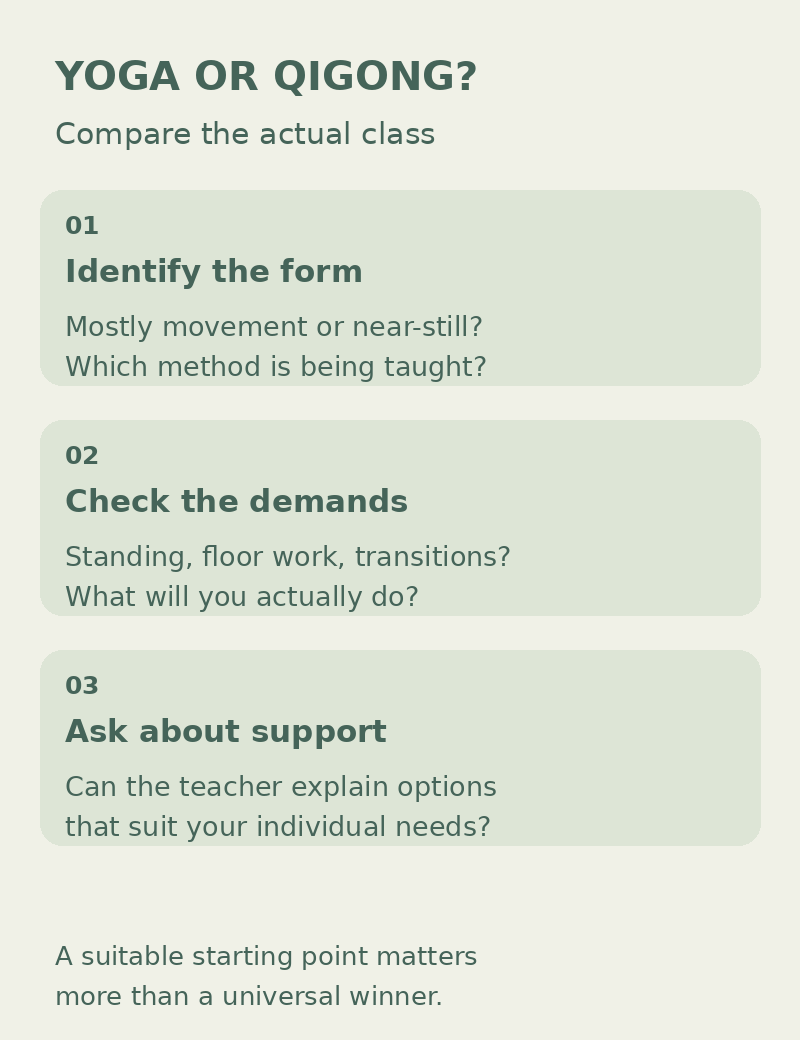
This distinction matters if someone recommends qigong without explaining the format. You might be imagining an outdoor movement class while the teacher is offering a mostly stationary practice. Ask what you will actually do, how instructions are introduced and which positions are used.
Do not assume that little visible movement means there is nothing to learn. Maintaining a position, following an unfamiliar cue or paying attention inwardly can still take effort. A suitable introduction gives you a way to ask questions rather than requiring you to copy a quiet-looking video without context.
Yoga has a wide physical range too
A yoga class may involve holding postures, moving between them, using supports, working from a chair or spending time in seated practice. NCCIH emphasizes that yoga styles range from gentle to physically demanding. The word yoga alone cannot tell you whether a class includes repeated floor transfers or weight through the hands.
Before choosing, identify the particular format. If you want detailed posture instruction, ask for that. If you want mostly supported rest or a seated practice, ask whether that is what the session actually offers. Beginner, slow and all levels are useful clues, but none answers every question about physical demands.
There is no need to choose the most visually impressive example of either tradition. The learning environment matters more than whether a demonstration looks complicated.
How are qigong and tai chi related?
They are related, but the words are not interchangeable. NCCIH explains that tai chi originated as a martial art and, when practised for health, is considered a form of qigong. Qigong is a broader category with many forms beyond tai chi.
That means a discussion of tai chi does not automatically describe the qigong session you are considering. A repeated exercise, a near-still meditative practice and a connected tai chi form may involve different learning tasks. Our yoga versus tai chi comparison focuses on that more specific question.
It also matters when reading research. A result from a particular tai chi program is not automatically evidence for every qigong technique. Look at what participants practised rather than borrowing a finding because the practices belong to a related family.
What about qi, prana and energy?
You may encounter qi in qigong teaching and prana in yoga teaching. The University of Minnesota’s mindful-movement overview describes these practices within their traditional mind-body frameworks. Such language can be important to how a tradition understands itself.
However, a traditional explanation and a biomedical finding answer different questions. Hearing that a movement supports energy does not by itself establish a measurable physiological effect, a diagnosis or a treatment benefit. Ask the teacher what an instruction means in practical terms rather than assuming the same word has an identical meaning across traditions.
You can learn the cultural vocabulary respectfully without turning it into a scientific guarantee. Nor do you have to force an unusual sensation to prove that a practice is working.
Does research show one is better?
Not as a general rule. A review comparing the yoga and qigong literature found that direct comparative information was scarce. It highlighted small samples, different styles, different amounts of practice and short interventions as reasons to be cautious. Those limits do not support declaring either practice the best for everyone.
NCCIH’s research discussion adds another important point: these practices combine several elements. Movement, breathing, attention, teacher contact, expectations and social support can all be involved. A study comparing a class with a waiting list does not necessarily show which element caused a change.
For qigong and pain specifically, NCCIH reports conflicting findings. Its yoga summary also explains that differences between styles make the health evidence difficult to evaluate. A useful comparison therefore asks about the outcome, population and program studied, rather than collecting benefit lists and counting which one is longer.
If you are choosing activity because of a health condition, ask a qualified healthcare professional what kind of supervised practice is appropriate. Do not stop treatment or postpone assessment because either practice is described as natural or traditional.
Safety: gentle does not mean suitable for everyone
NCCIH says qigong appears to be a safe form of activity, but some studies reported muscle pain, soreness or headache. It also notes the lack of safety research during pregnancy and advises pregnant people to speak with their healthcare providers before starting. A calm-looking movement is not enough evidence of suitability.
For yoga, NCCIH notes that injuries can occur and recommends qualified instruction. Beginners should avoid extreme practices such as headstands, shoulder stands, lotus position and forceful breathing. This article is an orientation, not a sequence or a breathing prescription.
Injury, pain, recent procedures, pregnancy, balance concerns or other health conditions are reasons to check with your doctor and teacher before starting. Do not force a breath pattern or push through pain or dizziness. Stop and ask for guidance when an exercise feels wrong.
Questions that make the choice easier
Ask whether the session is mainly moving or stationary, whether you will stand for long periods, and whether floor work is required. Explain what positions or transitions you find difficult. Ask about chair options or other support without assuming they are available.
Ask how the teacher introduces beginners and what training and relevant experience they have. NCCIH specifically recommends checking a qigong instructor’s training and experience. A reassuring title or a polished video is not a substitute for clear answers about the actual session.
Finally, consider the learning style you enjoy. Repeating a small movement, exploring individual postures and following a mostly stationary attention practice are different experiences. Preference is a reasonable part of the choice once suitability is addressed.
A practical conclusion
Choose between real classes rather than idealized labels. Yoga and qigong have different roots and varied methods, with useful overlap in movement, breathing and attention. A clear explanation of the form, appropriate physical demands and a teacher who can respond to your needs matter more than a claim that one tradition wins.