You find a yoga class that combines flowing movement with chanting, music and a discussion about compassion. The description says it is open to all levels, but another class at the same studio promises more detailed instruction. Which one is the better place to begin?
Jivamukti yoga is a particular method, not simply a name for an energetic workout. Its physical practice sits within an ethical and spiritual framework. Knowing both sides of that description, and reading the class format carefully, helps you decide whether the teaching matches what you want.
What is Jivamukti yoga?
The Jivamukti method describes its aim as enlightenment through compassion for all beings. In practical terms, the school connects yoga postures with how people relate to others, animals and the Earth. Its teaching brings together movement, devotional practices, meditation, listening and study.
The method was created by Sharon Gannon and David Life. Their backgrounds in art, music and performance are part of the school’s account of how the approach developed. Music and philosophical discussion are therefore not necessarily additions to an otherwise separate exercise class. They can be part of the method itself.
NACAMS, an organization providing professional liability insurance, also describes Jivamukti as combining vinyasa-based physical practice with ethical and spiritual teachings. That description is useful context, not clinical evidence about its benefits. A style overview cannot establish what any individual class will feel like.
The five tenets explained simply
Jivamukti names five central tenets. They describe the method’s framework rather than five poses to master. The school’s own explanation says they inform teaching even when a teacher does not announce each name aloud.
| Tenet | Main idea | In the method |
|---|---|---|
| Ahimsa | Non-harming and compassion | Concern for animals, people and the environment |
| Bhakti | Devotion | Chanting or setting an intention beyond self-interest |
| Dhyana | Meditation | Time for inward attention within a spiritual framework |
| Nada | Deep listening | Music, spoken words, the teacher’s voice or silence |
| Shastra | Study | Engagement with yogic teachings and texts |
Why the ethical side matters
Ahimsa is not presented only as being careful during a posture. The official method page extends compassion to other animals and the environment, with an explicit emphasis on veganism and animal rights. Omitting that aspect would give an incomplete picture of the school.
This is a description of the method’s ethical position, not individualized nutrition advice. If food choices come up in class, a general philosophical discussion does not replace guidance for a medical condition, pregnancy, a history of disordered eating or other individual nutritional needs.
Bhakti and shastra also make the spiritual dimension clear. Someone seeking a class focused almost entirely on physical exercise should ask how chanting, devotion and textual study are approached. It is better to understand the class honestly than assume that every yoga style uses the same language or has the same aims.
What happens in an Open class?
The school’s class guide describes an Open class as a teacher-created sequence with flowing vinyasa, breath awareness, alignment exploration, relaxation, meditation, chanting and teachings connected to its Focus of the Month. Music has an important role in the description.
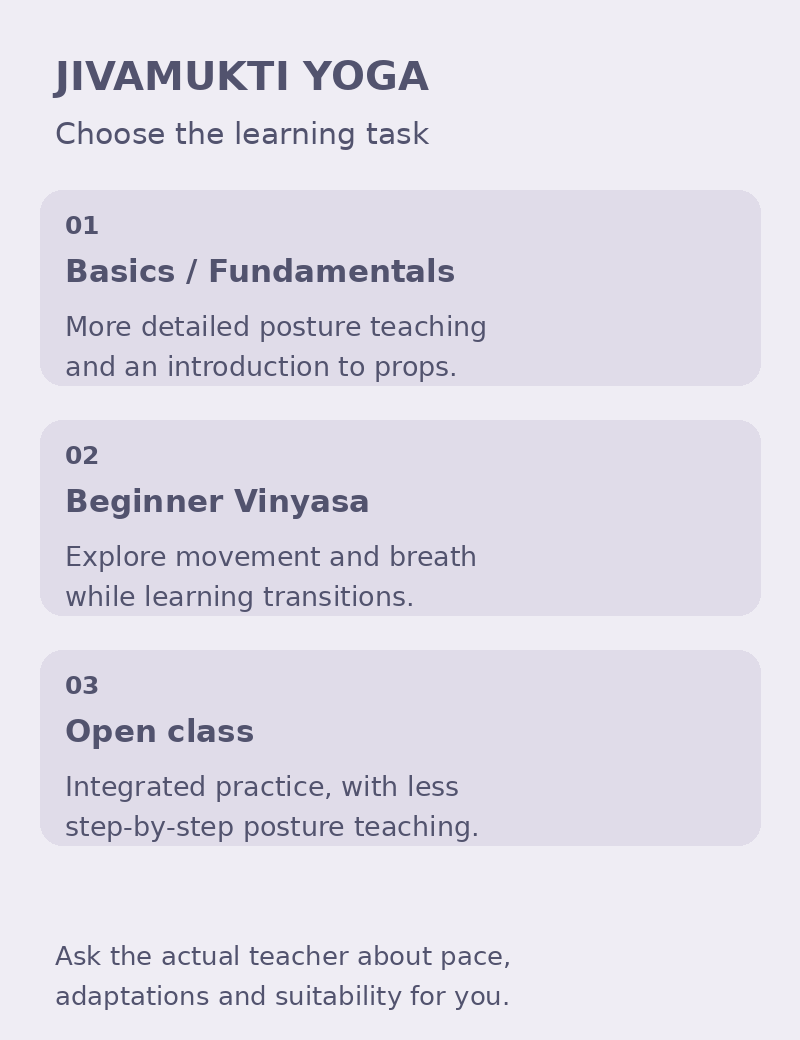
Open means practitioners of different levels are welcomed and offered options. It does not mean that the teacher will stop to explain every posture from the beginning. The same official guide warns that detailed how-to instruction is limited and directs new students toward Basics or Beginner Vinyasa when they need that foundation.
That distinction is easy to miss in a timetable. A person can be welcome in a class and still find its pace or assumed knowledge unsuitable. If you are new to yoga, ask the studio which format gives you enough time to learn rather than selecting only by the words all levels.
Basics, Beginner Vinyasa and Spiritual Warrior
The Basics Series, also called Fundamentals in parts of the school’s description, emphasizes alignment and how to do the postures, including the use of props. The official guide describes a structured course with changing themes. Check the local studio’s arrangement rather than assuming every location runs an identical timetable.
Beginner Vinyasa shifts attention toward how postures connect with movement and breath at a slower pace than Spiritual Warrior. It is not just another name for Basics. A student wanting detailed posture instruction and a student learning transitions may need different classes, even if both are beginners in some sense.
Spiritual Warrior is described by the school as a fast-paced fixed sequence with less stopping for explanation. Its name does not mean you need to prove toughness. Nor does its predictable structure make it an automatic first choice for someone who has never practised yoga.
The school lists other formats too, including slower or meditation-focused options. Availability and teaching vary by location. Choose from the actual description and a conversation with the teacher, not from a promise that one format is suitable for every body.
Music, chanting and hands-on guidance
Nada means deep listening in the school’s account. It may involve music, spoken words, the teacher’s voice or silence. It is more than a particular playlist, and the presence of music alone does not make any flow class Jivamukti.
Chanting and devotion can be unfamiliar to a first-time student. Ask what participation involves and explain any concern before class. You do not need to pretend familiarity with Sanskrit words to request a clear explanation.
The Open-class description also includes hands-on assistance. Ask about the teacher’s approach to consent and say whether you want touch before practice begins. You can decline a physical adjustment, change your mind or ask for a verbal cue instead. A spiritual aim does not remove the need for personal boundaries.
Physical demands and safety
Jivamukti can include demanding movement, but the specific format matters. Do not equate a spiritual theme with a restful physical class. Tell the teacher about your experience, relevant movement limits and what you need to learn. Ask how to rest and what alternatives are offered.
NCCIH advises beginners to avoid extreme practices such as headstands, shoulder stands, lotus position and forceful breathing. A posture appearing in a class description or demonstration does not make it a task you must attempt. This guide does not provide an inversion, advanced-pose or forceful-breathing sequence.
If you are pregnant, have an injury or medical condition, or are unsure about your exercise limits, check with your doctor and the teacher before starting. Stop a movement that causes pain. Needed medical or mental health care should remain in place; yoga is not a substitute for assessment or treatment.
What can you reasonably expect?
You can expect to encounter the school’s combination of physical, ethical and spiritual ideas when choosing a class taught in this method. You cannot infer a guaranteed health outcome from that combination. A class that one person finds meaningful may not be another person’s preferred learning environment.
NCCIH notes that yoga research includes different practices and populations, which makes broad conclusions difficult. Findings about yoga in general do not prove that Jivamukti is superior to other methods or that a particular class treats a condition. The school’s language about liberation describes a spiritual goal, not a result this article can promise.
Common questions
Is Jivamukti the same as vinyasa?
No. Vinyasa describes an approach linking postures through movement and breath. Jivamukti uses that physical approach within its own ethical, philosophical and teaching framework. A vinyasa class does not automatically include Jivamukti’s five tenets.
Is an Open class the best first class?
Not necessarily. The school welcomes different levels but also says Open classes offer limited detailed posture instruction. If that is what you need, ask about Basics or a suitable introductory option first.
Is the method only about exercise?
No. Compassion, animal rights, devotion, listening, meditation and study are part of its stated framework. Ask the teacher how those elements appear in the session you are considering.
Before your first session
Choose the learning task before choosing the fastest or most convenient class. Ask about posture instruction, transitions, philosophical discussion, sound and hands-on guidance. The right starting point is one where you can learn clearly, respect your physical limits and understand the wider ideas being taught.