A class description mentions precise alignment, a theme from everyday life and something called opening to grace. Is this a flowing workout, a philosophy lesson or a slow introduction to yoga? With Anusara, the answer depends on how those elements are brought together and which class you choose.
Anusara is a modern school of hatha yoga that combines a named system of alignment principles with a heart-oriented, spiritual approach. Understanding those ideas helps you read a class listing more carefully. It does not mean you need to master specialist vocabulary or attempt advanced poses before attending.
What is Anusara yoga?
The Anusara School describes its approach through three pillars: a life-affirming non-dual Tantric philosophy, the Universal Principles of Alignment and a community of teachers and students called the kula. These belong together in the school’s description. Anusara is therefore more specific than a general label for stretching with careful posture.
The school explains the name in terms of flowing with grace. That is its philosophical framing, not a promise that every movement will immediately feel effortless. A learner can be curious about the ideas while still needing clear instructions, physical adaptations and permission to rest.
Anusara belongs within the broad family of hatha yoga. If that larger term is unfamiliar, our guide to hatha yoga gives some background. A class called hatha can have many different teaching approaches; an Anusara listing points to a particular method within that wider field.
The main ideas at a glance
| Element | What it means here | What to ask |
|---|---|---|
| Philosophy | A heart-oriented theme and spiritual framework | How much discussion or chanting is included? |
| Alignment | A named system for teaching body awareness and action | Will the teacher explain new terms? |
| Community | A relationship between teachers, students and the wider school | Are questions and individual choices welcomed? |
| Class level | The actual physical demands of this session | Is it suitable for someone new to yoga? |
Attitude, alignment and action
The school also uses the three A’s: attitude, alignment and action. Attitude concerns the intention brought to practice. A teacher might connect physical work with a quality such as patience or willingness to learn. You do not need to manufacture a cheerful mood to participate. An intention can be something to explore rather than a feeling you must already have.
Alignment concerns how different parts of the body are placed and related in a pose. In the school’s wider philosophy, the term also connects physical practice with intention. For someone taking a first class, the useful question is whether the teacher translates the idea into instructions that are understandable and appropriate for that person.
Action concerns how the body, mind and breath participate in practice. Together, the three terms explain why an Anusara class may connect a physical instruction to a theme rather than teach movement as a separate exercise. They are teaching concepts, not medical measurements.
What are the five alignment principles?
The school’s overview names five Universal Principles of Alignment: Open to Grace, Muscle Energy, Inner Spiral, Outer Spiral and Organic Expansion. You may hear these names in a class or workshop. Their presence helps identify the method, but a list is not enough to learn their physical application.
In particular, words such as spiral are not instructions to twist a joint as far as possible. Ask the teacher to demonstrate and explain a cue in the context of the actual posture. If a cue is confusing or uncomfortable, pause rather than increase effort while guessing what it means.
The word universal is part of the system’s name. It should not be read as a guarantee that every person needs the same visible shape, range of movement or muscular effort. Individual anatomy, health and experience still matter. A branded alignment method cannot make injury impossible.
What might a class include?
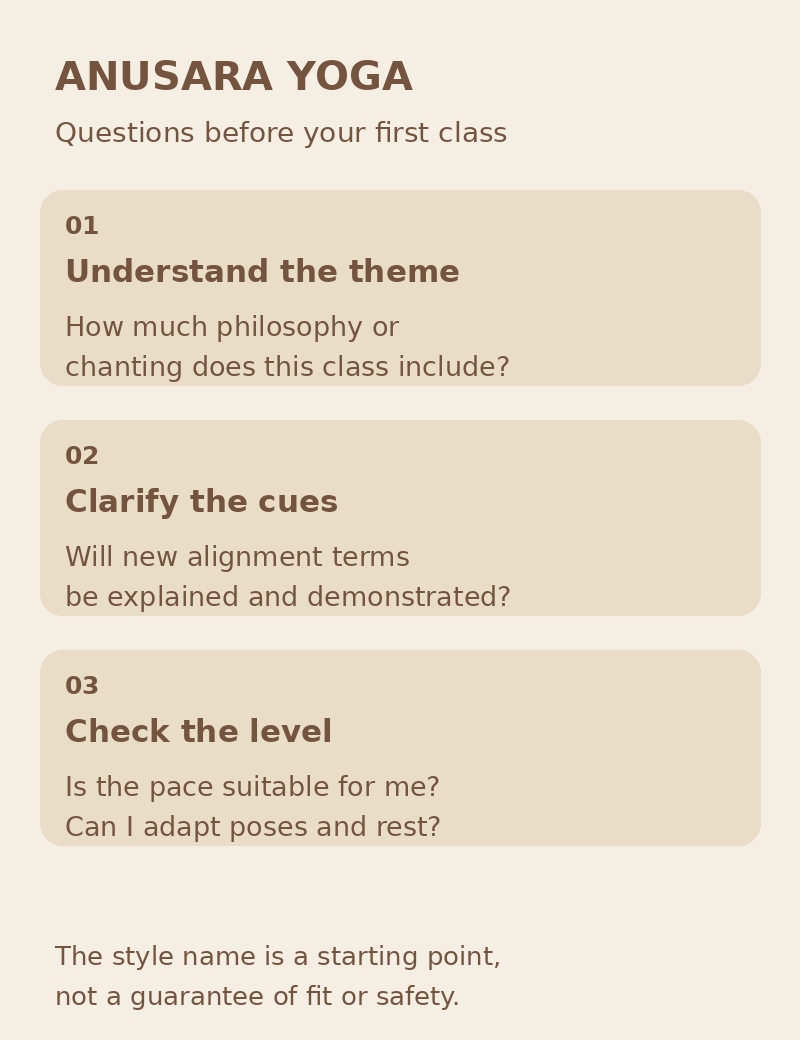
The school’s description connects heart-oriented themes with technical instruction. Expect the relationship between those elements to be part of the teaching approach. The exact postures, pace, amount of discussion and use of props still need checking with the teacher. The style name alone does not tell you how demanding a particular session will be.
Before booking, ask whether the class is introductory, mixed-level or intended for experienced practitioners. Ask whether unfamiliar alignment terms are explained and whether there are alternatives when a posture is unsuitable. If you prefer a mostly physical class with little spiritual language, say so before choosing rather than assuming every yoga listing offers the same experience.
Ask about chanting, opening reflections and hands-on assistance too. These are reasonable questions about the actual class, not a test of your commitment. You can decline touch and ask for a verbal explanation or demonstration instead.
Can beginners try Anusara?
A beginner can look for an introductory class, but beginner suitability is a property of the specific session and teaching, not a guarantee attached to the name. Someone new to the method may already have years of yoga experience; someone new to yoga may need a different pace and more explanation. Tell the teacher which describes you.
You do not have to prepare by copying difficult poses from promotional photographs. A useful first step is to contact the teacher, describe your experience and ask what the class expects. Ask whether props are available, whether standing and floor work can be adapted, and whether resting is an ordinary option.
The school has its own training and licensing pathway. Its Elements teaching license is an entry-level license within that system. A school credential can tell you about a teacher’s training route, but it is not a medical qualification or proof of a particular fit for your needs.
Safety and realistic expectations
NCCIH says yoga is generally considered safe for healthy people when practised properly with a qualified instructor, but injuries can occur. It advises beginners to avoid extreme practices such as headstands, shoulder stands, lotus position and forceful breathing. None is a requirement for understanding Anusara.
If you are pregnant, have an injury or health condition, or have concerns about balance or movement, check with your doctor and the teacher about suitable modifications before starting. Stop a movement that causes pain rather than treating discomfort as something the philosophy requires you to overcome. Yoga should not replace needed medical care.
Keep benefit claims separate from descriptions of the method. Research on yoga covers different practices and populations. General yoga findings do not establish that Anusara is better than other styles, that its alignment principles prevent injury, or that it treats a particular condition. Spiritual language describes the school’s approach; it is not clinical evidence.
A note on the school’s background
Anusara began as a modern yoga school founded by John Friend. The school’s own account distinguishes that origin from the later teacher-led Anusara School of Hatha Yoga and says Friend is no longer associated with it. That distinction matters when reading older descriptions that treat one founder and the current organization as interchangeable.
You do not need a detailed history lesson to choose a first class. You do need to know who is teaching now, what training they have and how they respond to questions and boundaries. Evaluate the actual learning environment rather than relying only on a founder’s reputation or a style label.
Common questions
Is Anusara the same as vinyasa?
No. Anusara names a particular school and teaching system. Vinyasa commonly describes a movement-and-breath approach, and a class can use flowing transitions without those two labels meaning the same thing. Ask about pace and structure in the session you are considering.
Do I need to be flexible first?
Do not use flexibility as the only admission test. Ask for a class that matches your experience and offers suitable options. Being able to reach a shape is not the same as understanding a cue or practising within comfortable limits.
Is Anusara purely physical?
No. Its official description includes philosophy, heart-oriented themes and community as well as physical alignment. The amount of spiritual discussion in a particular class is worth asking about before attending.
The useful starting point
Think of Anusara as an alignment-focused hatha yoga method with an explicit philosophical framework. Choose a clearly described introductory class, ask how the teaching is adapted, and keep your own physical boundaries. A suitable class should make the method easier to understand without requiring you to ignore uncertainty or discomfort.