
You sit quietly for a few minutes, then realise you have been imagining a conversation that has not happened. Was that meditation, daydreaming or simply a moment when attention moved elsewhere? Stillness on the outside does not tell you what the mind is doing.
The practical difference is the relationship to attention. In a basic mindfulness meditation, you notice experience and return to a chosen focus when you drift. In daydreaming, attention may become absorbed in a remembered or imagined story. Both can happen within the same few minutes. Noticing the shift is more useful than labelling the whole session a success or failure.
Start with the instructions, not the posture
NCCIH describes meditation as a family of practices, including attention to breathing, sound, an image or a repeated phrase. This comparison mainly concerns mindfulness-style attention practice. Other traditions may deliberately work with imagery or contemplation, so it would be inaccurate to define all meditation as the absence of imagination.
The NHS describes mindfulness meditation as paying attention to thoughts, sounds, breathing sensations or parts of the body, and bringing attention back when the mind wanders. The instruction is not to create a perfectly empty mind. Thoughts can occur while you are still engaged in learning to notice them.
Daydreaming is often discussed in research under the broader term mind wandering. An MIT Press Reader explanation describes attention moving away from the current task toward internally generated thoughts, such as a memory or a future plan. The terms are not a precise diagnosis, and not every brief distraction is an elaborate fantasy.
| Question | Attention practice | Daydreaming |
|---|---|---|
| Main activity | Notice and return attention | Follow a remembered or imagined story |
| Example | Return to a sound nearby | Imagine a future conversation |
| Thoughts | Notice them as events | Become involved in their content |
| Noticing | Recognise when the focus changes | May notice the drift only later |
| Overlap | Drifting can happen during practice | Noticing it can prompt a return |
A thought appearing is not the same as following it
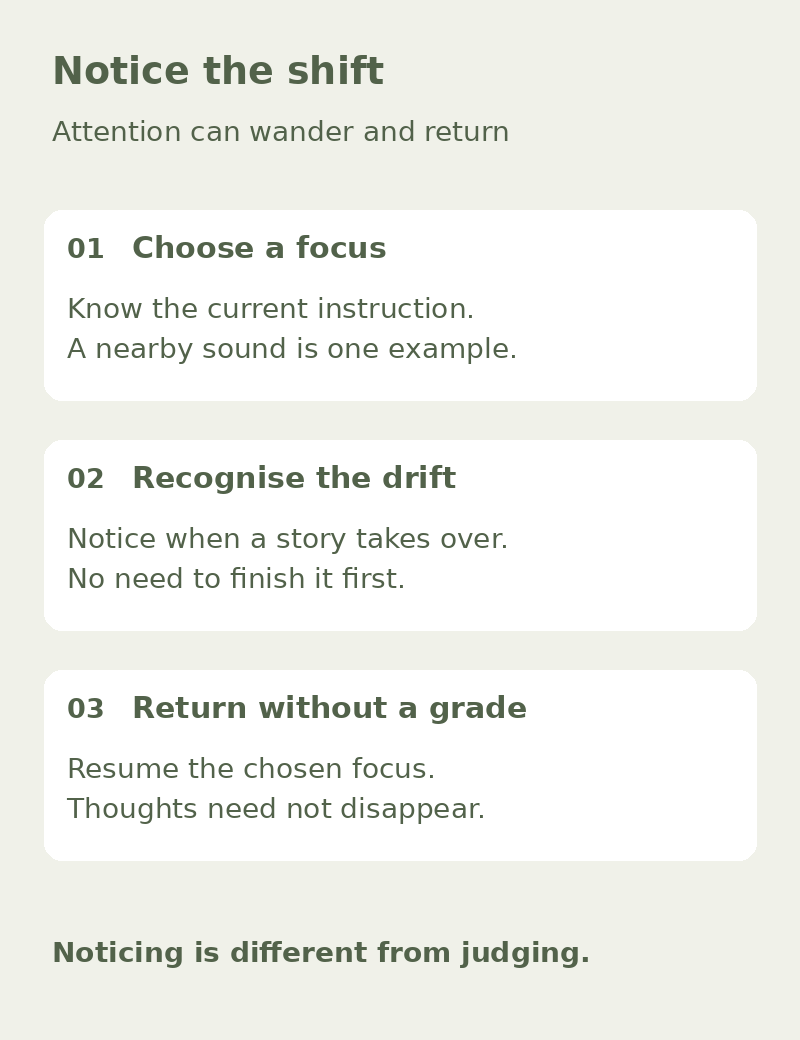
Imagine that you are listening to rain. A thought about an unfinished email appears. In an attention practice, you might recognise that thought and return to the sound. You do not need to finish composing the email in your head before you are allowed to return.
If attention instead follows the email into an imagined reply, a disagreement and a plan for tomorrow, you have become involved in the story. You may only notice that change later. The distinction is not whether the thought was good or bad, but whether you are following its content or recognising what attention is doing.
The NHS suggests seeing thoughts as mental events that come and go. This does not require arguing with them, suppressing them or pretending they have no importance. An important task can still be dealt with after practice. Choosing not to follow every thought immediately is different from deciding that nothing matters.
Mind wandering during meditation does not erase the practice
The moment you notice that you have drifted is part of understanding attention. You can resume the instruction rather than starting a second story about how badly you are meditating. A session containing repeated returns is not automatically a session in which nothing happened.
NCCIH has reported research that distinguishes attention to the breath, mind wandering and self-focused processing during meditation. That work was a small proof-of-principle study about measurement. It supports treating these as distinguishable states within a session, not using a brain scan to grade an individual meditator.
You do not need to estimate exactly how many seconds you spent in each state. If you are unsure what to return to, ask for clearer guidance. A vague instruction to be present may leave a beginner guessing, while a named focus such as a nearby sound makes the task easier to understand.
Daydreaming is not automatically a problem
A wandering mind can move toward memories, personal concerns or plans. The MIT Press discussion describes possible uses such as thinking about the future, while also explaining how drifting can interfere with a task that needs attention. Context matters more than a rule that all internal stories are harmful.
Thinking about a holiday while waiting comfortably is not the same situation as losing track of instructions during an important task. Nor is deliberately setting aside time to imagine possibilities identical to repeatedly finding yourself elsewhere when you meant to concentrate.
This article does not promise that daydreaming makes you more creative. Research discussions differ in how strongly they interpret that possibility, and the MIT Press explanation questions sweeping claims that the brain solves problems on its own while attention is elsewhere. A break can be welcome without becoming a guaranteed creativity technique.
What research on meditation can and cannot tell you
A systematic review in Neuroscience and Biobehavioral Reviews examined studies of mindfulness meditation and mind wandering. It reported that many intervention studies found reductions in mind wandering, but also noted substantial differences in designs, measures and interventions. The authors called for further research.
That is more modest than promising that meditation stops daydreaming. It also does not tell you what will happen after one short recording. A research programme, a familiar personal routine and a first attempt at home are different circumstances.
NCCIH similarly notes limitations in meditation research more broadly. Avoid turning a general finding into a personal deadline for having fewer thoughts. The useful learning task here is to recognise a change in attention, not to prove that your mind has become permanently quiet.
How to tell what you are doing
Ask what the current instruction is. If it is listening, are you attending to the sound or building a story around it? If it is observing thoughts, are you noticing that a thought appeared or becoming absorbed in how the imagined scene ends? These questions are prompts for understanding, not a diagnostic checklist.
Some meditations intentionally use imagined scenes. In that setting, returning to the guided image can be the task. The distinction is therefore not simply real versus imaginary. It is whether you are following the chosen practice knowingly or have drifted into something else without noticing.
You can make the task clearer by choosing a recording that explains its focus and what to do when attention moves. You do not need increasingly strict rules or self-criticism. If one approach is confusing, a qualified teacher can help you understand the instruction or suggest a different practice.
Ordinary drifting and disruptive daydreaming are different concerns
Cleveland Clinic discusses the term maladaptive daydreaming in connection with excessive, absorbing daydreams that interfere with work, relationships or other activities and can be difficult to control. That is different from occasionally realising that your mind wandered while reading.
The clinic also notes that this is not an officially recognised diagnosis and that research is still developing. Do not diagnose yourself from the vividness of a daydream, an online checklist or one distracted meditation. The practical reason to seek help is distress or interference with life, not failing to maintain perfect attention.
If internal stories repeatedly feel difficult to interrupt or crowd out activities you want or need to do, talk with a qualified mental health professional. Meditation is not a substitute for that assessment, and a comparison article cannot determine the cause of the experience.
Keep the practice optional and the expectations realistic
The NHS says mindfulness is not right for everyone and can make some people feel worse. NCCIH also reports possible negative experiences. If meditation increases distress, stop and seek suitable support rather than assuming that a longer or more intense session is required.
For ordinary exploration, the takeaway is straightforward: quiet sitting can include both intentional attention and wandering. When you notice the difference, you can choose what to do next. That choice does not require condemning imagination or pretending that thoughts will disappear.
Our meditation guide explains basic practice terms, while our mindfulness comparison separates two related labels. Use clear instructions, leave room for wandering and do not turn a moment of noticing into another reason to judge yourself.
Sources
- NCCIH: meditation and mindfulness effectiveness and safety
- NHS: mindfulness and returning attention
- NCCIH: research on measuring attention states during meditation
- Feruglio and colleagues: systematic review of meditation and mind wandering
- MIT Press Reader: daydreaming and concentration
- Cleveland Clinic: maladaptive daydreaming