You reach the shoulders in a relaxation recording. One voice asks you to notice what is there. Another asks you to tighten the muscles, release them and compare the feeling. Both move attention around the body, but they are not giving the same instruction.
A body scan generally builds awareness of sensations without requiring you to change them. Progressive muscle relaxation, often shortened to PMR, deliberately alternates muscle tension and release. This difference matters if you are choosing a recording, have a painful area, or keep wondering why a relaxation exercise asks you to do something active.
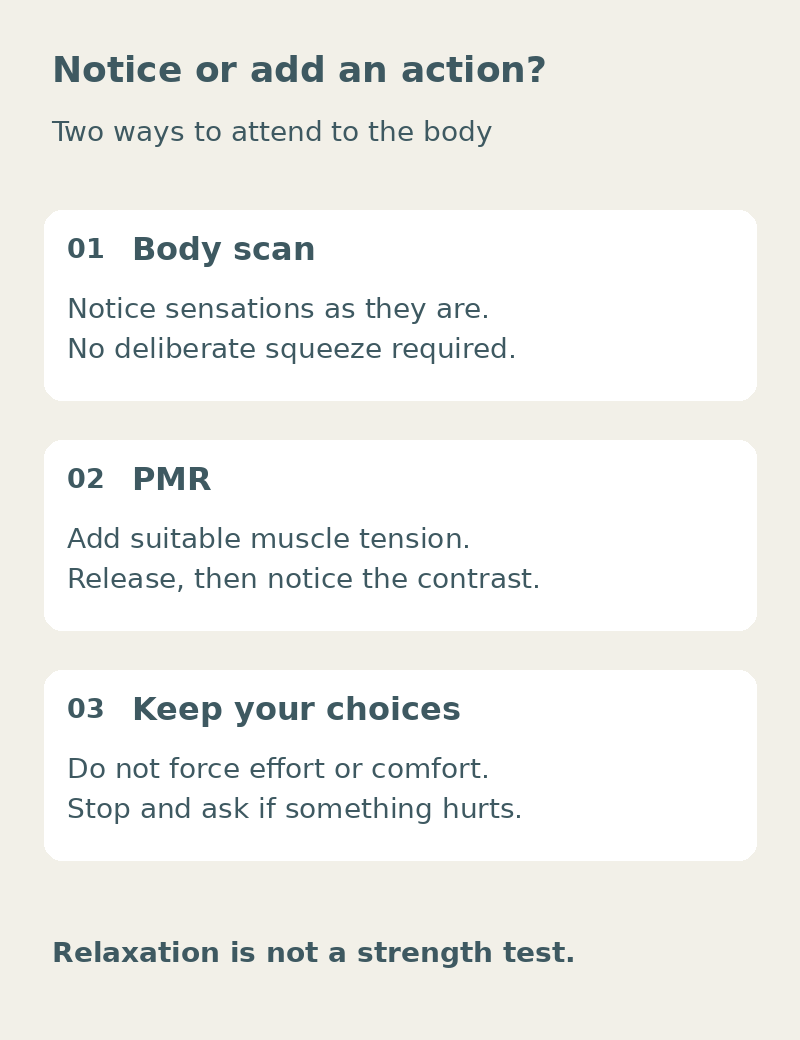
The main difference is the action
Cleveland Clinic’s discussion of body scan meditation describes checking in with sensations throughout the body. The stated goal is not necessarily to change anything, but to build present-moment awareness. You might notice contact with a chair, warmth, pressure or an area that feels less distinct.
In PMR, you intentionally create some muscle tension and then release it. The University of Wisconsin-Madison’s clinical tool describes learning to recognise the difference between tension and relaxation. Attention is still involved, but a deliberate physical action is added.
Neither description means you must complete a rigid head-to-toe routine. Recordings differ in order, pacing and language. The useful distinction is whether you are mainly observing what is already happening or deliberately tightening and releasing muscles to explore the contrast.
| Question | Body scan | PMR |
|---|---|---|
| Main task | Notice sensations | Tense, release and notice |
| Muscle effort | No deliberate squeeze required | Adds a deliberate contraction |
| Example | Notice shoulder sensations | Compare tension and release |
| If unclear | No special sensation needed | Do not increase effort to force it |
| Safety focus | How inward attention feels | Inward attention and muscle effort |
A body scan is not a search for faults
The word scan can make the activity sound like a test for hidden problems. Here it means moving attention through areas of the body, not diagnosing an illness. Noticing a sensation does not establish its cause, and failing to notice much does not mean that area is unhealthy.
For example, you may notice the pressure of your feet against the floor, then realise that your mind has moved to tomorrow’s plans. You can return to the chosen area without arguing with the thought. You do not need to produce a stronger sensation before the practice counts.
Cleveland Clinic’s body scan discussion also distinguishes awareness from immediately trying to fix every feeling. Relaxation might occur, but the instruction can remain observation. If you spend the whole session checking whether you are relaxed enough, ask for guidance about the task rather than treating it as a performance.
PMR adds a contrast you can notice
The University of Wisconsin-Madison describes PMR as a two-step process: first create tension in a muscle group, then release it and notice the difference. The aim is awareness of that contrast, not a strength test. Its guidance says a small amount of tension is enough and warns against straining.
The VA Health Library similarly says not to tighten a body part to the point of increasing pain. Only enough effort to sense the difference is needed. A recording that sounds demanding does not override your physical limits or advice from the clinician who knows your condition.
This article compares the methods rather than prescribing a full PMR sequence. It does not give a set of contractions for the neck, back, jaw or other sensitive areas. If you want to learn PMR, use suitable professional guidance, especially when an injury or medical condition affects what you can comfortably do.
Why they can sound similar
Both practices can move attention from one area to another. Both may ask you to notice the body after an instruction. A recording may also combine them, starting with awareness and then adding selected muscle contractions. The presence of a calm voice or a body-part list does not tell you which method is being taught.
There is another source of confusion: passive progressive relaxation. The VA’s Whole Health chapter describes a version that brings awareness to muscle groups without increasing tension. It may be used when contracting muscles is uncomfortable, including after surgery or because of pain.
That overlap does not make the labels useless. It means you should read the actual description. Ask whether the session is a mindfulness body scan, active PMR, passive relaxation or a mixture. A clear answer helps you avoid doing an unnecessary squeeze because a recording simply said to attend to your shoulders.
Which task fits what you want to learn?
If you want to practise noticing sensations without immediately changing them, a clearly guided body scan matches that task. If you want to learn what a small increase and release of muscle tension feels like, appropriately adapted PMR addresses that contrast more directly.
This is not a ranking of treatments. The fact that one feels easier on a particular day does not establish that it works better for every person or every symptom. A preferred recording can also be clearer, slower or better matched to your setting than another one, regardless of the method’s name.
Look for instructions that explain what to do if a sensation is faint, a body area is painful or attention wanders. You should not have to guess whether to push harder. You can stop, choose another approach or ask for help instead of finishing a sequence merely because it has started.
Physical comfort matters in PMR
The Wisconsin clinical tool recommends speaking with a physician before PMR and cautions about serious injuries, muscle spasms and back problems. Deliberate tensing can aggravate an existing problem. Recent surgery, pain or movement restrictions are reasons to ask about an adapted approach, not reasons to invent your own workaround.
Its guidance also says to ease up, stop or skip an area if discomfort or cramping occurs. It warns against holding the breath while tensing. Do not assume that a stronger contraction gives a better result, and do not treat pain as evidence that tension is being released.
A body scan does not require those contractions, but it is not a substitute for assessing unexplained symptoms. A new or concerning sensation should be considered on its own merits. Meditation cannot tell you whether a symptom needs medical attention.
Inward attention is not comfortable for everyone
Both activities involve paying attention to bodily experience. Cleveland Clinic’s body scan discussion notes that this can bring up intense feelings for some people with severe anxiety or a trauma history, and recommends working with a therapist in that situation.
NCCIH likewise reports possible negative experiences with meditation and occasional increased anxiety or intrusive thoughts during relaxation practices. You do not need to continue an exercise that becomes distressing to prove that you are committed. Stopping and seeking suitable support is a reasonable response.
If you are using either method for a health condition, discuss it with a qualified professional and keep needed care in place. Neither an attention exercise nor a muscle-relaxation recording should delay medical or mental health treatment.
Keep expectations specific
NCCIH’s relaxation review discusses research across varied methods and conditions, with limits in the evidence. A study about a particular programme does not establish that all relaxation recordings have the same effect. This article does not promise better sleep, pain relief or a cure for anxiety from either activity.
A more useful first question is whether you understand the instruction and can follow it comfortably. A body scan may include ordinary sensations, wandering attention or little noticeable change. PMR may reveal a contrast without producing complete relaxation. Neither needs a dramatic result to make its basic task understandable.
For more about the awareness side, see our body scan meditation guide. Our meditation guide explains the wider context. Remember the practical distinction: a body scan notices; PMR deliberately tenses and releases, then notices. Choose and adapt with that difference in mind.
Sources
- Cleveland Clinic: body scan meditation discussion
- University of Wisconsin-Madison: progressive muscle relaxation clinical tool
- VA Health Library: progressive muscle relaxation
- VA Whole Health: mind-body approaches and passive relaxation
- NCCIH: relaxation techniques and safety
- NCCIH: meditation and mindfulness effectiveness and safety