Two yoga mats can look almost identical while their labels promise very different things. One says TPE, another says PVC, and both claim comfortable cushioning and reliable grip. It is tempting to choose the material that sounds newer or more natural.
A better comparison starts with the actual mat. TPE and PVC tell you something about the material, but not everything about texture, firmness, sweat handling, ingredients or end-of-life options. Neither name is a complete performance grade or an environmental certificate.
This is a material-label guide, not a product ranking. The manufacturer examples illustrate why details matter; they are not recommendations to buy those models.
What TPE means
TPE stands for thermoplastic elastomer. The British Plastics Federation describes TPEs as materials that combine rubber-like elastic behaviour with thermoplastic processing. There are several groups and formulations, with a wide range of softness and hardness.
That range is the important point for a yoga mat. Seeing TPE on the label does not tell you the exact blend, density, surface texture or layer construction. It also does not mean the mat is natural rubber.
A maker may describe a particular TPE mat as lightweight or cushioned. That describes the product being sold. It should not become a promise that every TPE mat is lighter, softer or more suitable than every PVC mat.
What PVC means
PVC stands for polyvinyl chloride, also known as vinyl. The British Plastics Federation explains that PVC can be made rigid or flexible through formulation. Flexible PVC uses plasticisers, while other additives can contribute different properties.
A yoga mat is therefore not meaningfully compared with a rigid pipe simply because both carry the same base-polymer name. The final formulation and construction matter. Nor should every flexible PVC product be assumed to contain the same plasticiser or the same amounts of other ingredients.
Ask what the maker discloses about the finished mat. A broad claim about a polymer cannot replace information about that particular product, any relevant substance testing and the conditions under which it is intended to be used.
At a glance
| Check | TPE mat | PVC mat |
|---|---|---|
| Meaning | TPE family | Vinyl polymer |
| Formula | Different blends and grades | Different flexible formulations |
| Feel | Check the actual foam and surface | Check the actual foam and surface |
| Grip | Not established by the label alone | Not established by the label alone |
| Disposal | Confirm a route for the finished mat | Confirm a route for the finished mat |
Grip depends on more than the material name
Compare the top surface and the underside separately. You need the surface under your hands and feet to suit your practice, while the mat itself needs to stay put on the floor. A texture that feels comfortable when dry may not behave the same way when wet.
Manduka’s own guidance gives a useful example. It describes its PVC PRO Series as closed-cell, with moisture remaining on the surface. It also acknowledges that people may notice reduced traction as perspiration increases and discusses compatible towel use.
This is a specific construction example, not a verdict on all PVC. Gaiam also describes a TPE model as closed-cell. So closed-cell should not be treated as a feature belonging exclusively to one of these material labels.
If a mat slips, stop and address the surface or setup. Do not use a difficult pose as a grip test, and do not assume a towel will help unless the combination lies flat and stays secure.
Cushioning, firmness and carrying weight
Thickness describes a measurement, not how much the material compresses. TPE compounds themselves cover a broad hardness range, according to the British Plastics Federation. A finished mat’s feel also depends on its design.
Compare the listed weight and dimensions, rather than assuming that one material always travels better. Check how the mat rolls, whether the edges lie flat and whether its support feels suitable on the floor you use.
Our yoga mat thickness guide explains why extra millimetres do not automatically mean greater comfort or safety. A soft mat and a firm mat with the same measurement can feel very different.
Does TPE mean environmentally friendly?
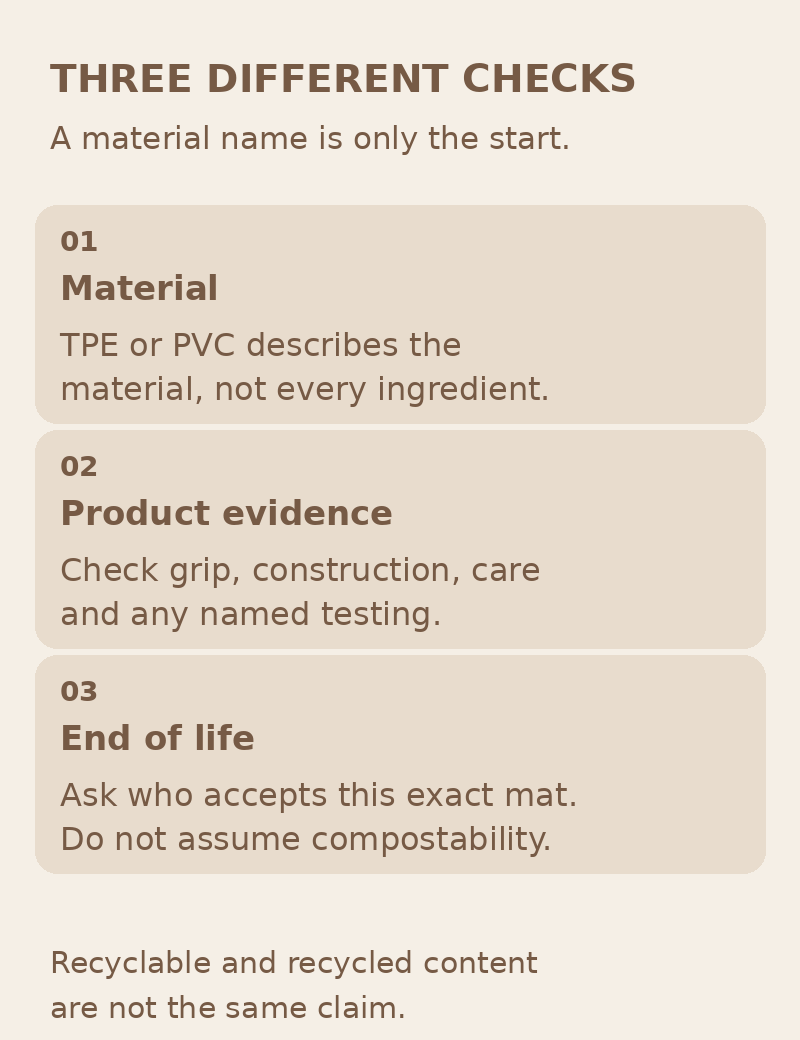
No material abbreviation establishes the environmental impact of the whole product. TPE refers to a material family, not an independently assessed environmental outcome. Look for specific, supported claims instead of treating a green colour scheme or the word eco as evidence.
The US Federal Trade Commission’s Green Guides distinguish claims about recyclability, recycled content, compostability and other environmental attributes. These are different claims with different conditions. A mat made partly from recycled material is not necessarily accepted by a recycling program after use.
Likewise, the ability to reprocess a material is different from having somewhere that will collect and process your finished mat. Ask about the whole article, including any layers and backing, and whether a real collection route is available where you live.
Recyclable is not the same as biodegradable
Do not put a TPE mat into garden compost simply because an advertisement uses an environmental claim. The FTC’s guidance treats compostability as something requiring evidence about all materials, the conditions involved and whether the necessary facilities are available.
The same caution applies to PVC. Material-industry descriptions of reprocessing or established recycling for other PVC products do not prove that a local service accepts a used yoga mat.
Ask the maker or collection service whether the exact mat is accepted and how to prepare it. If the answer is unclear, do not invent a disposal route. You also do not need to replace a serviceable mat merely because another label sounds greener.
What about non-toxic and substance testing?
Non-toxic is a broad claim, not something established by the letters TPE or PVC. The FTC’s Green Guides explain that such claims need evidence and should not mislead about effects on people or the environment.
A named test standard is more informative when you can identify what was tested. OEKO-TEX describes STANDARD 100 as testing for harmful substances, with criteria related to the article’s intended use. Its site provides a way to check a label using the certificate number or QR code.
That kind of certificate should be understood within its stated scope. It is not a grip test, a guarantee against every individual sensitivity, proof of compostability or a comparison of the entire environmental footprint of two mats.
If you have a known allergy or sensitivity, ask about the complete finished product rather than guessing from the main material. Stop using a mat that causes irritation and seek appropriate advice. A reassuring marketing term is not a substitute for your own health needs.
Care instructions can decide the choice
Read the actual care label before choosing a cleaner. Instructions for one TPE product cannot be assumed to apply to every TPE mat, and the same is true of PVC.
Gaiam’s TPE example specifies spot cleaning and drying flat, with a warning about prolonged sun exposure. Manduka’s PVC PRO guidance says not to soak or submerge the mat and limits which cleaning methods it recommends. These are product-specific instructions, not universal recipes.
Follow the maker’s guidance and let the mat dry as directed before storing it. Do not transfer a soaking, oil, abrasive-scrubbing or sun-treatment recommendation from another product simply because both are called yoga mats.
Questions worth asking
What is the complete material description, including backing and layers? What are the actual dimensions and weight? What does the maker say about dry and sweaty grip? Is there relevant finished-product testing with a checkable certificate?
Then ask how to clean it and what happens when it is worn out. Specific answers are more useful than a universal TPE-versus-PVC winner. For comfort, test an ordinary supported position or simple movement you already know, in a safe setting, rather than challenging balance on an unfamiliar surface.
Common questions
Is TPE always softer than PVC?
No. Both labels cover variation in finished products. Compare the mat’s construction and compression instead of treating the polymer name as a firmness rating.
Does PVC automatically mean the mat is unsuitable?
No. Look at the actual formulation information, product testing, handling and intended use. Broad reassurance and broad alarm can both miss the details that matter.
Can a different material fix wrist or knee pain?
A mat is not treatment. If practice causes pain, stop and seek individual advice about the movement and support you need rather than relying on a material change.
The useful comparison
TPE and PVC are starting points for questions, not complete answers. Compare actual grip, firmness, weight, care and product evidence. Keep substance testing and environmental claims separate, and verify disposal for the finished mat rather than the material in theory.