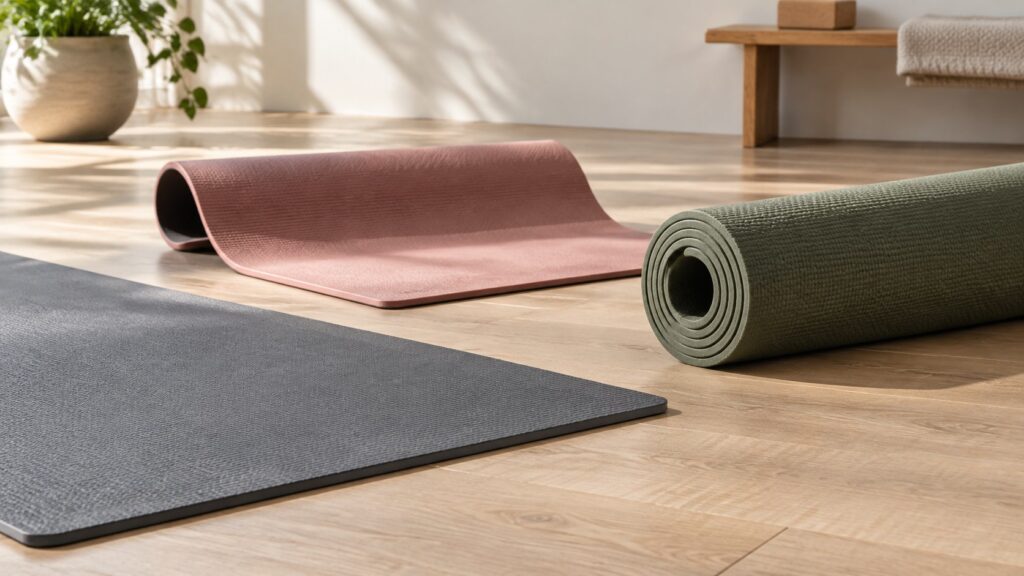
For a first everyday yoga mat, comparing firm mats around 4-5 mm thick is a useful starting point. It is not a universal ideal. A thinner mat may suit travel or a preference for close floor contact, while a thicker mat may feel more comfortable during kneeling and floor work. Material, firmness, grip and the floor beneath you matter as much as the number.
The important question is not simply how thick a yoga mat should be. It is whether a particular mat gives you a stable, comfortable surface for the practice you actually do. Extra millimetres do not automatically mean extra safety, and a mat cannot treat an injury.
There is no single correct thickness
Published buying guides do not agree on one number. REI suggests about one-eighth of an inch as a starting point, particularly for a strong flowing practice. Runner’s World’s guide quotes a yoga instructor who favours around 5 mm, while also discussing personal preference and the type of yoga.
That difference is useful. It shows why an everyday starting range should not become a strict rule. Someone who carries a mat on public transport may make a different choice from someone leaving it on a hard floor at home.
Think of thickness as one measurement in a wider decision. Ask how easily the surface compresses, whether your hands slip, whether the underside moves and whether the mat is practical to clean and store. A comfortable number on a label cannot answer those questions.
What do thin, medium and thick usually mean?
The following ranges are practical shopping categories, not official performance grades:
- Around 1-2 mm: very thin travel mats, designed with portability in mind. Expect less padding when used alone on a hard floor.
- Around 3 mm: a relatively thin practice mat, which may appeal when floor contact and carrying weight matter.
- Around 4-5 mm: a common everyday compromise between cushioning and a firm connection with the floor.
- Around 6 mm and above: more substantial mats that may suit a preference for additional cushioning, with performance depending on material and firmness.
There is no sharp boundary where a good yoga mat becomes unsuitable. A dense 6 mm mat and a soft foam mat of the same thickness can feel very different. Avoid rejecting or choosing either one solely from the measurement.
Thickness is not the same as firmness
Thickness tells you how far apart a mat’s surfaces are. It does not tell you how much the mat compresses under your weight. A soft surface can feel pleasant at first, yet allow a hand, foot or knee to sink more than you prefer.
Liforme’s guide makes this distinction between thickness and the material’s ability to resist compression. Its description is also sales material for its own products, so its strongest claims about protection should not be treated as independent medical evidence.
For a practical comparison, press two mats of similar thickness with your palm. Notice how they compress and recover. If a trial is available, compare them on a similar floor using ordinary movements you already know. This is a comfort and handling check, not a test that proves injury prevention.
There is no need to seek the hardest mat either. The aim is a surface you can use with confidence, not the maximum of one property at the expense of everything else.
Balance and cushioning can pull in different directions
REI and Runner’s World both discuss the trade-off: more cushioning can be comfortable for floor work, while a very soft surface can make standing balances feel less steady. This does not mean that every thick mat is unstable.
Think about where your practice spends its time. If most of it involves standing transitions, a stable surface may be a higher priority. If it includes longer periods of seated or kneeling work, local pressure against the floor may matter more to your comfort.
Try to identify the actual problem before replacing equipment. Is your knee uncomfortable only during one position, or does the whole mat feel unsuitable? Is your balance difficulty caused by a shifting surface, or are you attempting a pose that needs modification? A different thickness may not answer every concern.
How to compare 4 mm and 6 mm mats
Neither measurement wins by default. Start by comparing firmness, texture and weight, then consider the extra thickness. If possible, compare mats made from a similar material rather than assuming that all of the difference comes from two millimetres.
A 4 mm mat may be easier to roll and carry, but weight depends on construction and dimensions too. A 6 mm mat may offer a more substantial feel, but it is not guaranteed to feel softer or more comfortable to every person.
Manduka’s own mat finder illustrates why the number is only part of the description: it lists different materials, weights and uses alongside thickness. Those product details are useful examples, not a reason to buy one model or a guarantee about your experience.
If both mats feel suitable, choose the one that fits your routine. A mat that is awkward to transport or difficult to store can be a poor match even if it feels pleasant for a short trial.
Travel mats make a deliberate compromise
Very thin mats exist because people want something that packs down. REI notes that this portability comes with less cushioning. JadeYoga’s own FAQ likewise distinguishes its thin portable mats from its more cushioned, heavier models.
A travel mat is not automatically a complete replacement for your usual mat on every surface. Before relying on it, consider whether you will use it on a hard floor, over another suitable mat or in a setting where cushioning is less important to you.
If placing one mat over another, check that neither layer slides or bunches. Do not assume that stacking two surfaces preserves the grip of either one alone. The same caution applies to an ordinary towel, which is not necessarily designed to stay put during movement.
Travel also makes dimensions relevant. A compact mat may save luggage space, but it still needs to accommodate the movements you intend to do.
Grip is a separate question
Thickness does not tell you how slippery a mat will become. Runner’s World considers grip at both the upper surface and the underside. A mat can feel stable under your feet while moving against the floor, or stay still beneath you while your hands slide on top.
Check the maker’s description of dry and sweaty use, then test only in a safe way. If slipping occurs, stop and address it rather than pushing harder through a pose. Cleaning instructions and any required break-in guidance can differ between products.
A yoga towel may be useful with a compatible mat, but it also changes the surface. Look for a setup that lies flat and stays in place. Adding thickness is not a solution to poor traction.
Consider the floor and the whole setup
The same mat can feel different on a hard floor and a soft carpet. The surface underneath remains part of your support. Check that the area is level, clear and dry, with room for your movements.
On a soft surface, a very cushioned mat may feel less predictable than it does on a firm floor. Do not use a thicker mat to hide an uneven surface or a rug that moves. If the setup shifts, change the setup before practising.
This is also why a shop trial cannot perfectly predict home use. Note what you are comparing and avoid treating one brief experience as a guarantee.
Materials, allergies and care still matter
Natural rubber, PVC, TPE and layered constructions can feel different even when the listed thickness is similar. Read the actual product’s materials rather than relying only on broad labels such as natural or eco-friendly.
For example, JadeYoga advises people with latex allergies to avoid contact with its natural rubber mats because trace latex proteins may remain. That is manufacturer-specific advice worth checking, not a reason to assume that every mat has the same composition.
Care can also change your choice. JadeYoga warns that some cleaners can damage its rubber mats and that oils can make them slippery. Follow your own mat’s instructions rather than borrowing a cleaning recipe from a different material.
A mat that remains damp, becomes damaged or cannot be kept clean needs attention regardless of its original thickness. The number is not a measure of its current condition.
What if your knees or wrists hurt?
Do not assume that a thicker mat is the treatment. It may change pressure against the floor, but pain can have causes that equipment alone does not address. A pose may need modification, a different support or to be left out.
NCCIH advises that yoga can cause injuries and that people with health conditions may need modifications. It also advises against using yoga to postpone care for a medical problem. Persistent, new or worsening pain deserves appropriate individual advice.
If you use a small pad for a particular position, check that it is secure and does not make transitions unsafe. Stop if the setup feels unstable. Comfort should not depend on ignoring warning signs or forcing a movement.
A short checklist before choosing
- Name your main use: flowing practice, longer floor positions, mixed practice or travel.
- Compare feel: check compression and texture instead of choosing by thickness alone.
- Check both sides: the upper surface and underside should work with your intended setting.
- Check the practical details: length, width, weight, storage, materials and care.
- Keep health questions separate: a mat is equipment, not a diagnosis or treatment plan.
If you already own a mat that works well, you do not need to replace it merely because another guide recommends a different number. This guide is a framework for comparing needs, not a demand to buy more equipment.
Frequently asked questions
Is a thicker yoga mat always better?
No. Extra cushioning can suit some uses, while softness may make standing work feel less steady. Material and firmness matter too.
Is 4 mm enough for a beginner?
It can be. A firm mat around this thickness is a reasonable everyday option to compare, but comfort, grip and intended use should guide the choice.
Is a 6 mm mat automatically too thick?
No. Six millimetres does not tell you how much the surface compresses. Judge the actual mat and your setup rather than the number alone.
Will a thicker mat fix joint pain?
No such promise is justified. It may change cushioning, but pain can require modifications and individual health advice.
The bottom line
Compare thickness together with firmness, grip and everyday practicality. Around 4-5 mm is a useful starting range for an all-purpose mat, not a rule. Choose for the practice and surface you use, and keep equipment decisions separate from medical care.
Sources and further reading
- REI Expert Advice: choosing a yoga mat
- Runner’s World: tested yoga mats and buying guidance
- Liforme: mat thickness and density
- Manduka Japan: mat finder
- JadeYoga: materials, care and mat FAQ
- NCCIH: yoga effectiveness and safety
About the author: Ranjana Sinha
Ranjana Sinha is a yoga teacher with an MSc in Yoga and an M.PEd in physical education. She previously worked as an assistant professor of physical education and yoga and has taught at Kaivalyadhama Institute. Read more about Ranjana.
This article is general education, not medical advice. Speak with a health professional about your individual needs.