You reach into a drawer for a yoga strap and find a stretchy exercise band instead. Both are long, both fit in a small bag, and both sometimes appear in stretching routines. Can one simply stand in for the other?
Not automatically. A traditional non-elastic yoga strap and an elastic resistance band do different jobs. Changing the tool changes the task, the load and sometimes the risk. Start with the purpose of the exercise rather than choosing whichever item is nearby.
This guide compares the equipment. It does not prescribe a stretching routine, rehabilitation exercise or resistance level. If you have pain, an injury, recent surgery or a health condition, check with your healthcare professional before starting a new practice.
The main difference is elasticity
Here, yoga strap means the traditional woven, non-elastic kind used to extend reach. Run To Yoga, for example, describes its cotton yoga strap explicitly as non-elastic. Manduka describes its cotton Align strap as a reach-extending prop with an adjustable buckle.
A resistance band is elastic. Performance Health describes versions made from latex or synthetic rubber in different shapes, including flat bands, loops and tubes. The material stretches as you work against it.
The word strap alone is not enough to identify a product. Some stretching straps contain elastic material, and some bands have fabric covers or handles. Read the material description and instructions. Do not decide whether something is non-elastic from its colour or photograph.
At a glance
| Check | Yoga strap | Elastic band |
|---|---|---|
| Main role | Extend reach | Add resistance |
| Material | Woven, not elastic here | Designed to stretch |
| Adjustment | Length and grip | Band type and stretch |
| Key check | Webbing and buckle | Tears and connections |
| Swap? | Not without changing the task | Not without changing the task |
A yoga strap bridges a distance
A teacher may use a strap when the hands do not comfortably meet or when a student needs more room in a suitable position. The aim is not to drag the body farther. More available strap can allow a different arrangement without requiring the hands to reach as far.
That does not make the whole pose appropriate for everyone. The shoulders, spine, legs and balance still need attention. A strap cannot turn an unfamiliar or painful position into a suitable one just by making a connection possible.
Our guide to binding choices explains why keeping the hands free is a valid option. You can decline a bind, use more space or ask a teacher for another version rather than pulling harder.
A resistance band changes the load
An elastic band resists being stretched. Its resistance changes with elongation rather than behaving like a fixed length of woven webbing. Research in the Journal of Physical Therapy Science describes this relationship: greater elongation produces greater tension in the tested bands.
The same study also found differences between measured tension and the manufacturer’s reference values. That is a reason to avoid treating a colour or a printed force label as a universal, exact load for every setup.
If a physiotherapist has given you a particular band and exercise, use that plan. Replacing it with a yoga strap removes the intended elastic behaviour. Replacing a strap with a band can add an elastic pull that the original instruction did not include.
Why a stretchy substitute can surprise you
A non-elastic strap and an elastic band do not respond the same way when you pull or change position. With a band, the amount of stretch matters. Its connection, grip and return path also matter.
The Royal Devon NHS advice warns against using an exercise band where it might snap towards the face. University of Utah Health also describes serious eye injuries caused when exercise bands recoil after slipping. These warnings concern real equipment hazards, not merely discomfort during a stretch.
Do not improvise a band-assisted version of a yoga pose because the two tools look similar. Ask the teacher or clinician whether that particular band and setup are appropriate. If the answer is unclear, leave the substitution out.
Check the product, not just the label
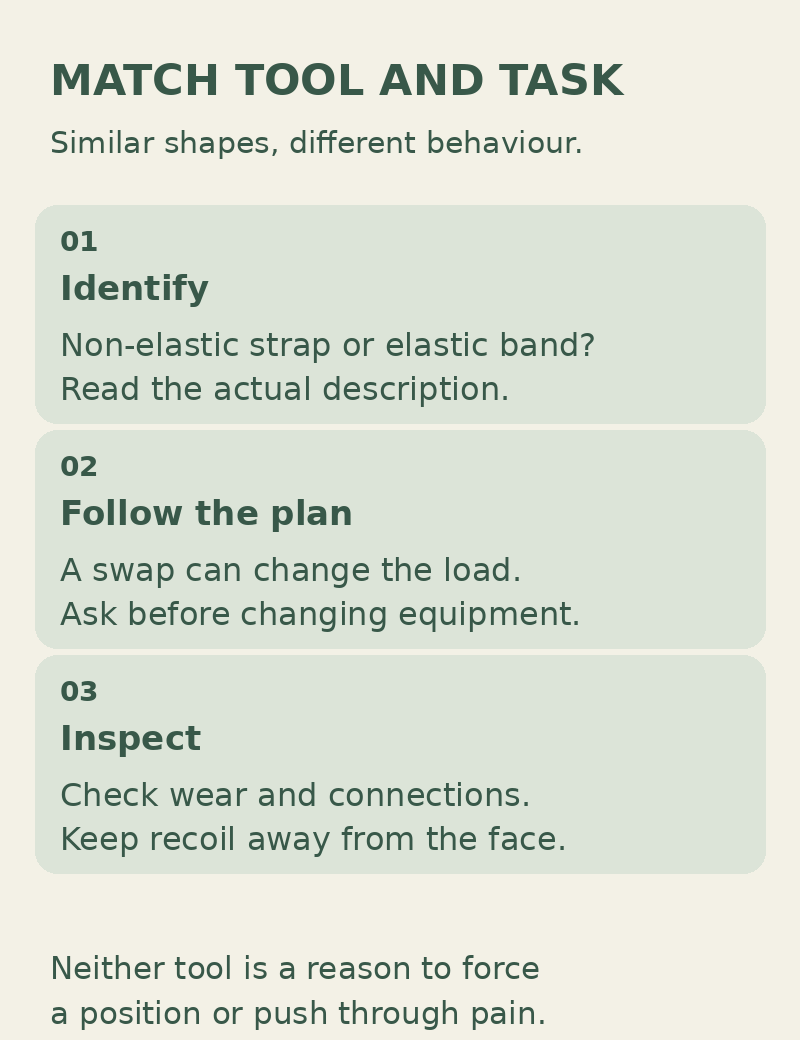
For a yoga strap, inspect the woven material, stitching and buckle. If the webbing is frayed, the buckle is damaged or the adjustment will not hold, do not use it. Learn how that buckle is meant to be threaded; different designs should not be treated as identical.
For resistance equipment, check the full band and every connection before use. Royal Devon and Torbay NHS advice both call for inspecting bands for damage or deterioration. Small cuts, nicks or splits are reasons to stop using the band, not places to patch casually and continue.
Performance Health also draws attention to wear around attachment points. Handles, loops and anchors add parts that need their own checks. Equipment that worked last time still needs inspection this time.
Do not invent an anchor setup
A yoga strap buckle is not automatically a resistance-band attachment. A door handle, furniture leg or other convenient object is not automatically an appropriate anchor either. Use only a setup and accessories specified for the equipment and exercise.
Royal Devon advises a secure attachment and keeping the potential recoil path away from the face. If you need help understanding the anchor or the route the band could travel if it slips, get instruction before exercising.
Protective eyewear also deserves attention. Performance Health’s band guidance recommends suitable eye protection, and the American Academy of Ophthalmology describes how a recoiling exercise band can cause severe eye damage. Eye protection does not make a damaged band or insecure attachment acceptable.
Colour is not a complete prescription
Resistance bands are often colour-coded, but read the chart for that exact product range. The colour systems in the NHS and manufacturer sources refer to the bands they discuss. They are not evidence that every green band from every maker behaves the same way.
A colour is also not a clinical assessment. Choosing a band depends on the exercise and the person using it. Do not automatically choose the strongest band available, or shorten a band to make an unfamiliar movement harder.
Likewise, the length of a yoga strap is not a flexibility score. There is no requirement to shorten the grip each session or stop using the prop as practice develops.
Latex, care and storage
Resistance bands may contain natural rubber latex. Royal Devon advises using a latex-free band when someone has a latex allergy or sensitivity. Check the complete product description, including accessories, rather than assuming that a fabric appearance establishes its ingredients.
Follow the care instructions for the actual item. Manduka’s Align strap instructions say hand wash and hang to dry, while other makers may give different directions. Band care also varies with the product. Do not apply a cotton-strap washing method to elastic equipment without checking.
NHS band guidance warns against direct sun and temperature extremes. Keep equipment away from items that could cut or damage it, and do not treat exercise bands as toys. If the condition of a band is uncertain, ask the supplier or your clinician rather than trying one more repetition.
When to stop and ask for help
Stop an exercise that causes pain, numbness, tingling, dizziness or difficulty breathing. Do not use the extra reach of a strap or the pull of a band to push through a symptom. A healthcare professional can advise on symptoms; a qualified teacher can help with suitable yoga choices.
If a band strikes an eye, take it seriously. The American Academy of Ophthalmology notes that serious damage may not be immediately obvious. Get medical help right away for pain, trouble seeing, flashes, floaters or other signs of injury rather than waiting for the next practice.
Common questions
Can I use a resistance band instead of a yoga strap?
Not as an automatic swap. Elasticity changes the task and introduces recoil concerns. Ask for guidance on the specific exercise, or use the non-elastic tool the instruction calls for.
Can a yoga strap replace my prescribed therapy band?
No. It does not provide the same elastic resistance. Ask your physiotherapist for a suitable replacement if your therapy band is missing or damaged.
Which one is better for flexibility?
There is no useful universal winner here. They can be used in different kinds of practice, but the exercise, your needs and appropriate instruction matter more than choosing a category winner.
The useful choice
Choose the tool that matches the intended task. A traditional yoga strap extends reach; a resistance band adds elastic resistance. Read the actual product instructions, inspect the equipment and ask before substituting one for the other.
Sources and further reading
- Run To Yoga: non-elastic cotton strap example
- Manduka: Align strap construction and care
- Performance Health: resistance-band types and safety
- Royal Devon NHS: exercise-band advice
- Torbay and South Devon NHS: therapy-band guide
- University of Utah Health: exercise bands and eye injuries
- American Academy of Ophthalmology: band-related eye injury and warning signs
- Journal of Physical Therapy Science: elastic-band tension measurements