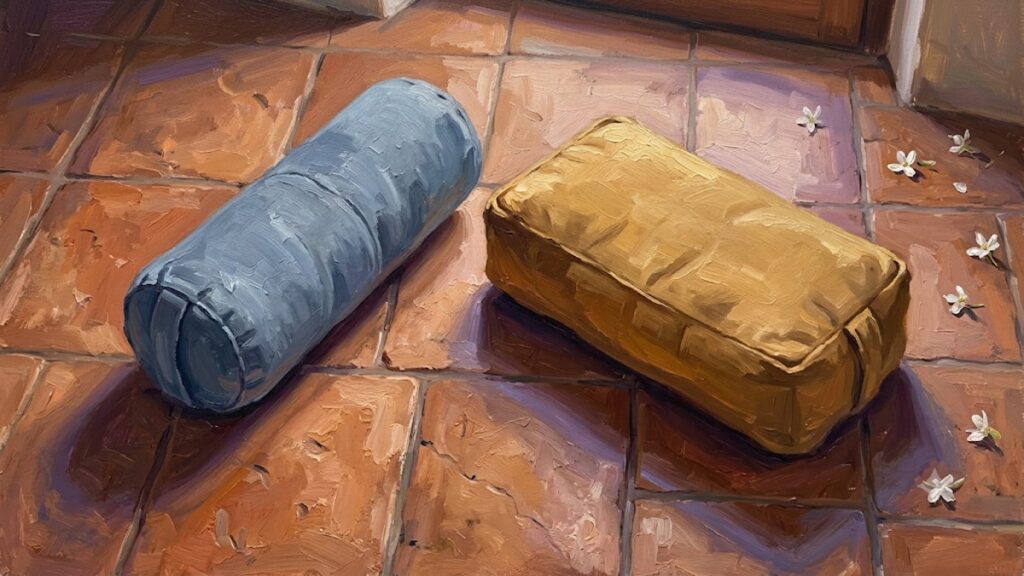
A round bolster and a rectangular bolster can both look inviting in a quiet yoga room. One has a curved surface; the other looks like a broad, flat cushion. The useful question is not which shape is more advanced. It is which surface fits the support you actually need.
Shape matters, but it does not decide everything. A small, firm rectangular bolster can feel very different from a broad, softly filled one. Two round bolsters may differ in diameter, filling and how much they compress.
This guide compares the equipment, not medical outcomes or a sequence of supported poses. Manufacturer examples explain construction differences; they are not a product ranking.
The basic shape difference
A rectangular bolster has broad, relatively flat faces. A round bolster is cylindrical, with circular ends and a curved lengthwise surface. Yoga Journal Japan and Hugger Mugger both distinguish the flat contact of a rectangular bolster from the curved contact of a round one.
The rectangular design can provide a broad resting surface and a flat base. A round bolster offers a different contour, but its curved underside means you also need to notice whether it moves. A cylinder is not automatically unstable, and a rectangle is not automatically secure on every floor.
Check the actual prop on the surface where it will be used. Fabric, filling, wear and the way it is positioned all belong in the comparison.
At a glance
| Check | Round | Rectangular |
|---|---|---|
| Surface | Curved | Broad and flat |
| Shape | Cylinder | Flat-sided cushion |
| Measure | Length and diameter | Length, width, height |
| Notice | Contour and movement | Width and edge feel |
| Firmness | Depends on construction | Depends on construction |
Where the flat surface helps
Hugger Mugger describes its rectangular Standard bolster as having a flat top and bottom for stability. Its selection guide suggests a rectangular shape as a versatile starting point for broad support. That is a manufacturer’s practical recommendation, not a rule that everyone should buy one.
If your teacher uses a broad support surface in a familiar setup, a rectangular design is worth comparing. Look at whether the width gives you the contact you want and whether the edge feels comfortable.
A flat shape does not justify making a tall stack of props. If the arrangement shifts, feels precarious or asks you to brace, stop and ask for a different setup rather than assuming a rectangular base solves the problem.
Where the curved surface helps
A round bolster may be worth trying when you prefer a rounded contact surface. Hugger Mugger gives support beneath the knees as one common use. Its guide also makes clear that a rectangular bolster can be used there, too.
The distinction is therefore not round for one pose and rectangular for another with no overlap. It is how the contour, size and firmness feel in the particular arrangement. A curve that one person likes may be too high or too concentrated for someone else.
Do not choose a cylinder simply because an advertisement promises a deeper stretch. Extra range is not the same as appropriate support, and more intensity is not a requirement of using a bolster.
Height can matter more than the outline
Compare the dimensions before deciding from photographs. Rectangular bolsters are normally described with length, width and height. For a round one, look for length and diameter, and check which measurement the seller means.
Hugger Mugger notes that there is no single universal standard bolster size. A product called standard or large from one maker should not be assumed to match another maker’s version.
Height changes the amount of lift. Width changes the available contact surface. Length affects how much space the prop occupies in your intended setup. None of those measurements alone tells you whether a position suits your body.
Remember that listed dimensions describe the product, not necessarily its height once someone rests on it. Ask about compression and try the actual design if possible.
Round does not automatically mean softer
Shape and firmness are separate questions. Hugger Mugger discusses cotton batting, foam constructions, hull fillings and fibre fills as different ways a bolster can be made. The amount of fill and the construction also affect how it feels.
Manduka UK’s round and rectangular enlight product pages both describe cushioned, fibre-filled designs. That is another reason not to use the outline alone as a firmness rating. Nor does it establish that every model carrying a similar name has the same feel.
Descriptions such as firm, soft and supportive are useful starting points, but not a shared measurement scale across all brands. If you like a studio’s bolster, note its exact model and condition rather than shopping only for the same colour and shape.
Try the support, not a new pose
When comparing bolsters, use a familiar, suitable setup with guidance if needed. You do not need to add a backbend, deeper fold or long hold simply to test a cushion.
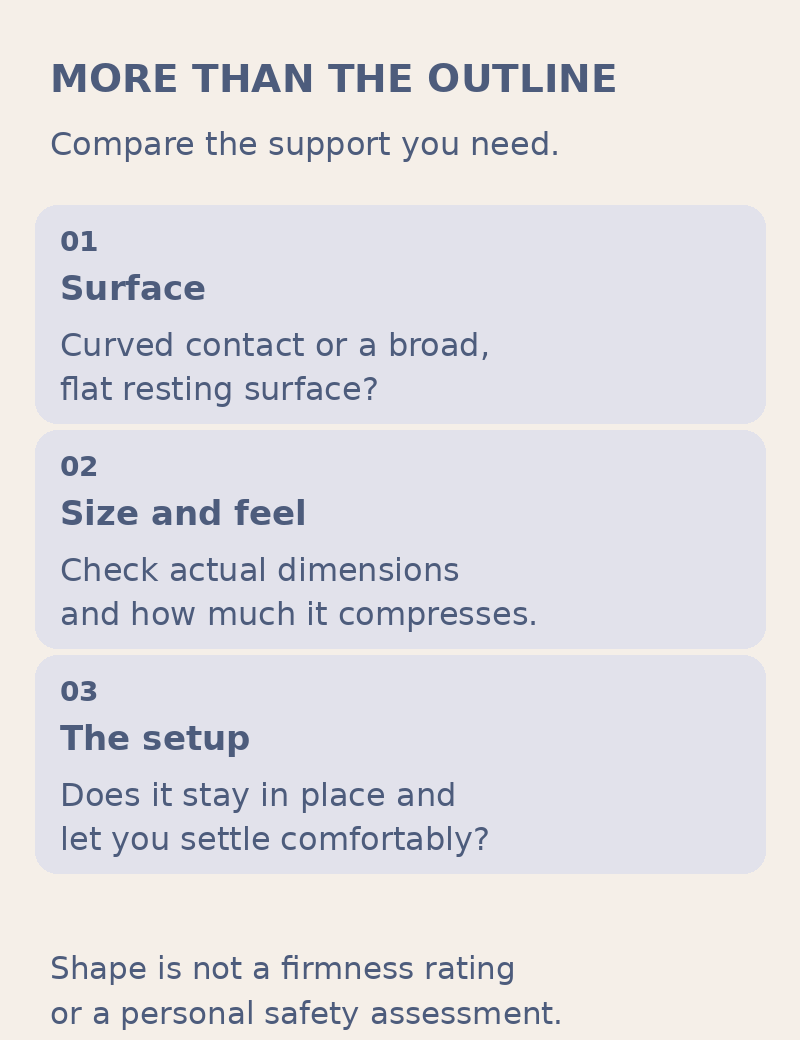
Notice whether you can settle without reaching, gripping or holding yourself away from the prop. Check whether an edge presses uncomfortably and whether a curved surface stays where it is intended to stay. A quick squeeze in the hand cannot answer every question about support under use.
If a setup feels too high, do not force yourself onto it to justify the choice. Ask for a lower support or a different arrangement. You can also decide that neither of the two models is the right fit.
What about restorative and yin yoga?
Either shape can appear in restorative or yin classes. A room with round bolsters is not automatically one style, and rectangular bolsters do not define another.
Our yin and restorative comparison explains why the intention matters. Supported rest without seeking a stretch differs from a practice that deliberately includes sustained sensation. The prop does not decide that intention for you.
Ask the teacher what support the class needs and whether alternatives are available. There is no need to buy both shapes before attending an introductory class, especially if the studio supplies equipment you can try.
Care is a separate decision
A zipper does not establish that a cover should be removed. Hugger Mugger’s bolster guide advises against removing its tightly fitted covers and recommends spot cleaning. Manduka UK’s listed enlight models give directions for removing and washing their outer microfiber covers.
Those instructions belong to the particular products. Do not transfer the washing method from one bolster to another just because the shapes match. A washable outer cover also does not establish that the filled inner can be soaked or machine washed.
Our bolster cover guide covers model matching and the difference between the outer fabric and the inner cushion. Read the label before cleaning, and store the prop dry.
Practical questions before choosing
What is the intended use? Does your teacher recommend a broad surface or a rounded contour for that setup? What are the actual dimensions, filling and listed weight? Can you move and store the prop comfortably?
Then check the cleaning instructions and whether a replacement cover is available for that exact model. These are more useful questions than deciding that one shape is universally more professional or better for beginners.
Keep safety separate from softness
NCCIH recommends qualified instruction and individual advice for people whose health conditions, pregnancy or other needs may call for changes to yoga practice. A soft-looking prop is not a personal safety assessment.
If you have an injury, recent surgery, a medical condition or pregnancy-related needs, check with your healthcare professional and give the teacher that guidance. Do not rely on a product description to select a therapeutic position.
Stop for pain, pinching, numbness, tingling, dizziness or difficulty breathing. The aim is not to endure pressure because the bolster is sold as supportive.
Common questions
Is a rectangular bolster the best first choice?
It can be a useful starting point when you want broad, flat support. Compare the actual size and feel, and ask about your intended setup. It is not a universal recommendation.
Can a round bolster replace a rectangular one?
Sometimes a teacher can adapt the setup, but do not assume a direct swap. Shape, height, contact and movement may change.
Do I need both?
Not necessarily. Try the equipment supplied in a class or identify your main use first. Two shapes are not a requirement for beginning a supported practice.
The useful comparison
Choose between curved contact and a broad, flat surface, then check dimensions, firmness, movement and care. The better bolster is the one that fits the intended support, not the one that promises the deepest stretch.