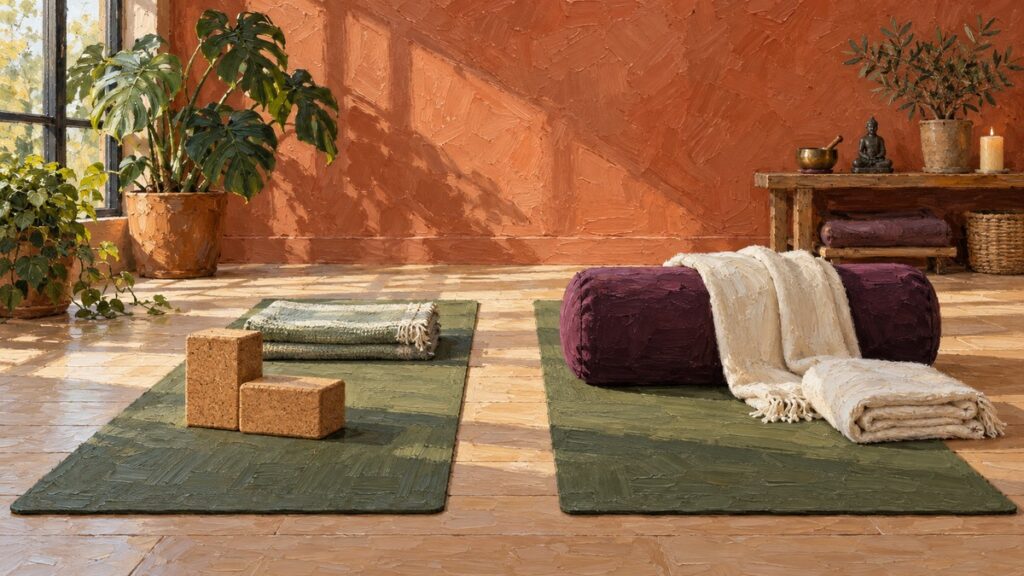
Yin yoga and restorative yoga can look similar: a quiet room, floor-based positions, blankets and time spent still. The main difference is the intention. Yin commonly involves a sustained stretch or other physical loading. Restorative yoga, especially in the approach taught by Judith Hanson Lasater, uses support for rest without seeking a stretch.
That difference matters when choosing a class. A session can be slow yet physically demanding, and a room full of bolsters does not automatically make it restorative. Ask what the teacher will invite you to do, not only what equipment appears in the photograph.
This is a class-selection guide, not a sequence or a prescription for how long to hold a pose.
The aim matters more than the shape
Bernie Clark’s YinYoga.com distinguishes yin from restorative yoga by their different intentions. In yin, a position is used to create sustained sensation or loading. The Lasater restorative teacher directory describes gentle, supported positions for relaxation rather than stretches.
A similar-looking seated or reclining shape can therefore serve different purposes. If the instruction is to notice a manageable stretch, that is different from arranging support so that you do not have to seek or maintain a stretch. Looking at the silhouette alone will not tell you which experience is intended.
Neither approach is a test of how far you can move. The right question is whether the position and teaching match your purpose and individual needs.
| Ask | What to listen for |
|---|---|
| Aim | Yin: sustained sensation or loading. Restorative: supported rest without seeking stretch. |
| Props | Yin: support or adjust the position and sensation. Restorative: reduce effort and support rest. |
| Time | Both may include long stays. Ask about the actual class, not a fixed cutoff. |
| Choice | In either style, you should be able to adjust, leave a position or choose another option. |
Props do not separate the two styles
It is tempting to say that restorative yoga uses props while yin does not. That is misleading. Clark describes many reasons to use props in yin, including support, comfort and changing the amount or location of physical stress.
A block or bolster can reduce a reach, support a body part or change how a position feels. Its presence does not tell you whether the aim is rest. Ask what the prop is doing in that particular setup.
In restorative yoga, support is arranged to reduce the effort of staying in the position. If you are bracing to remain there or waiting for a strong stretch to become bearable, tell the teacher. More time in an uncomfortable setup does not turn it into supported rest.
Clark also warns that props do not make a practice injury-proof. A supported position can still be unsuitable, too intense or held longer than works for you.
A longer hold is not a definition
Both styles can involve staying in a position for minutes rather than moving on with each breath. Restorative classes may leave more time for rest and use fewer positions, but the schedules vary.
Yoga Journal’s comparison describes typical differences in duration while also explaining the different intentions. Cleveland Clinic describes restorative sessions built around fewer positions held for longer periods. Neither gives you a universal clock rule for every teacher or student.
Do not decide that a position becomes restorative after a certain number of minutes. Nor should a suggested duration become a target you must finish. Ask how the teacher introduces long stays and what alternatives are available if you want to move sooner.
Quiet does not always mean easy
A class with little movement can still ask for sustained physical input. Yin is not simply a flowing class slowed down, and it should not be assumed to be the least demanding option because most of the work happens near the floor.
Restorative teaching aims at ease, but the setup still has to suit you. Getting down to the floor, changing sides or finding comfortable support may need a different arrangement. A class described as gentle is not a personal safety assessment.
Stillness can also be an unfamiliar experience. You do not have to like long quiet intervals or feel calm on demand. Ask about open eyes, a different resting position, shorter stays or stepping out when needed. These are class-fit questions, not evidence that you are bad at yoga.
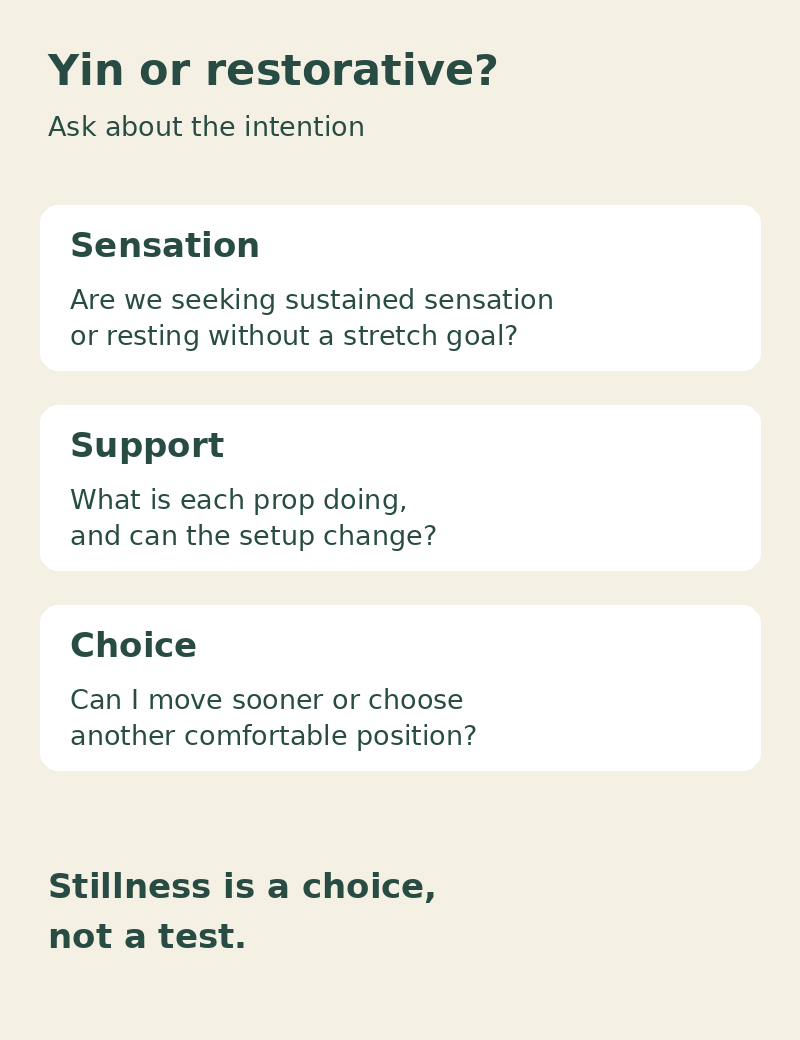
Questions to ask before joining
- Is this yin, restorative, or a class that combines both?
- Will we be seeking a stretch, arranging support for rest, or alternating between them?
- What props are supplied, and is there time to adjust them?
- How much floor work and getting up and down is involved?
- Can I change position, shorten a stay or choose an alternative?
- What experience does the teacher have with the needs I want to discuss?
A clear answer is more useful than a promise that the class is suitable for absolutely everyone. If your main aim is rest without stretching, say that directly. If you are interested in sustained sensation, ask how the teacher introduces it without pushing range or treating discomfort as an achievement.
What about a yin and restorative class?
Some sessions deliberately combine the approaches. You might be invited to work with sensation in one part and use fuller support for rest in another. That can be a clear plan, provided the teacher explains the change of intention.
Yoga Journal notes that the labels are sometimes confused. Instead of rejecting or trusting a mixed title automatically, ask what each part includes. A timetable name cannot tell you how the entire session will feel.
You can also change your choice from day to day. Wanting rest today does not commit you to one style forever, and enjoying yin does not mean every quiet practice needs a stretching aim.
Keep safety separate from the style name
NCCIH notes that yoga styles range from gentle to physically demanding and that injuries can occur. It recommends qualified instruction and individual advice for people whose health conditions, pregnancy or other needs may require modifications.
If you have an injury, joint condition, recent surgery or pregnancy-related needs, ask an appropriate health care professional about suitable activity and give the teacher that guidance. Neither a yin nor a restorative label establishes that a long-held position is right for you.
Do not use a comparison article to justify enduring pain, pinching, tingling, numbness or difficulty breathing. Stop the position and seek appropriate help for concerning or persistent symptoms. Tell the teacher if the setup feels wrong rather than waiting for the group to move.
Which should you choose?
If you want supported rest without a stretching goal, look for restorative teaching that explicitly offers that. If you are curious about sustained sensation in still positions, ask a qualified yin teacher about an introductory class and suitable options.
There is no need to declare a winner for sleep, anxiety, flexibility or recovery. NCCIH cautions that differences between yoga methods make research findings hard to generalize. An explanation of a method is not proof of a particular medical result or of superiority over another style.
Choose the class whose actual instructions, support and freedom to adjust fit what you are seeking. Afterward, consider whether you could follow the teaching, communicate discomfort and make changes without pressure. Those answers tell you more than whether your pose looked like the class photograph.
Sources
- YinYoga.com: different intentions in yin and restorative yoga
- Bernie Clark: props and their limits in yin yoga
- Restorative Yoga Teachers: the Lasater approach
- Yoga Journal: comparing intention, time and support
- Cleveland Clinic: restorative practice and comfort
- NCCIH: yoga styles, evidence limits and safety