Yoga and barre can both involve controlled movement, balance and close attention to the body. The main difference is their framework. Yoga is a broad practice rooted in Indian philosophy; barre is a ballet-inspired fitness method that commonly uses repeated movements, held positions and a stationary rail.
If you are choosing a class, compare what you will actually do rather than deciding from the name alone. A quiet, supported yoga session and an energetic barre workout are very different experiences. So are a demanding yoga flow and an introductory barre class.
This comparison explains those differences without prescribing a routine or declaring one activity the winner for every body and goal.
Yoga is broader than a workout format
The National Center for Complementary and Integrative Health describes yoga as an ancient and complex practice rooted in Indian philosophy. Many contemporary classes emphasize postures, breathing techniques and meditation, but yoga also includes elements beyond physical exercise.
A particular class might spend time in held postures, link movements together, or use supports for rest. The amount of breathing practice, quiet attention and traditional study varies. Ask the teacher what the class includes if any of those elements matters to your choice.
It would be misleading to reduce yoga to stretching or to assume it is always slow. NCCIH notes that styles range from gentle to physically demanding. The style, level and teacher tell you more than the word yoga alone.
Barre uses a different kind of class structure
Barre takes its name from the stationary rail associated with ballet. Cleveland Clinic describes a fitness approach drawing on ballet, Pilates and yoga, often with fine, controlled movements and many repetitions. Muscular endurance is a common emphasis.
The American Council on Exercise also describes sustained positions under isometric tension, meaning the muscles work while a position is held. Some classes alternate these holds with small movements often called pulses. Others include larger movements or faster intervals.
You may work at the rail and on a mat, with light hand weights, bands or a small ball. Equipment and sequence differ between methods. Barre is not simply yoga performed beside a rail, even when its class includes stretching or borrows a familiar shape.
| Ask | How the classes may differ |
|---|---|
| Focus | Yoga: Posture, breath and attention within a wider tradition. Barre: Ballet-inspired fitness with repeated movements and holds. |
| Moves | Yoga: May be flowing, held or supported. Barre: Often repeated small movements, with other exercises depending on format. |
| Props | Yoga: May include a mat, blocks, straps, blankets or a chair. Barre: May include a rail, mat, weights, bands or a ball. |
| Check | Yoga: Which style and level, and how much movement or rest? Barre: Which format, pace and resistance, and what beginner options? |
You do not need a ballet background
Mayo Clinic Press explains that ballet expertise is not required for a beginner barre class. You may hear unfamiliar movement names, but the instructor should introduce them rather than expect you to know the vocabulary.
That does not mean every class is a suitable starting point. Ask whether there is an introduction to the basic positions, whether you can watch a demonstration, and how the teacher helps new participants follow the pace.
The same principle applies to yoga. Being new is a reason to choose clear instruction, not a reason to force yourself into the shape of the person next to you. A beginner label should be supported by beginner teaching.
Low impact is not the same as easy
Barre is often described as low impact because many movements avoid jumping and heavy landings. Cleveland Clinic explicitly separates this from being gentle. Repeated muscle work and sustained positions can feel demanding even when the movement looks small.
Yoga can also involve substantial effort through body-weight support, balances and transitions. Moving slowly does not remove those demands. A mat, a rail or a small hand weight does not by itself establish how hard a session will be.
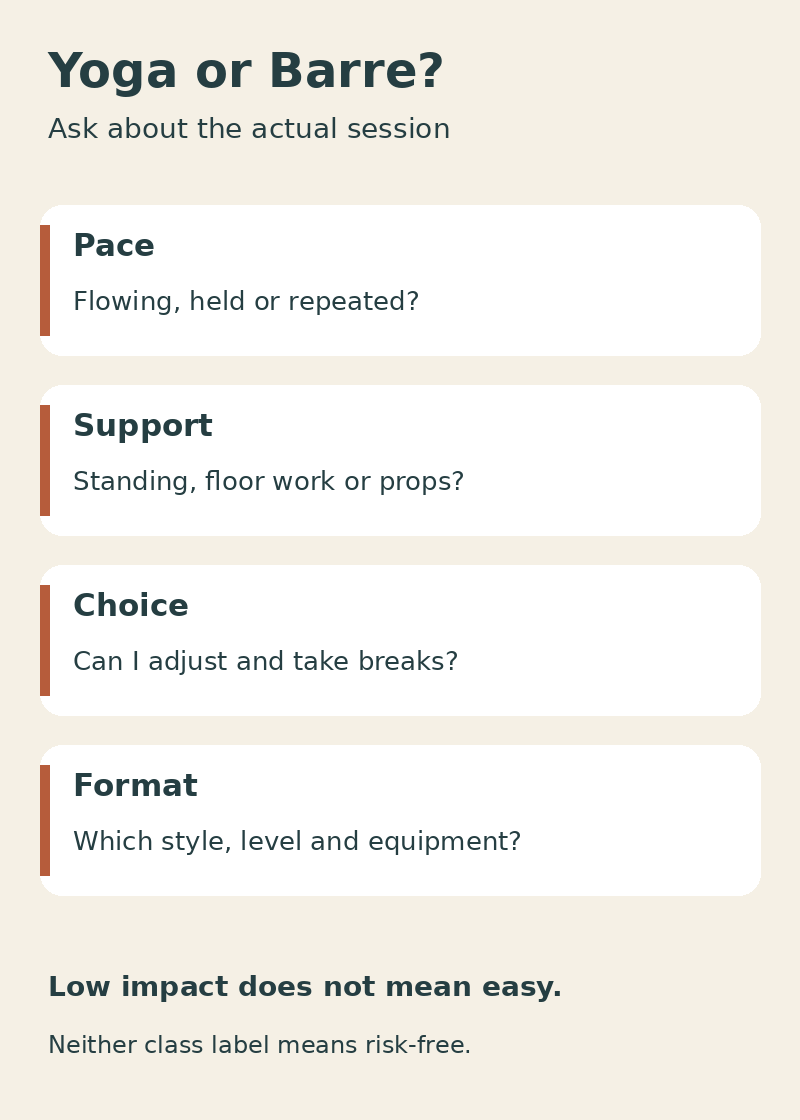
Compare two realistic starting options. Ask about time spent standing, getting down to the floor, pace changes and rest breaks. Do not compare an advanced version of one activity with the most supported version of the other.
Strength, flexibility and cardio are separate questions
Barre commonly emphasizes repeated muscle work and endurance. Some yoga classes challenge muscles through held postures and transitions. To understand the strength work in either class, ask which movements are used, what resistance is involved and how the challenge changes as you learn.
Both activities may include stretching and movement through different ranges. That does not establish a universal flexibility winner. A class description is more useful than a photograph of the deepest stretch or the widest ballet turnout.
Cleveland Clinic advises against forcing turnout, the outward rotation used in some ballet-inspired positions. Work in a range that allows control without pain and ask for an alternative. Extra range is not automatically an improvement.
For aerobic activity, the class name is not enough either. A quiet supported session and a faster interval format should not be counted as identical work. Consider your activity across the week rather than assuming one class covers every need.
WHO’s general physical activity guidance distinguishes aerobic activity from muscle-strengthening work. Mayo Clinic Press likewise advises treating yoga and barre as possible complements to cardio and resistance training. You can value a class without asking it to replace every other kind of movement.
Read the format, not only the brand
As one commercial example, Pure Barre describes a Classic format based on isometric movements, Define with additional dumbbell training, Empower with intervals, and Align with an emphasis on balance and flexibility. These are examples of how one operator separates its classes, not rules for all barre studios.
Those descriptions do not prove that one format is best, safer for everyone or guaranteed to change body shape. Treat promises about a dancer’s body, rapid results or injury prevention with caution.
Yoga styles and individual teachers vary too. If your priority is a quieter experience with time for breathing and rest, ask for that directly. If repeated fitness movements and a more structured workout appeal, ask a barre teacher which introductory class matches that interest.
What to check before a first session
Ask what equipment is supplied and what clothing or footwear the venue expects. A class photograph is not a reliable shopping list. If you need particular footwear or support, discuss that before attending rather than assuming a general studio rule settles your needs.
Describe any relevant limits to the teacher. Can standing work be changed? Is there an alternative to getting down to the floor? Can you pause without being singled out? Clear answers are more helpful than a claim that the class suits absolutely everyone.
For a home session, check the space and support the instructor requires before starting. Do not assume any lightweight chair can replace a fixed rail for every movement. If the setup is unsuitable, choose another session rather than improvise under load.
Keep safety individual
If you have an injury, a health condition, recent surgery or pregnancy-related needs, seek advice from an appropriate healthcare professional about suitable activity. Give them the actual class description. A yoga-versus-barre comparison cannot assess individual readiness.
NCCIH recommends qualified instruction for yoga and notes that injuries, including sprains and strains, can occur. Beginners should avoid extreme practices such as headstands and forceful breathing. This article does not teach those practices or advanced barre positions.
Do not chase pain, shaking or exhaustion as proof of a successful session. Pause if you cannot follow the instruction or control the movement. Stop if you develop pain, dizziness or feel unwell, and seek appropriate help for concerning symptoms.
Can you enjoy both?
Yes, but combining them is an option rather than a requirement. Consider the demands of the sessions and your existing routine. Adding an active class is different from adding a quiet supported practice, even if both use a mat.
After trying a suitable session, ask whether the pace, instruction and atmosphere worked for you. Did you understand how to adjust the movement? Were breaks welcome? Would you want to return? Those answers are more useful than deciding that one activity must always beat the other.
Choose yoga when its particular mix of posture, breath and attention fits your interests. Choose barre when its ballet-inspired fitness format appeals. Neither choice needs a promise about weight, appearance or a cure to be worthwhile.
Sources
- NCCIH: yoga, style variation and safety
- Cleveland Clinic: barre movements, intensity and beginner guidance
- American Council on Exercise: barre formats and isometric holds
- Mayo Clinic Press: comparing class experiences and starting safely
- WHO: general physical activity guidance
- Pure Barre: one operator’s class format examples