On a studio timetable, hatha yoga usually means a more pose-by-pose class, with time to settle and receive instructions. Vinyasa yoga usually means poses linked into a flowing sequence, with movement coordinated with breathing. The practical difference is how the class moves between positions, not a completely different set of poses.
There is a naming wrinkle: hatha also has a broader meaning that includes many forms of physical yoga. Vinyasa and hatha are therefore not always separate categories. A studio may use the names to distinguish two teaching formats rather than two unrelated traditions.
This comparison helps you read those labels and ask useful questions. It is not a home sequence, a fitness ranking or a promise that either format suits everyone.
Hatha has a broad meaning and a timetable meaning
The University of Southern California’s yoga style guide distinguishes the broad use of hatha for physical yoga from its modern use as a class label. In that narrower setting, students can expect time to settle into a pose and receive instruction without rushing.
Ekhart Yoga makes a similar distinction. Its hatha classes typically involve postures and breathing techniques, with slower practice and more static holds than vinyasa flow. Its discussion of hatha also includes practices beyond postures. Reducing the whole tradition to gentle stretching would miss that wider meaning.
For choosing a class, use the studio’s description. If hatha and vinyasa appear side by side, the studio is probably distinguishing teaching formats. Ask how it uses the words rather than treating the labels as a strict family tree.
The transition is part of the comparison
Healthline describes vinyasa as moving directly from one pose into the next, while noting that both the poses and the pace vary with the instructor. It also notes that hatha and vinyasa share many poses. A photograph of one standing shape will not reliably tell you which class it came from.
Imagine two classes that both include a standing posture. In one, the teacher first demonstrates the setup, gives people time to arrange support, then introduces the next position separately. In the other, the same posture appears within a linked passage. That is an illustration of teaching structure, not a fixed rule about either style.
The second class may ask you to follow instructions while already moving. The first may give more time to listen before changing position. Consider which learning environment you want, as well as which poses you recognize.
| Compare | Typical class distinction |
|---|---|
| Structure | Hatha: more pose-by-pose teaching. Vinyasa: more linked movement. |
| Breath | Both can teach breathing. Vinyasa often uses breath cues to time movement. |
| Learning | Ask whether setups are demonstrated and transitions explained. |
| Level | Neither name alone tells you the difficulty, support or time to rest. |
Breathing belongs in both
The difference is not that vinyasa includes breathing and hatha does not. Ekhart Yoga includes breathing techniques in its description of hatha classes. Healthline describes conscious breathing in both approaches and coordination of transitions with inhalation or exhalation in vinyasa.
A flowing class may give a series of breath-and-movement cues. Ask the teacher what to do if your comfortable breathing rhythm does not match the group. You do not need to force a larger breath, hold your breath or hurry a movement merely to arrive on cue.
Separate breathing exercises may also appear in a class. Their presence is another detail to ask about, rather than something the style name fully explains. NCCIH advises people new to yoga to avoid forceful breathing and extreme practices.
Slower is not a complete measure of effort
Kaiser Permanente contrasts generally slower hatha classes with faster, more continuous vinyasa. Peloton’s style guide also describes hatha as measured and vinyasa as more flowing. These are useful starting descriptions, not measurements of the particular session in front of you.
A slowly held standing position can still require effort. Moving more slowly also does not remove a balance demand, a kneeling position or a difficult reach. Conversely, an introductory flow can be taught with clear demonstrations, pauses and alternatives.
USC describes its vinyasa classes as potentially physically demanding and asks new students to tell the instructor. Peloton points out that beginner vinyasa options exist. Read those together: the actual class level and teaching matter more than a universal claim that one style is easy and the other is hard.
Check repeated movements, not only the headline pace
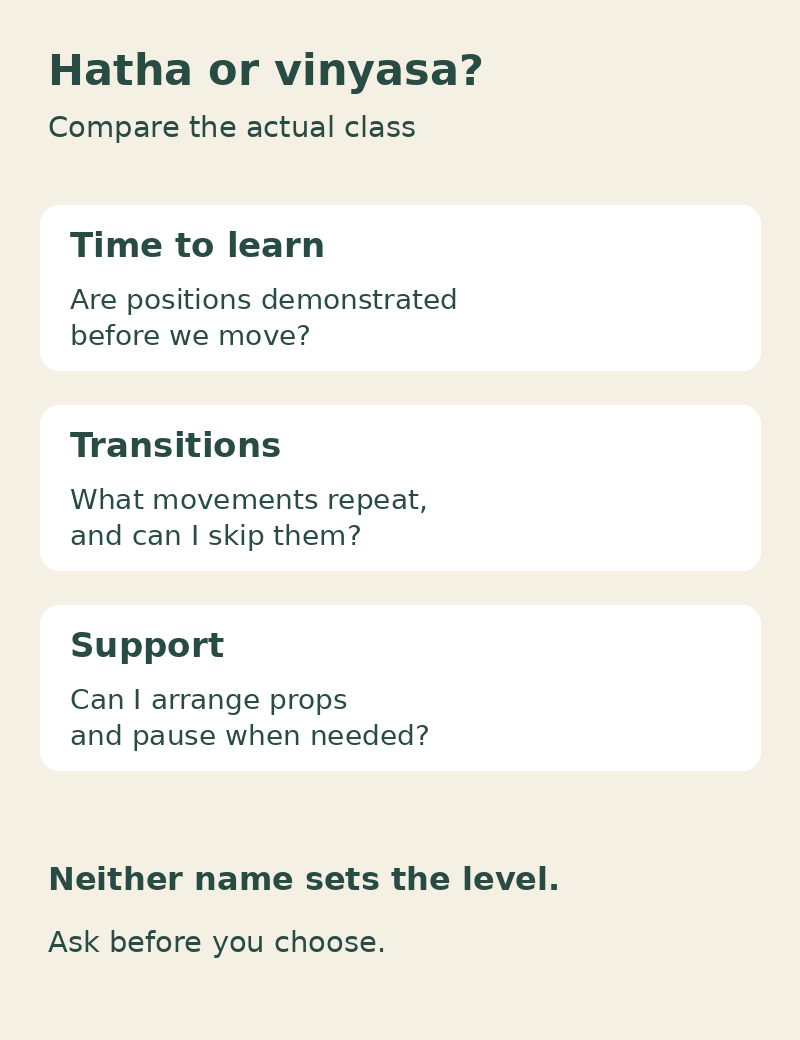
For someone comparing classes, a useful question is how often the session changes between standing and floor positions. Another is whether the same weight-bearing transition repeats throughout the flow. A class can feel manageable in one pose yet unsuitable in the movement that connects it to the next.
Ask whether the teacher explains those transitions, offers a route without them and leaves time to arrange props. Do not assume that a hatha label removes wrist loading or that every vinyasa class requires the same repeated passage.
If you need a chair, wall support or an alternative to kneeling, name that need when you ask about the class. A specific answer is more useful than being told that a style is suitable for all levels.
Questions for the teacher
- When you say hatha or vinyasa, what will the movement pattern actually be?
- Is this class designed for first-time students, or does it assume familiar pose names?
- Will you demonstrate setups and explain how to leave each position?
- How often do we move between the floor and standing?
- Can I skip a repeated transition or take a different resting position?
- What support is available, and is there time to set it up?
If you prefer time to watch and arrange each position, a clearly described pose-by-pose class may be a useful place to look. If you enjoy linked movement, look for a vinyasa class whose level and options match your experience. Neither choice needs to become a permanent identity.
Keep safety and health claims separate from the label
NCCIH says yoga styles range from gentle to physically demanding and that injuries can occur. It recommends qualified instruction. People who are pregnant, older adults and people with health conditions should discuss individual needs with their health care provider and instructor.
A hatha label is not medical clearance, and the word flow does not explain whether a movement is right for an injury. Seek individual advice when needed. Stop rather than pushing through pain, pinching, numbness, dizziness or difficulty breathing, and seek appropriate help for concerning or persistent symptoms.
There is also no need to declare one style the winner for weight, sleep, anxiety or flexibility. NCCIH notes that differences between the yoga methods used in studies make findings hard to evaluate. A description of class pacing is not evidence of a superior medical result.
Choose by the session you can actually take
Compare two real descriptions, not only two words. Look for the level, the way transitions are taught, the available support and your freedom to pause. After trying a suitable class, consider whether you had time to understand instructions and communicate a need without pressure to keep up.
For more background on each format, read our hatha yoga guide and vinyasa yoga guide. The useful comparison remains simple: how much pose-by-pose time do you want, and what kind of linked movement can you comfortably follow?