Ashtanga yoga and vinyasa yoga both link movement with breathing. The useful distinction on a class timetable is usually the structure: the contemporary Ashtanga method teaches an established sequence, while a general vinyasa class gives the teacher more freedom to arrange the flow. That does not mean every Ashtanga student does a complete series, or that every vinyasa class is different each time.
For a new student, another distinction matters just as much: who sets the pace, and how will you learn what comes next? Ashtanga may be taught in a teacher-led group or in a Mysore-style room where students learn and practise individually within the group. A vinyasa class has its own level, teaching style and expectations. Compare those details before choosing a label.
The names overlap, but the class formats differ
Here, Ashtanga means the contemporary Ashtanga Vinyasa posture method, not a general discussion of the eight limbs of yoga. The word vinyasa is already part of that method: breathing and movement are connected. It would be misleading to say that one style uses breath while the other does not.
Healthline describes the main contrast as a repeated Ashtanga pattern versus vinyasa sequences and pacing that vary with the instructor. Read that as a comparison of common teaching structures, not an absolute rule about every class. A vinyasa teacher can repeat a familiar sequence. An Ashtanga teacher may teach a student only the portion appropriate to their current learning.
Two people can therefore be working from the same Ashtanga system without doing the same amount of practice. Equally, two classes called vinyasa may ask very different things of a newcomer. A title is a starting point for questions, not a complete class description.
| Question | What to check |
|---|---|
| Order | Ashtanga: an established sequence. Vinyasa: usually teacher-planned flow. |
| Pace | Ask whether you follow a group count or receive individual instruction. |
| Entry | Check whether complete beginners are taught from the start. |
| Options | Ask about rests, props and alternatives to repeated transitions. |
Mysore does not mean practising without a teacher
The University of Virginia’s Contemplative Sciences Center describes Mysore as a self-paced setting with individual instruction. Students work on their own practice while a teacher helps people around the room. The room is shared; the instruction is not necessarily delivered to everyone at once.
Its FAQ explicitly says that students do not need to know the sequence before attending its Mysore class. New students learn pose by pose, with practice built gradually around their needs. Ashtanga Yoga Central similarly describes teaching a short sequence first and adding material over subsequent visits.
That is different from arriving alone with a chart and being expected to work everything out. It is also different from a led class where the next instruction is addressed to the whole group. If you want to try Mysore, ask the particular school how it welcomes someone who has never practised yoga before. The answer should explain the first visit, not simply say that all levels are welcome.
A long Mysore slot on a timetable also need not mean that every student practises for that whole period. Virginia’s FAQ describes students arriving within a practice window and building the length of their practice gradually. Check the school’s first-visit arrangements before assuming that you may drop in at any time. A newcomer may need an agreed arrival time so the teacher can give an introduction.
A led Ashtanga class has a different learning rhythm
In Ashtanga Yoga Central’s description of a counted led class, the teacher calls the postures and counts, and students move together. That shared rhythm is a real distinction from self-paced Mysore practice, even though both belong to Ashtanga.
A led class can help someone understand the overall structure and follow spoken guidance. It can also require prior familiarity. A timetable entry such as led primary is not, by itself, a promise of a first lesson. Ask what participants are expected to know and whether the class teaches a limited portion or follows a longer sequence.
Do not decide between Ashtanga and vinyasa as though Ashtanga has only one classroom format. You may prefer group instruction but still need a class designed to teach newcomers. Or you may prefer individual attention but need reassurance that a teacher will explain each new part. Those are practical learning needs, not tests of commitment.
Why advice about a first Ashtanga class can conflict
There is a useful disagreement in the sources. Virginia’s Mysore programme welcomes students who do not know the sequence. In a Yoga Journal answer, teacher Tim Miller recommends guided classes for complete novices and suggests trying Mysore after learning the opening material. Both describe Mysore as allowing individual pacing, but they do not offer the same entry recommendation.
The sensible response is not to declare one format universally best for beginners. Schools differ in how they organise teaching and divide the teacher’s attention. Ask whether the class you are considering is actually set up to introduce a new student. A beginner course, an introductory appointment or a designated first visit may answer that need better than an unqualified style recommendation.
Ekhart Yoga’s beginner Ashtanga class description provides another concrete example: it includes sun salutations and modified standing postures followed by relaxation. That is evidence of a particular introductory format, not a reason to assume every Ashtanga class is introductory.
Vinyasa is not one fixed level of difficulty
The University of Southern California describes its vinyasa classes as dynamic, breath-linked and potentially physically demanding. Healthline also notes that the flow and pace depend on the instructor. Together, those descriptions are a reason to read the class level, rather than treating vinyasa as the easier alternative to Ashtanga.
A teacher-planned flow may offer variety, but variety is not automatically easier to follow. A familiar repeated pattern may reduce uncertainty about what comes next, but familiarity does not remove physical effort. Neither observation establishes that one style is safer, better exercise or more effective for a health problem.
Ask whether the teacher demonstrates transitions, how quickly instructions arrive, and whether the class assumes that students already recognise pose names. Also ask what happens if you need to stop moving for a while. A clear answer tells you more than a description such as energising or flowing.
Look at the repeated transitions as well as the poses
When comparing two actual classes, ask how often the session moves between standing and the floor, and whether it repeats weight-bearing passages through the hands. A photograph of one standing pose will not show those demands. Nor will a list of pose names tell you how much time you have to arrange support between them.
If you need to avoid kneeling, loading a wrist or getting down to the floor, say so before class and ask what an alternative would look like. Do not assume that a familiar sequence must be completed unchanged. Do not assume that a general flow class will provide the support you need unless that has been discussed.
For more on this question, our guide to yoga without wrist loading looks at the whole session rather than a single pose.
Keep safety separate from tradition and ambition
NCCIH recommends learning with a qualified instructor and notes that yoga injuries can occur. It advises people new to yoga to avoid extreme practices and forceful breathing. A sequence’s traditional place in a system is not an instruction to attempt it before you are ready.
Pregnant people, older adults and people with health conditions should discuss individual needs with their health care provider and instructor. An injury, balance concern or other limitation may change what is appropriate. This comparison is general education, not clearance for either class.
Stop rather than pushing through pain, pinching, numbness, dizziness or difficulty breathing. Seek appropriate help for concerning or persistent symptoms. You do not owe a class a complete sequence, a matching breath count or a particular appearance.
Questions to ask before choosing
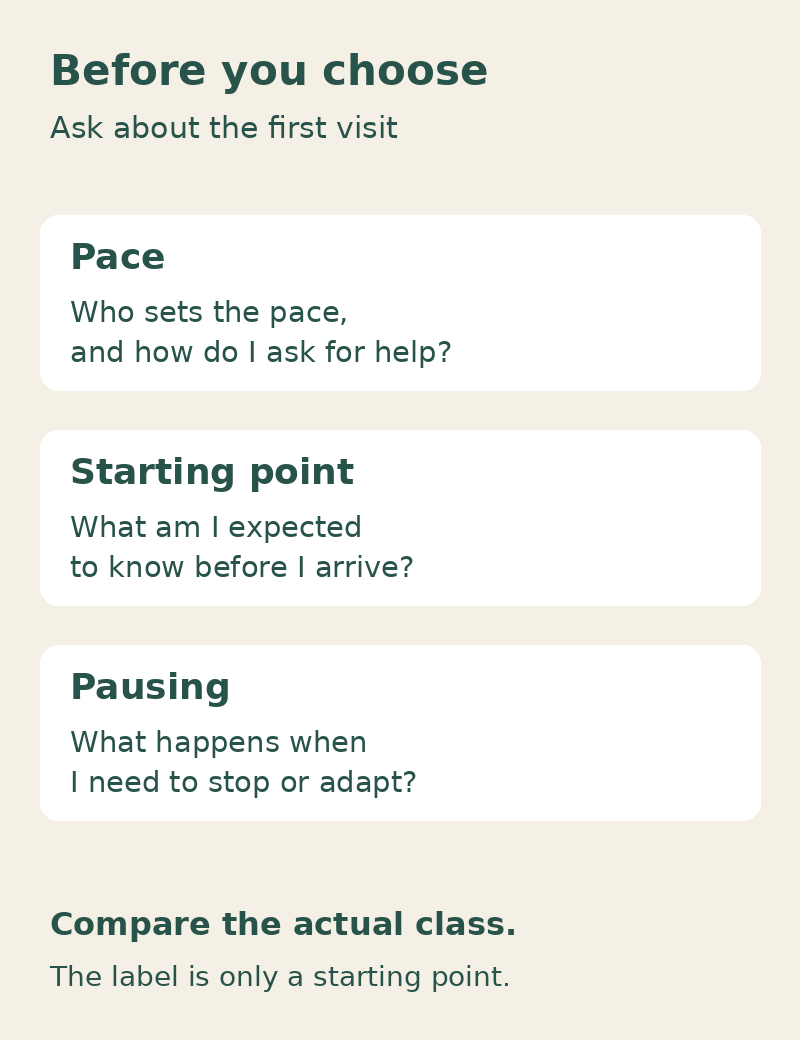
- Is this session designed to teach someone with no previous yoga experience?
- For Ashtanga, is it Mysore-style, a guided introduction or a counted led class?
- What do I need to know before I arrive?
- Who sets the pace, and how do I ask for help?
- Can I pause, use props or take an alternative to a repeated transition?
- How does the teacher introduce new material rather than expecting me to copy others?
If you like returning to a familiar framework, an appropriately taught Ashtanga introduction may interest you. If you prefer a teacher-planned flow, look closely at a vinyasa class’s level and teaching arrangements. Neither preference requires choosing a permanent identity or proving yourself in a demanding class.
Our Ashtanga yoga guide and vinyasa yoga guide give more background on each label. For the comparison itself, keep the decision concrete: the sequence you will learn, the way it will be taught and the options available when you need something different.
Sources
- Healthline: vinyasa, Ashtanga and sequence structure
- University of Virginia: Mysore class questions
- Ashtanga Yoga Central: Mysore and led formats
- Yoga Journal: Tim Miller on a beginner’s first format
- Ekhart Yoga: an introductory Ashtanga class description
- USC Yoga: class style guide
- NCCIH: yoga effectiveness and safety