Iyengar yoga is a form of hatha yoga, so the two names do not describe completely separate kinds of practice. The useful comparison is between a defined teaching method and a broader label that studios use in different ways. On a timetable, hatha often means a pose-by-pose class; Iyengar names the method developed by B.K.S. Iyengar and his family.
Both classes may include familiar standing, seated and reclining poses. What you need to compare is how those poses are taught, how support is arranged and what experience the class expects. A style name is a starting point for that conversation, not a guarantee of difficulty or suitability.
Start with the overlap, not a contest
The BBC describes Iyengar’s method as a form of hatha yoga. The University of Southern California’s style guide also explains that hatha has a broad meaning associated with physical yoga, alongside its narrower modern use as a class label. That is why saying you must choose between Iyengar and hatha can be misleading.
A studio may put the names in different boxes simply to help students read its schedule. One box might identify a specific method and teacher qualification; the other might describe a general class. Ask what the studio means rather than assuming that the labels settle the content.
This comparison concerns choosing an actual class. It is not a full history of hatha traditions, a home-practice sequence or a claim that one approach produces better health outcomes.
| Question | What the names tell you |
|---|---|
| Method | Iyengar: a defined method. Hatha: a broad term and a variable timetable label. |
| Teaching | Iyengar emphasizes precise explanation, demonstration and progressive learning. Ask how the particular hatha class is taught. |
| Props | Important in Iyengar teaching, but also used in other yoga classes. |
| Level | Neither label alone tells you whether the session welcomes first-time students. |
What is distinctive about Iyengar teaching?
The Iyengar Yoga Institute of Los Angeles describes precise language, demonstration, individual correction and a systematic progression from foundational learning. Its emphasis is on understanding the actions within a pose, rather than simply moving through a list of shapes.
USC similarly describes methodical explanations and attention to physical alignment. In practical terms, you may be asked to watch a demonstration, try a position, then reconsider a detail with further instruction. You can ask what an instruction means before trying to follow it.
That does not mean other hatha teachers ignore alignment, offer no individual help or teach without a plan. Those would be unfair conclusions from a broad label. The distinction is that these teaching priorities belong to the named Iyengar method; a general hatha listing needs more description.
Props are teaching tools, not a separate style
The Los Angeles institute lists several purposes for props. They can provide support, change access to a posture or help someone understand a particular action. A block or belt is therefore not only an easier substitute to discard as soon as possible.
The Iyengar Yoga Association Southeast also describes blankets, bricks and belts as tools for adapting practice to a student’s needs. The reason for a prop matters more than the number of objects beside the mat. Ask what you are meant to notice and how to leave the setup comfortably.
Other hatha classes can use the same equipment. Seeing blocks in a photograph does not identify a class as Iyengar, and seeing few props does not tell you whether teaching will be thoughtful. Compare the instruction and the purpose of the support, not the appearance of the room.
Do not copy an unfamiliar chair, belt or wall arrangement from a picture. Have the teacher explain its use in that class. Our yoga props guide gives general background, but a specific setup still needs appropriate instruction.
A defined method does not mean an identical class
The Los Angeles institute explicitly says its classes are not all the same. Sequencing varies with the students’ level and condition and other factors. Its beginner guidance introduces fundamental shapes and actions through repetition, with more material introduced gradually.
It is therefore inaccurate to describe Iyengar as one fixed sequence that every student completes. A shared teaching method can produce different lessons. Equally, a general hatha teacher may repeat a familiar sequence so that students can learn it over time.
Ask whether a course builds from week to week, whether you can join partway through and what a beginner session assumes. These details affect your first visit more directly than a broad comparison of pose lists. Knowing a pose name in another class does not necessarily mean you know this teacher’s way of studying it.
How teacher certification changes the comparison
The Iyengar Yoga National Association of the United States explains that Certified Iyengar Yoga Teachers have passed a standardized assessment and maintain continuing education and practice. Assessment includes demonstrated practice, a written examination and demonstrated teaching skills.
That gives you a specific qualification to ask about when a class is advertised as Iyengar. It does not establish the teacher’s experience with every injury, disability or learning need. You can ask both about certification and about the particular support you need.
Hatha is not one single teacher-certification scheme. A teacher using that label may have substantial training in a particular school, but the word alone does not tell you which training. Ask about the programme, experience with newcomers and the class’s intended level. This is a request for useful information, not a reason to rank all teachers by a label.
Ask how breathing is introduced
Do not assume that Iyengar teaching is only about external shape or that breathing belongs only in a general hatha class. The Los Angeles institute describes developing breath awareness in beginning classes, with formal pranayama introduced after a foundation in posture practice.
That is the institute’s stated teaching progression, not a reason to prescribe a breathing exercise to every new student. Ask whether the session includes separate breath practices and what preparation is expected. Someone looking for a quiet breathing class may need a different listing from someone seeking detailed posture instruction.
You do not need to force your breath to prove that you are following correctly. Tell the teacher if an instruction is uncomfortable or confusing. A useful explanation should help you understand what is being asked, including whether you can return to ordinary breathing.
Choose an entry point, not a challenge
The Los Angeles institute recommends an introductory course or beginner class for new students. It also encourages people coming from other yoga styles to begin at that level so they can learn the method’s principles. IYASE describes its beginner classes as introducing foundational standing, sitting and recuperative postures and the use of props.
Those descriptions are more useful than assuming that a slow class must be easy. Time spent in a standing position can still involve effort. Setting up support and following detailed instructions also takes attention. Conversely, a general hatha class can give a new student plenty of explanation and time to learn.
Neither label promises a particular pace, hold duration or amount of rest in every session. Ask what happens if you need to stop before the group. A suitable entry point leaves room to communicate rather than making endurance a test of belonging.
Discuss health needs before relying on the label
IYASE advises people with serious limitations to contact the studio about an appropriate class or teacher; a private meeting may be suggested before joining a group. This is an important limit on broad claims that props make every class suitable for everyone.
NCCIH recommends qualified instruction and notes that yoga injuries can occur. Pregnant people, older adults and people with health conditions should discuss individual needs with their health care provider and instructor. People new to yoga should avoid extreme practices and forceful breathing.
A certification or a cupboard full of equipment is not medical clearance. If you need to avoid kneeling, wrist loading or getting down to the floor, explain that need before class. Ask about the movements between positions as well as the positions themselves. Stop rather than pushing through pain, numbness, dizziness or difficulty breathing, and seek appropriate help for concerning or persistent symptoms.
Questions that make the choice clearer
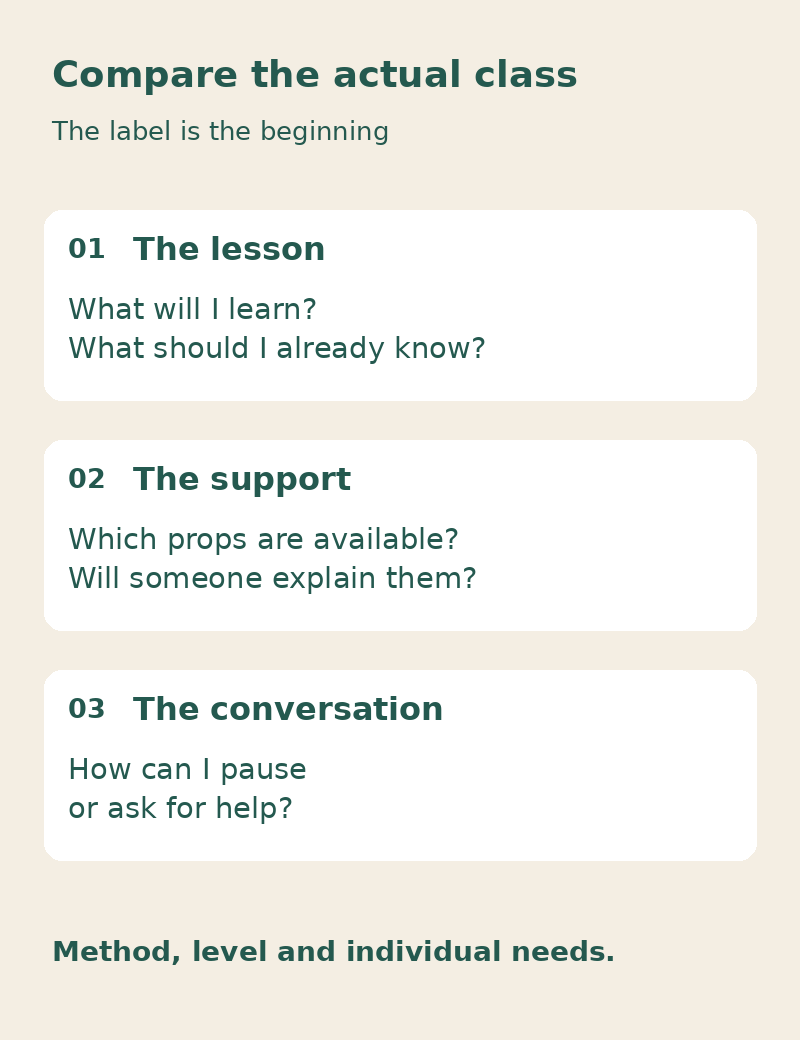
- Is this class designed for someone new to yoga or new to this method?
- What will I be expected to know before attending?
- Will setups and ways out of poses be demonstrated?
- Which props are available, and will their use be explained?
- How can I request a different position or take a rest?
- What training and experience does the teacher have for this class?
If you enjoy studying a few details at a time, a clearly described introductory Iyengar class may interest you. If you are considering general hatha, look for equally clear information about its teaching, level and support. You do not need to dismiss one to explore the other.
Our Iyengar yoga guide and hatha yoga guide provide more background. For this decision, keep the comparison specific: what will you learn, how will it be taught and can you ask for what you need?