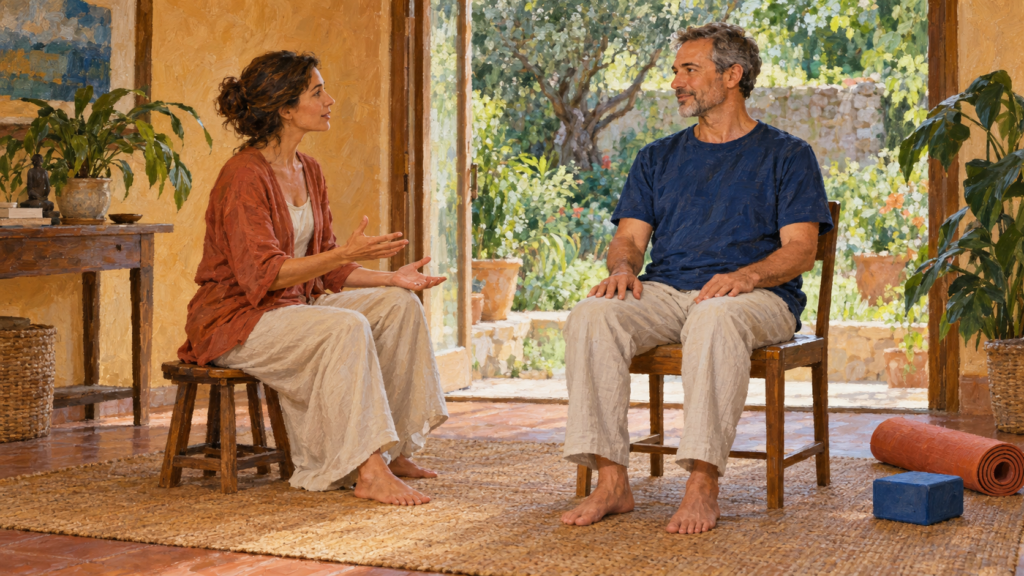
Viniyoga is an approach to yoga that adapts practice to the person rather than asking everyone to perform the same routine. The central question is what a practice is for, who is doing it and how it should change to fit that person’s circumstances.
That can mean changing a posture, choosing a manageable sequence or using movement alongside breathing and attention. It does not mean that every session must be easy, nor does it mean that any routine with modifications automatically represents this teaching approach.
If you have seen the name and wondered whether it is another spelling of Vinyasa, this guide explains the distinction. It also describes what to ask a teacher, how to understand individualization and where general information must give way to personal guidance.
What does Viniyoga mean?
The American Viniyoga Institute describes the term as implying differentiation, adaptation and appropriate application. In its teaching, the means and methods of yoga are selected around an individual’s condition, needs and interests.
A useful plain-language explanation is the appropriate application of yoga. The emphasis falls on the relationship between a method and its purpose, rather than on collecting a particular set of impressive positions.
Paul Harvey’s Centre for Yoga Studies makes an important distinction: the phrase ‘the Viniyoga of Yoga’ describes a process of applying yoga, not simply a style or brand. Organizations also use Viniyoga as a name for their teaching. Understanding both uses helps avoid treating one organization’s presentation as the entire meaning of the word.
Where the approach comes from
The approach is associated with the teachings of T. Krishnamacharya and his son and student T.K.V. Desikachar. The American Viniyoga Institute identifies Gary Kraftsow’s teaching as drawing on that transmission.
Yoga Journal’s historical account describes Krishnamacharya adapting postures, breathing and sequencing for different students. That account is useful background, but stories about individual students recovering from illness should not be treated as controlled evidence of a treatment’s effectiveness.
There is no need to memorize a family tree before starting. The practical lesson is that a teaching method can preserve its principles while changing its expression. Two people may work with a similar idea through different movements, positions or lengths of practice.
Function matters more than appearance
The American Viniyoga Institute lists function over form as a defining feature. Before choosing the shape of a posture, the teacher considers what the movement is intended to do within that practice.
For example, a forward-bending movement does not have to end with straight legs and hands on the floor. A teacher may change the knee bend, range or support. These are examples of the adaptation principle, not a prescription for a particular back or knee condition.
This changes the question from ‘Does my pose look right?’ to ‘Is this version appropriate for the task and for me?’ Appearance still provides information, but it is not the only measure. Comfort, breathing, steadiness and the person’s response also belong in the conversation.
Breathing and movement are connected
The institute also emphasizes breath as a medium for movement. Its teaching material describes using the breath to initiate movement and adjusting breathing patterns as part of practice.
This does not mean beginners should force a long inhale or copy a complicated ratio. A simple starting discussion is whether you can move without straining, holding your breath unintentionally or feeling rushed. If coordinating movement and breath makes the task harder, tell the teacher rather than trying to conceal the difficulty.
Breath practices are not interchangeable. Quiet observation, a longer exhalation and a breath-retention exercise make different demands. General reading cannot establish which is suitable for someone with a medical condition. Avoid forceful breathing and unsupervised advanced techniques when you are new to yoga.
Repetition and staying both have a place
A Viniyoga practice may include moving into and out of a posture several times as well as remaining in it. The institute calls this repetition and stay. Neither approach is automatically better in every situation.
Repeated movement can give a teacher opportunities to observe how a student responds. A stay offers a different experience of the position and the breath. The number of repetitions and the length of a stay should fit the person and the purpose, rather than become a challenge to endure.
For a newcomer, the useful question is why a movement is repeated or held. A clear explanation is more helpful than assuming that longer holds mean a more advanced practice. You should be able to shorten, pause or leave a movement without being pressured to finish.
Sequencing is more than a list of poses
The fourth distinction named by the institute is sequencing. Practices can differ in orientation, length and intensity according to their intention and context.
That means the order matters. Preparation, the main work and what follows are considered together. Taking the most demanding posture out of a sequence and practicing it alone can miss the reasoning behind its inclusion.
A written home practice should therefore be understandable as a whole. Ask how to begin, what to leave out if time is short and what signals mean you should stop. Do not assume that doubling every repetition makes the same practice twice as useful.
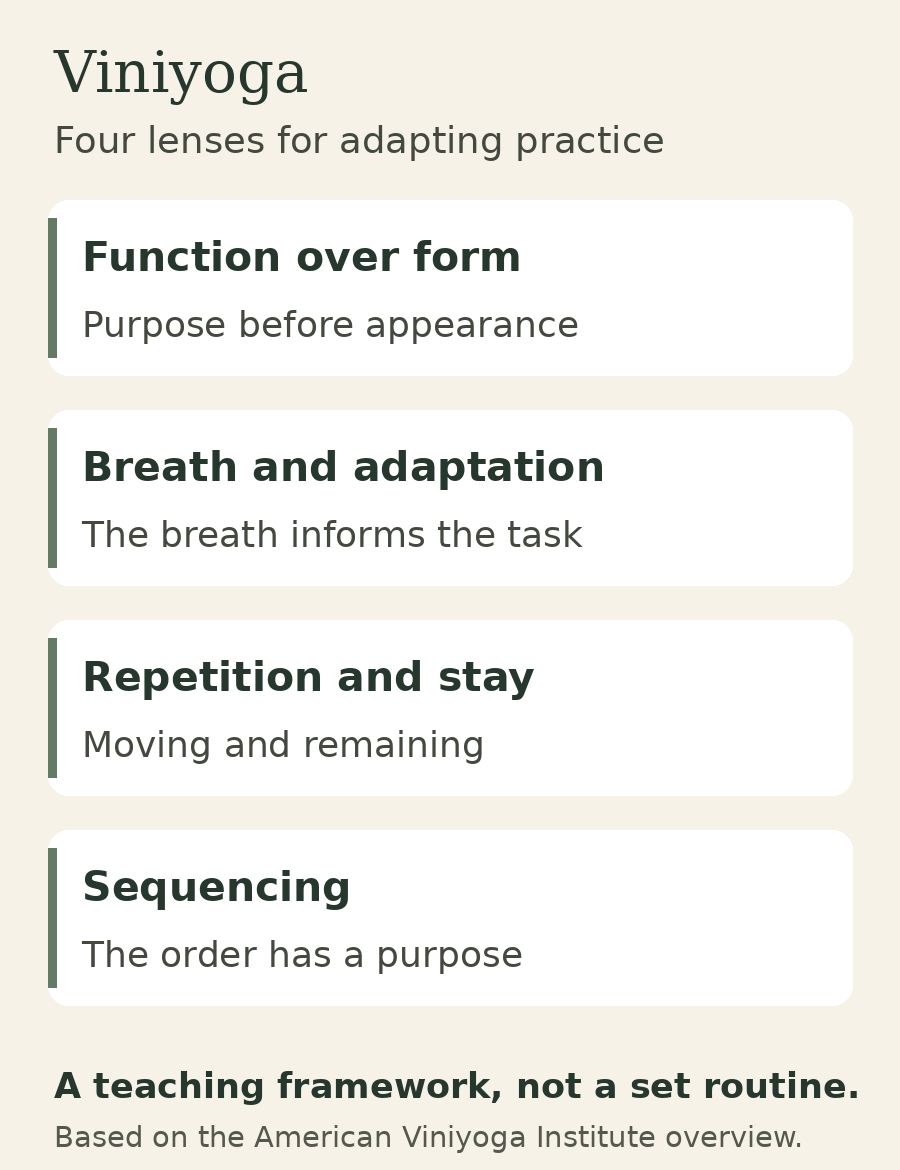
Four questions about an adapted practice
| Emphasis | Ask the teacher |
|---|---|
| Function over form | What is this version intended to do? |
| Breath and adaptation | Can we change the task if the breathing feels strained? |
| Repetition and stay | Why repeat this movement or remain in the position? |
| Sequencing | How do preparation, main work and finishing fit together? |
These are questions for learning, not a prescription for choosing your own therapeutic sequence.
Viniyoga and Vinyasa are not the same name
The similar spellings can cause confusion. A Vinyasa class label often refers to flowing movement linked with breathing, while Viniyoga emphasizes appropriate application to the individual. Breathing and movement can appear in both, so their presence alone does not distinguish them.
Nor should the comparison become a claim that one approach personalizes practice and every other approach ignores people. Many teachers across yoga traditions offer thoughtful adaptations. The meaningful question is how a particular teacher works, rather than whether the class name sounds right.
Read the description and ask about pace, transitions and alternatives. A label cannot tell you whether there is sustained floor work, repeated standing movement or a level of effort that suits your needs.
The practice can extend beyond postures
The American Viniyoga Institute includes breathing practices, sound, chanting, meditation, personal ritual and study of texts alongside asana. A session need not contain every one of these elements.
Different students may have different interests and cultural or religious boundaries. Ask what will be included and whether an alternative is available. You can be curious about a tradition without agreeing to every explanation or practice associated with it.
Traditional descriptions of personal transformation should be understood in their teaching context. They do not establish a medical mechanism or guarantee a particular psychological experience. If an activity feels uncomfortable or conflicts with your boundaries, say so.
What to ask before learning
Ask how the teacher learned this approach and what experience they have adapting practice for people with needs similar to yours. General teaching experience and specialist clinical knowledge are different things.
Useful questions include how the teacher chooses a sequence, what information they need from you and how they review your response. If you are learning remotely, ask how alternatives will be explained and what to do when a movement cannot be observed clearly.
Look for practical answers rather than a promise to fix everything. You should know whether the session is general yoga education or a more individualized service, and what falls outside the teacher’s scope. A respectful teacher can explain limits and recommend appropriate professional input.
Individualized does not mean risk-free
The National Center for Complementary and Integrative Health says yoga is generally considered safe for healthy people when performed properly with qualified guidance, but injuries can occur. Adaptation is a way to address needs, not proof that an activity cannot cause harm.
Pregnancy, existing injuries, balance difficulties, glaucoma and other health conditions can require changes. Discuss relevant needs with your healthcare professional and teacher. Avoid assuming that an ordinary sequence becomes suitable simply because it is performed slowly.
Stop if you experience pain, dizziness or difficulty breathing. Seek medical advice for concerning symptoms rather than treating them as signs that the practice is working. Yoga should not delay assessment of a medical problem or replace prescribed care.
What about yoga therapy and health claims?
Some Viniyoga organizations teach yoga therapy and describe applications for health challenges. This does not make every Viniyoga class a medical treatment, and the name alone does not prove effectiveness for a particular condition.
NCCIH notes that yoga research involves different practices, which makes its findings difficult to compare. Results from one programme cannot automatically be applied to every sequence, teacher or individual. A lineage description explains teaching history; it is not a clinical trial.
If a health goal is your main reason for considering yoga, ask what evidence supports the proposed practice and how it fits with your existing care. Keep diagnosis, medication decisions and rehabilitation advice with the appropriate healthcare professionals.
Making a personal practice workable
The practical value of adaptation depends on feedback. Tell the teacher what was manageable, what was confusing and how you felt afterward. A short note about the movements and your response can make the next discussion more specific.
Agree on a realistic amount of practice instead of copying someone else’s schedule. If your energy, available space or circumstances change, ask how the plan should change too. A useful routine is one you understand well enough to follow without forcing yourself through it.
Viniyoga is best understood through that relationship between purpose, person and method. Begin with clear questions, preserve your right to choose and let practice develop through observation rather than through a demand to match a picture.
This is an educational overview, not a personal sequence, a breathing prescription or instruction in advanced practice.