Would you rather learn a yoga practice, move with music, or try an activity that fits comfortably into your week? Yoga and dance can answer different interests, but neither name tells you everything about a class.
A supported yoga session differs from a demanding flow. An introductory social dance lesson differs from a fast dance-fitness workout or technical ballet class. Comparing the hardest version of one with the gentlest version of the other is not very useful.
This guide compares learning goals, class experience and practical questions. It does not prescribe a routine or declare a winner for every person, body or health condition.
Yoga is more than a stretching class
NCCIH describes yoga as an ancient and complex practice rooted in Indian philosophy. Many contemporary classes emphasise postures, breathing techniques and meditation, while the wider practice includes more than physical exercise.
Styles range from gentle to physically demanding. A class may spend time in held poses, link movements together, use supports or include quiet attention and rest.
If you want to learn yoga’s particular practices or wider context, ask what the teacher includes. A session with music and flowing movement can still be yoga; silence and stillness are not universal entry requirements.
Dance is a broad category too
MedlinePlus lists many dance styles, including salsa, ballroom, tap, ballet, jazz, modern dance and folk forms. It also distinguishes dance-fitness classes that draw movements from several styles.
A technique class might teach specific steps and ways of moving. Another class may focus on choreography, creative expression, social participation or following a fitness routine to music.
These differences matter more than a general claim that dance is always fast, social or performance-focused. You do not have to want a stage career to take a beginner class, and not every class requires a partner.
Yoga and dance compared
| Question | Yoga | Dance |
|---|---|---|
| Learn | Poses, breath, attention | Steps, technique or expression |
| Structure | Held, flowing or supported | Drills, routines or social forms |
| Music | May be included | Often part of the activity |
| Effort | Depends on the style | Depends on style and pace |
| Check | Floor access and options | Level, footwear and movement |
These are common features, not rules for every tradition or teacher. Read the actual description before deciding which starting point suits you.
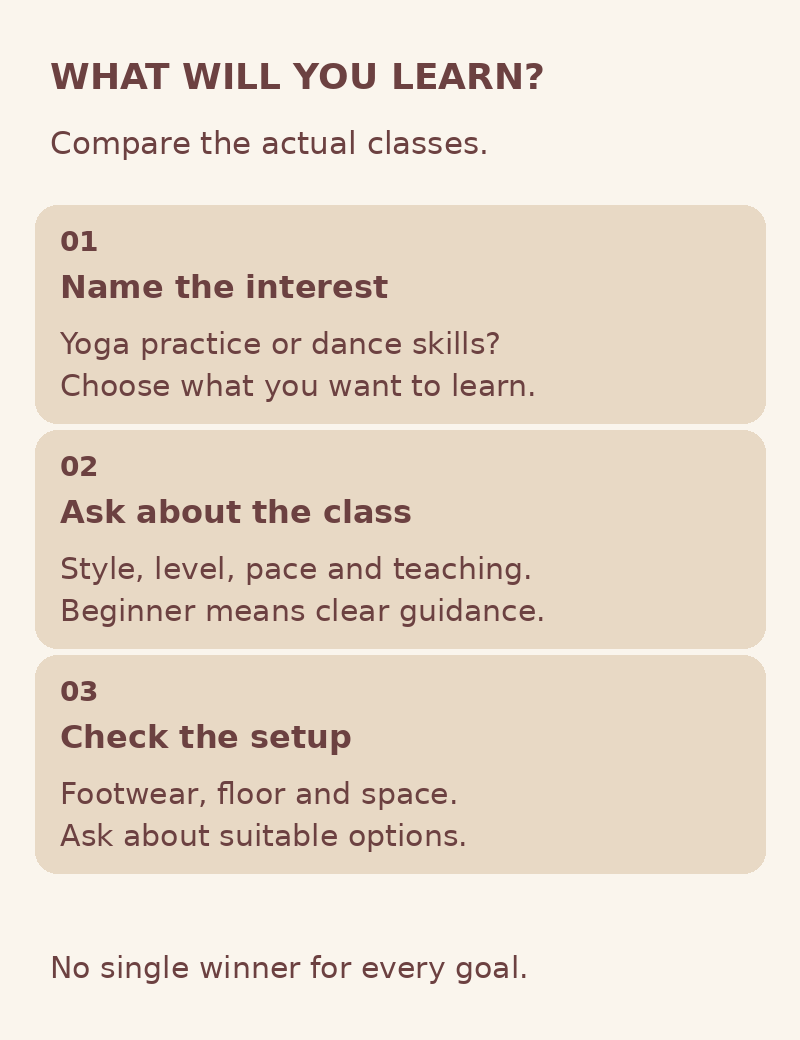
What do you want to learn?
If you want to learn a dance form, a suitable dance teacher directly addresses that goal. Yoga cannot replace instruction in rhythm, vocabulary, partnering or the technique of a particular style.
The Royal Academy of Dance’s adult class descriptions illustrate the variety. Its beginner ballet classes teach basic technique, while its jazz classes include technical exercises and choreography. Contemporary classes have their own movement vocabulary and entry expectations.
These are examples from one school, not a universal syllabus. Their useful lesson is to ask what you will be taught and what prior knowledge is expected.
If your interest is yoga’s postures, attention or wider practice, choose a yoga class that explains those elements. You do not need to justify that interest by proving it is the best substitute for dance.
Which is more aerobic?
Dance can provide aerobic activity, but the amount depends on the style, pace and time spent moving. MedlinePlus distinguishes the demands of different forms rather than treating all dance as one workout.
A lesson with demonstrations and pauses differs from a sustained dance-fitness session. Learning a difficult step can be mentally demanding without making every minute vigorous exercise.
Yoga intensity varies too. A quiet supported class and an active flow have different demands. Do not assume an activity meets an aerobic goal just because it feels challenging or makes you warm.
The CDC explains aerobic intensity in terms of how hard your body is working and distinguishes aerobic work from muscle-strengthening activity. Look at your whole week rather than expecting one favourite class to cover everything.
Strength and flexibility are separate questions
Some yoga postures use body weight to challenge muscles. The CDC includes some yoga postures among examples of muscle-strengthening activity, but this does not mean every yoga class trains every major muscle group sufficiently.
Dance can also challenge muscles through its movements and positions. Moving Medicine suggests that people who dance regularly may benefit from including specific strength work alongside it.
Neither label proves a universal flexibility advantage. Ask about the movements, support and progression in the class. A photograph of a split, high leg or deep pose is not a sensible starting target.
Do not force a range simply because someone else can reach it. Extra flexibility is not the same as control, dance technique or readiness for a more demanding class.
Music, attention and atmosphere
If moving with music is the attraction, say that when looking for dance classes. Ask about the style of music, whether routines repeat and how new steps are introduced.
If you prefer less sound, fewer changes of direction or more time with each instruction, describe those needs rather than assuming every yoga class will supply them. Some yoga classes use music and a brisk pace.
You can also ask whether partnering, improvisation or performing in front of others is involved. A clear answer is more helpful than a broad promise that a class is suitable for everyone.
Beginner means new to that activity
Being fit does not mean you already know a dance vocabulary. Being flexible does not mean you know how to enter and leave yoga poses comfortably. Both activities involve learning.
MedlinePlus recommends a beginner class for someone new to dance or returning after inactivity. It also suggests watching classes when deciding what to try.
Ask whether the teacher breaks down movements, welcomes questions and offers pauses. A beginner label should mean beginner teaching, not merely permission to stand at the back and guess.
If coordination takes time, choose a manageable pace rather than treating uncertainty as a reason to move faster. Moving Medicine encourages newcomers to speak with the instructor, take breaks and use lower-impact options where offered.
Check footwear, floor and space
Ask the venue what footwear and clothing are appropriate for its particular class. The NHS La Bomba workout, for example, specifies trainers, while dance schools may have different requirements for different styles.
That is a reason to check, not a reason to buy specialist shoes before choosing a class. Do not assume yoga and dance share the same floor setup or that any shoe works on every surface.
For home activity, clear enough space for the session’s movements. A yoga mat is not automatically a suitable surface for travelling dance steps, turns or jumps. Follow the instructor’s setup guidance rather than improvising a slippery or obstructed area.
Low impact does not mean effortless
A class without jumps can still ask for sustained muscle work, balance or repeated changes of direction. Equally, moving slowly does not remove the load on wrists, knees or shoulders in some yoga poses.
Ask about floor transitions, time spent standing and alternatives to movements you cannot comfortably do. If balance or mobility is a concern, ask specifically about adapted or seated options rather than relying on a general fitness label.
Moving Medicine describes chair-based dance among accessible starting possibilities. Suitability still depends on your circumstances and the actual teaching, not simply the presence of a chair.
Safety is individual
NCCIH recommends qualified instruction for yoga and notes that injuries can occur. The NHS exercise guidance advises getting professional advice when health problems, injury, symptoms, recent surgery or pregnancy raise questions about suitability.
Give the professional the actual class description. This comparison cannot decide whether a particular session is appropriate for your condition.
Stop if movement causes pain or you become unwell. Seek appropriate help for concerning or persistent symptoms. Do not chase exhaustion, painful stretching or difficulty keeping up as proof of progress.
Can you enjoy both?
Yes, but combining activities is an option rather than a requirement. A demanding yoga class adds work; it is not automatically recovery from dance.
If you already dance, our guide to yoga alongside dance discusses a separate supporting practice. Keep dance technique, class warm-ups and any rehabilitation advice under the guidance of the appropriate teacher or clinician.
If ballet-inspired fitness rather than learning a dance form appeals, our yoga and barre comparison addresses that different choice.
The useful choice
Choose the activity you want to learn, then compare the teacher, level, access and demands of real classes. Neither yoga nor dance needs a promise about body shape, rapid results or a cure to be worth your time.