Yoga and running can both belong in an active life, but they do not ask you to learn the same thing. A yoga class may involve poses, breathing and attention. Running develops the specific skill and physical tolerance needed to move at a running pace.
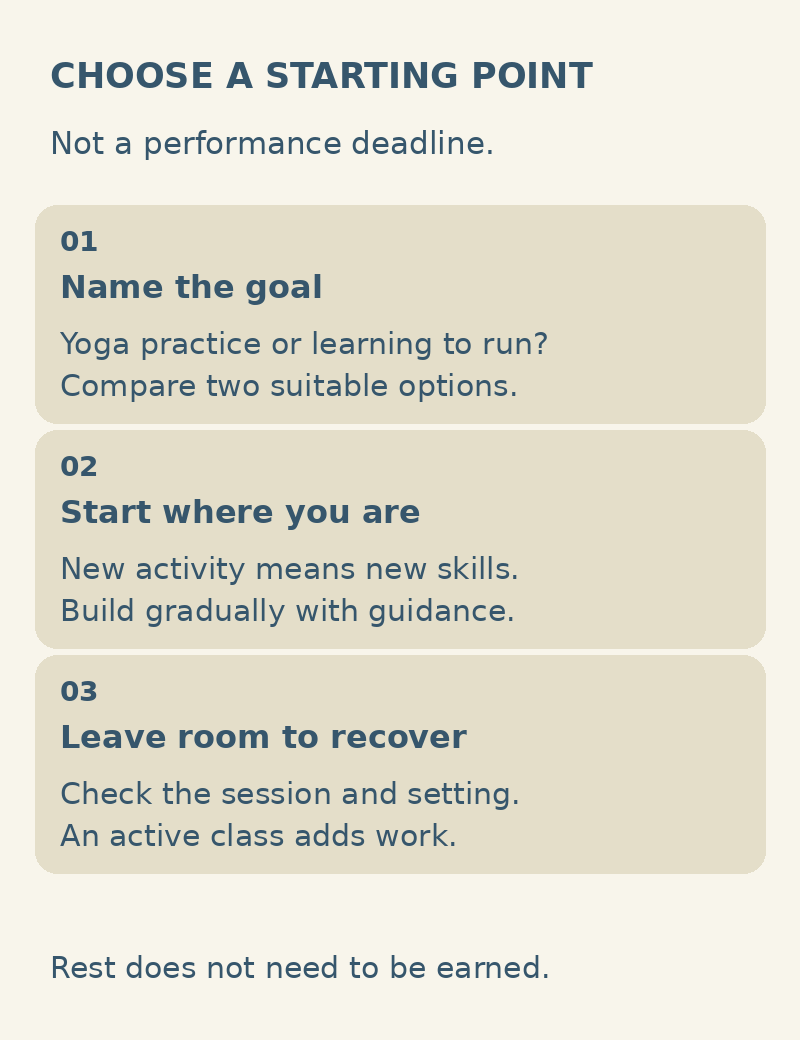
If you are choosing where to start, compare two realistic options: a suitable introductory yoga class and an appropriate beginner running approach. An advanced flow and a gentle walk-run session would tell a very different story from a supported yoga class and a hard training run.
This guide explains the choice without prescribing a schedule, promising weight loss or ranking one activity as best for every person.
What yoga includes
NCCIH describes yoga as an ancient and complex practice rooted in Indian philosophy. Many contemporary classes emphasise postures, breathing techniques and meditation, although yoga includes more than physical exercise.
Its styles range from gentle to physically demanding. Some classes involve supported rest and held positions; others link movements and require considerable muscular effort.
Ask about the actual style, pace, floor access and options for support. The word yoga does not guarantee either a quiet rest period or a complete fitness programme.
What running involves
Running is a form of locomotion that can be practised for enjoyment, transport, fitness or sport. A beginner’s task is not necessarily to run continuously or quickly. Learning to manage effort and build gradually matters.
The NHS Couch to 5K programme introduces running through a mix of walking and running, with rest days between sessions. It illustrates a gradual starting approach, not a requirement to match another person’s pace.
Running can also be social. England Athletics’ RunTogether programme describes leader-supported groups ranging from introductory walk-jog sessions to more challenging runs. That is one organised example, not a rule that you must join a group or race.
Yoga and running compared
| Question | Yoga | Running |
|---|---|---|
| Common task | Poses, breath and attention | Moving at a running pace |
| Effort | Varies widely by class | Varies with pace and terrain |
| Starting help | A suitable yoga teacher | A gradual plan or qualified leader |
| Setting | A stable practice space | A suitable route or facility |
| Check | Support and transitions | Progression, route and recovery |
The categories are broad. Use the table to ask better questions, not to assume every yoga class or running session has identical demands.
Running is more directly aerobic
The CDC lists jogging and running as examples of vigorous aerobic activity. Running therefore directly addresses aerobic fitness when the activity and effort are suitable for your health and current ability.
That does not mean a beginner should try to work as hard as possible. The CDC also explains that intensity depends on the person. A pace that feels manageable to one runner can be too demanding for another.
Yoga intensity varies, and a class that feels difficult does not automatically provide the same sustained aerobic work. A demanding balance or body-weight hold can be challenging for reasons other than cardiovascular effort.
If aerobic activity is your main goal, ask how it fits into the whole week. You can value yoga for its own practices without claiming it replaces every other form of exercise.
Strength is another part of the picture
The CDC distinguishes aerobic activity from muscle-strengthening work. It includes some yoga postures among strengthening examples, but not every yoga class works every major muscle group sufficiently.
Running does not remove the value of other training either. Cleveland Clinic’s beginner running guidance recommends including strength work and other activities rather than doing only running.
Look at what a session actually asks your muscles to do, what support is used and how challenge changes over time. Neither owning a yoga mat nor completing a run proves that every fitness need has been covered.
Fitness in one activity is not experience in the other
A regular yoga practice does not automatically prepare your legs for a large amount of running. Cleveland Clinic notes that even aerobically fit beginners can benefit from gradually adapting to running’s impact.
Likewise, a runner may be unfamiliar with yoga floor transitions, wrist loading or balance poses. Being able to run a distance is not a reason to copy an advanced posture.
Choose beginner instruction in the activity that is new to you. Let the teacher or running leader know what you already do, while keeping expectations matched to the new task.
Progression should not become a race
Mayo Clinic’s sports medicine guidance recommends considering your current fitness, time away from exercise and relevant health conditions before starting a vigorous running programme. It describes a walk-to-run approach rather than doing too much immediately.
The NHS also includes recovery days in its beginner plan. Those days are part of learning to tolerate activity, not a sign that you lack commitment.
This article does not supply a universal mileage increase, a speed target or a deadline for continuous running. A named plan is a framework to discuss and adapt, not a promise that every body progresses on the same timetable.
Yoga needs progression too. A larger range, longer hold or faster flow is not automatically the next useful step. Clear instruction and comfortable control matter more than matching the class photograph.
Compare access and the real time commitment
For yoga, check travel, the timetable, class length and what equipment is provided. Ask whether the venue or teaching supports your needs, including alternatives to getting down to the floor.
For running, consider a suitable route, daylight, weather, footwear and somewhere to begin at a manageable effort. A nearby route may be convenient, but it still needs to fit the conditions and your ability.
The NHS advises reflective clothing and well-lit routes when visibility is low. It also includes comfortable clothes, appropriate running shoes and access to water among practical preparation points.
You do not need to choose the activity that looks simplest on paper. Compare the full session, including preparation, travel and recovery, with the time and support you actually have.
Comfortable footwear beats a miracle promise
Mayo Clinic’s running guidance emphasises shoes that fit well and feel comfortable. A shoe purchase does not replace gradual training or individual assessment of recurring pain.
Do not assume more cushioning, a particular brand or a fashionable shoe will make an unsuitable running load safe. If you have foot problems or prescribed footwear advice, discuss that with a qualified professional.
For yoga, ask what surface and footwear arrangements the class uses. Check that your practice area is stable and clear rather than treating any available floor as suitable.
Can yoga be a rest day?
It depends on what you mean by yoga. A demanding flow adds physical work. Calling it stretching does not make it recovery from a hard run.
A quiet supported practice may feel different, but it is still optional. You do not need to add a class whenever your running plan says rest, and you do not have to stretch away every feeling of fatigue.
Tell your teacher or coach about the other activity you do. If you want to combine them, consider the demands of both rather than simply filling every open day.
Keep symptoms separate from training goals
NCCIH recommends qualified yoga instruction and notes that injuries can occur. Its guidance also says not to use yoga to postpone medical care.
If you have an injury, ongoing pain, a health condition, recent surgery, pregnancy-related concerns or uncertainty about suitable effort, seek advice matched to your circumstances before starting or increasing activity.
Stop for pain, dizziness, chest discomfort or unusual breathlessness, and seek appropriate help for concerning symptoms. Do not switch from running to a yoga stretch in order to test or fix a painful area without assessment.
Persistent fatigue or symptoms on rest days deserve attention too. A coach can explain a training session; a general comparison cannot determine the cause of a health problem.
Which should you choose?
Choose running if learning to run is the interest, with suitable guidance and gradual progression. Choose yoga if its particular combination of posture, breath, attention or wider practice is what you want to explore.
You can enjoy both, or choose another activity. There is no need to claim a universal winner, earn rest through exhaustion or turn either practice into a body-shape promise. A useful starting point is one you understand, can access and can adapt without ignoring your limits.