A recording says to notice your thoughts without changing them. Another invites you to imagine a peaceful place and settle. Both may sound calming, but they are not necessarily asking you to learn the same thing.
Meditation names a broad family of practices. Relaxation can name a feeling, a bodily response or a set of techniques intended to reduce tension. The categories overlap, so the useful question is not which one wins. It is what a particular session asks you to do.
This guide compares everyday uses of the terms, with particular attention to mindfulness meditation. It is general education, not a treatment plan or a full account of every meditative tradition.
What meditation means here
NCCIH describes meditation as a variety of practices involving mind and body. Some use a chosen focus, such as a sensation, sound, image or repeated phrase. Mindfulness approaches involve awareness of present experience without judgement.
That means meditation is not one identical exercise. A session may involve returning attention to a focus, noticing experience more openly, or following instructions connected with a particular tradition.
Some people meditate partly because they want to unwind. Others are interested in awareness, spiritual practice or a different relationship with thoughts. A benefit someone hopes for is not always the immediate task of the practice.
What relaxation means
In ordinary conversation, relaxation might mean enjoying music, reading or taking a break. In health guidance, relaxation techniques are more specific. NCCIH describes practices intended to bring about a relaxation response, associated with changes such as slower breathing and a reduced heart rate.
Its examples include progressive muscle relaxation, guided imagery and autogenic training. These methods differ from one another. A session might work with a contrast between muscle tension and release, or with an imagined calming scene.
You do not need to measure your pulse or breathing to prove that a break was worthwhile. A description of a physiological response is not a requirement to make your body achieve a target on demand.
Meditation and relaxation compared
| Question | Meditation | Relaxation |
|---|---|---|
| Meaning | A family of practices | A state or set of techniques |
| Common task | Attention or awareness | Encouraging ease or less tension |
| Calm needed? | Not a universal requirement | Often an aim, not a guarantee |
| Overlap | Can feel relaxing | Can involve focused attention |
| Ask first | What am I practising? | What does this method involve? |
The table describes common differences rather than drawing a hard boundary. A meditation may be taught specifically for relaxation, and a relaxation exercise may include mindful awareness.
Mindfulness is not a test of calm
The NHS explains mindfulness as paying attention to what is happening inside and outside ourselves. Its guidance says the aim is not to make thoughts disappear, but to recognise them as mental events that come and go.
For that reason, noticing a busy mind does not automatically mean you failed. In a mindfulness exercise, recognising that attention has wandered and returning to the chosen task can be part of the instruction.
Suppose you notice impatience during a session. If the task is awareness, you do not need to manufacture a peaceful feeling before you can notice that impatience. This is different from deliberately using a calming image to encourage a change in how you feel.
This distinction is not an instruction to endure distress. Ordinary distraction and an experience that feels overwhelming are not the same. You can stop and seek suitable support.
Relaxation also takes attention
It would be misleading to say meditation uses the mind while relaxation switches it off. Mayo Clinic explains that relaxation techniques generally involve focus and awareness too.
In guided imagery, for example, attention may be directed toward an imagined setting. In progressive muscle relaxation, attention is used to recognise a difference between tension and release. Neither is simply doing nothing.
Equally, reading quietly or listening to music can be a valid personal way to unwind without becoming a formal training exercise. You do not have to rename every pleasant pause as meditation.
The intention can differ even when the setting looks the same
A peer-reviewed narrative perspective by Luberto and colleagues compares mindfulness with relaxation in clinical contexts. It describes a useful contrast between learning acceptance of present experience and deliberately encouraging a calmer internal state.
The authors also stress overlap and the fact that programmes often combine methods. Their discussion is not a trial proving one category superior, and it does not establish that every meditation has the same purpose.
Two people might therefore sit in similar chairs, listen to similar voices and follow different tasks. The furniture, background music and closed eyes do not tell you enough. Read the description and listen to the actual instruction.
Choose the task you want to learn
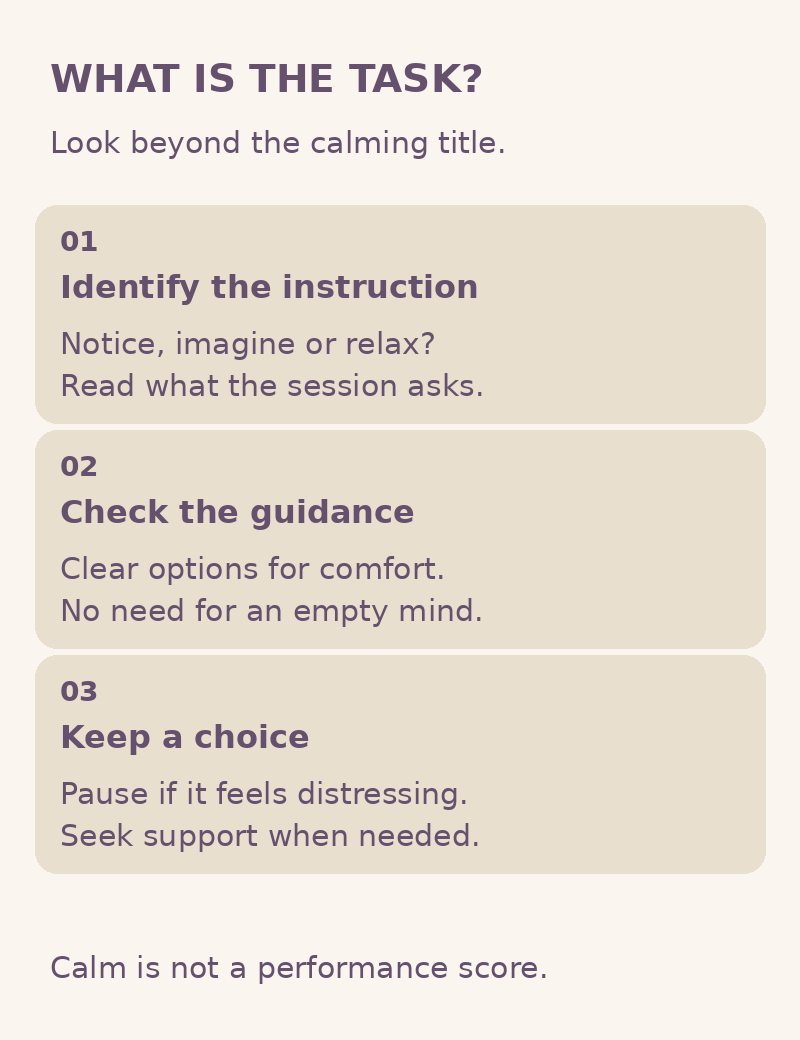
If you want to understand a mindfulness exercise, look for a teacher or recording that explains where attention goes and what to do when it wanders. Clear guidance should not require an empty mind.
If you want a structured way to unwind, a clearly described relaxation method may fit that purpose. Check whether it involves imagery, deliberate muscle effort, breathing changes or another technique before beginning.
If you simply need a break, you can choose an ordinary activity you find comfortable. There is no obligation to turn every rest period into self-improvement.
Our body scan and progressive muscle relaxation comparison looks at one specific pair of methods. The broader distinction here is between practice categories, not a substitute for learning either method properly.
Can a session include both?
Yes. A class may begin with settling, include awareness practice and finish with guided relaxation. NCCIH notes that meditation and other mind-body practices can produce a relaxation response even though its relaxation fact sheet discusses them separately.
That combination is not inherently confusing if the guide explains the change of task. You might first be invited to notice sensations, then follow a different instruction intended to encourage ease.
Ask what the session includes rather than insisting on one label. A mixed recording should still make clear whether you are observing, imagining, moving or deliberately contracting muscles.
Comfort matters more than completing the track
The Cumbria, Northumberland, Tyne and Wear NHS Foundation Trust advises choosing a setting that feels safe and comfortable, and says you can stop if an exercise does not feel right. It also warns against listening to relaxation exercises while driving or operating heavy machinery.
That is a useful boundary for both categories. An inward-focused recording belongs in a setting where you do not need to monitor traffic, machinery or another safety-critical task.
Do not force breath holds, large breaths, painful muscle effort or an uncomfortable posture because a recording sounds authoritative. If a technique conflicts with medical advice or physical limits, pause and ask for appropriate guidance.
Neither approach suits everyone
NCCIH says meditation safety has not been studied enough to make definite statements for every person or practice. Negative experiences can occur. Its relaxation guidance also notes occasional increased anxiety, intrusive thoughts or fear of losing control.
Mayo Clinic advises stopping a relaxation technique and speaking with a healthcare or mental health professional if it causes emotional discomfort. People with serious health concerns or a trauma history may need guidance matched to their circumstances.
A session becoming distressing is not evidence that it is working more deeply. You do not need to persist to prove willingness or discipline. Ask about an instructor’s training, experience and approach to difficulties.
Keep health claims separate from personal preference
You may prefer one recording because the voice is clearer or the task feels easier to understand. That preference is useful information, but it does not establish that the method treats a condition better.
NCCIH describes important limits in meditation research, including varied practices, study quality and difficulty interpreting results. Research about a structured programme should not be treated as a guarantee for any app or short recording with a similar title.
Do not replace prescribed care or delay assessment of persistent anxiety, depression, pain or sleep problems with either approach. The NHS trust explicitly presents its relaxation exercises as wellbeing support rather than treatment for mental health problems.
Common questions
Is relaxing the same as meditating?
Not necessarily. You can unwind without following a meditation practice, and a meditation can involve noticing experience without feeling especially relaxed.
Is relaxation less valuable?
No. Learning awareness and taking a comfortable break answer different needs. Neither needs to be ranked as a more advanced use of time.
Must I use both?
No. Choose appropriate guidance for your purpose, and keep the option to stop or choose something else.
The useful distinction
Meditation describes practices; relaxation can describe a state, an aim or a method. Their overlap is real. Choose by what you are being asked to do, whether it is suitable for you and whether the guidance leaves room for comfort and choice.