
Yoga and swimming offer very different settings for movement. One may involve a dry floor, a teacher and time spent noticing a posture. The other asks you to move through water, coordinate a stroke and manage the demands of a pool or another water environment.
Neither label tells you exactly how hard a session will be or whether it fits your needs. A quiet yoga class differs from a demanding flow, just as a swimming lesson differs from sustained lap training.
This guide compares the activities so you can choose a suitable starting point. It is not a swimming lesson, a yoga routine or an individual medical plan.
What yoga includes
NCCIH describes yoga as an ancient, complex practice rooted in Indian philosophy. Many contemporary classes emphasise physical postures, breathing techniques and meditation, while the wider practice includes more than exercise.
Classes range from gentle to physically demanding. Ask about the actual style, pace, amount of floor work and options for support rather than assuming yoga always means stretching slowly.
You may be interested in learning the wider practice, exploring movement and attention or joining a class with quiet rest. These are different aims from swimming a particular distance, and they do not need to compete.
What swimming involves
Swimming means moving through water using swimming skills. Healthdirect describes its familiar strokes and explains that effort can increase with speed and training demands.
Learning to swim is itself a worthwhile goal. Someone beginning adult lessons may spend time developing confidence, water skills and breathing coordination before sustained laps become appropriate.
This guide focuses on ordinary pool-based swimming. Open-water swimming brings additional risks, including currents, temperature and visibility. Being comfortable in a pool does not automatically prepare you for a lake, river or sea.
Yoga and swimming compared
| Question | Yoga | Swimming |
|---|---|---|
| Setting | Usually a dry practice space | A suitable water environment |
| Common focus | Poses, breath, attention | Stroke skills and moving in water |
| Effort | Varies by style and session | Varies by pace and skill |
| Starting help | A suitable yoga teacher | A qualified swim instructor |
| Extra safety | Stable space and suitable options | Water skills and supervision |
The table compares common features, not every possible class. Neither activity has one fixed level of difficulty or one guaranteed result.
Which is more directly aerobic?
The CDC lists swimming laps among examples of vigorous aerobic activity. Sustained swimming can therefore be a direct way to work on aerobic fitness when your swimming ability and health make that appropriate.
That does not mean every minute in a pool is vigorous exercise. Lessons, rest breaks and leisurely movement have different demands. Fitness, skill and the way a session is organised all matter.
Yoga intensity also varies. Do not assume that a class meets an aerobic target simply because it feels difficult or leaves you warm. Ask what it actually involves rather than treating all physical effort as the same kind of training.
For general health, the CDC recommends a mix of aerobic and muscle-strengthening activity. Choosing a favourite activity is useful, but it does not remove the need to consider the rest of your week.
Low impact does not mean no risk
Healthdirect describes swimming as low impact because being in water reduces pressure on weight-bearing joints. That can be an appealing feature, but it is not a promise that every stroke will be comfortable for every person.
The same source discusses swimming-related shoulder problems and the importance of appropriate technique and gradual training. A stroke that repeatedly provokes symptoms needs attention, not a stronger effort to push through.
Yoga has its own physical demands. Some poses load the wrists, knees or shoulders, and some classes require repeated changes between the floor and standing. Ask about alternatives before joining if these demands are a concern.
If pain, injury or a health condition is driving your choice, discuss suitable activity with your clinician. Neither a general yoga class nor a public lap session is individual rehabilitation.
Swimming and aquatic exercise are not identical
Mayo Clinic explains that aquatic exercise uses water’s support and resistance. Some water-based classes can be done without knowing how to swim, but that is not the same as being ready to swim independently.
A supervised class in an appropriate depth, a lap-swimming session and clinician-led hydrotherapy have different purposes and requirements. Ask which one a provider is offering.
Do not take research about warm-water therapy or a particular clinical programme as proof that an ordinary swim treats your condition. The CDC’s swimming overview discusses several forms of water-based exercise, which should not all be read as interchangeable.
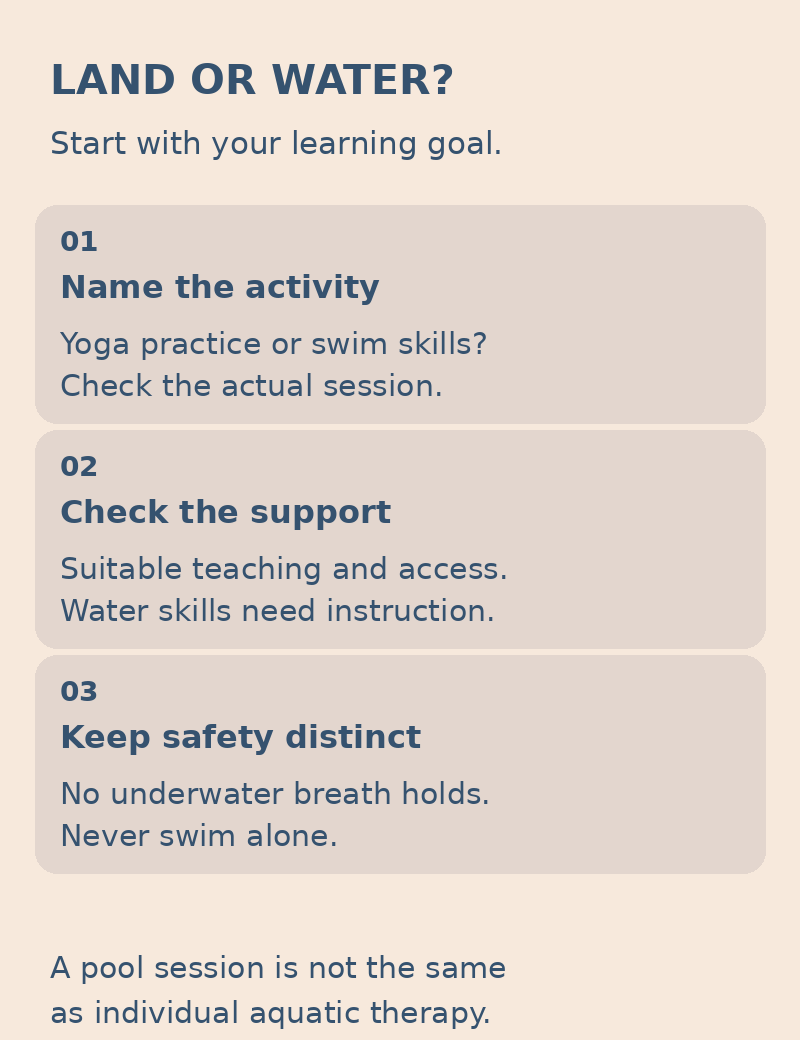
What do you want to learn?
If your aim is to feel more capable and comfortable in water, swimming instruction directly addresses that skill. Yoga on land cannot teach you to enter, float, turn or leave the water safely.
If you want to explore yoga’s postures, attention or wider practice context, a suitable yoga class addresses that interest more directly. You do not need to justify it by claiming it is the best cardiovascular workout.
If your main aim is simply finding activity you can keep doing, practical access matters. A pleasant class that fits your life may be more useful than a theoretically ideal session you rarely attend.
Compare the practical commitment
For yoga, check the class timetable, travel, floor access and whether the venue provides a mat or supports. If you want a home option, ask what instruction and space would be appropriate.
For swimming, check pool opening times, the kind of session, adult lessons, lifeguard coverage and changing facilities. Lane access does not necessarily include teaching.
Healthdirect lists swimwear, a towel, goggles and a cap among common swimming equipment. Check the pool’s own requirements. Think about the whole visit, including changing and travel, rather than comparing only the minutes spent exercising.
Water safety is part of the choice
The American Red Cross describes water competency as a combination of swimming skills, understanding risks and knowing how to respond to an emergency. Fitness on land is not a substitute for those skills.
Never swim alone. Choose a supervised setting, follow local rules and use qualified instruction when learning. Do not assume that another person nearby can recognise trouble or rescue you.
Swim sober and tell the instructor about relevant medical concerns or limits. Follow the venue’s advice about safe entry, depth and hygiene. Open water requires its own preparation and safety advice rather than a direct transfer of a pool routine.
Keep yoga breathing out of underwater challenges
Do not combine yoga breath holds or deliberate overbreathing with swimming. Do not compete over who can remain underwater longest or swim farthest without breathing.
The Royal Life Saving Society UK explains that hyperventilation and breath-holding can lead to loss of consciousness from low oxygen. Blackout can happen at any water depth, and a swimmer may have no useful warning.
A quiet pool or a lifeguard does not turn a breath-hold challenge into a suitable practice. Learn ordinary swimming breathing with a qualified instructor, and keep yoga breathing exercises on land in an appropriate setting.
Can you do both?
Yes, if both fit your interests, energy and any individual guidance. They do not need to be placed in competition, and you do not have to add yoga after every swim.
A demanding yoga class adds physical work rather than automatically providing recovery. Tell your teacher or coach what else you do and leave space for rest.
Our guide to yoga alongside swimming discusses a separate land-based practice. Keep that distinct from swim technique or rehabilitation, and choose a dry, stable place rather than a slippery pool edge.
When individual advice comes first
Talk with your clinician before starting or changing activity if you have a health condition, recent surgery, ongoing pain, unexplained symptoms or exercise restrictions. Pregnancy may also call for guidance matched to your circumstances.
Ask your instructor how they adapt the session without forcing range, effort or confidence. A good starting point is one you can learn safely, not one chosen to match somebody else’s performance.
Stop activity and seek appropriate help for concerning symptoms such as chest pain, faintness or unusual breathlessness. In water, alert the instructor or lifeguard immediately rather than trying to finish a length.
Common questions
Can yoga replace swimming lessons?
No. Swimming and water-safety skills need appropriate instruction in that environment.
Is swimming always gentler than yoga?
No. Water can reduce joint loading, but the stroke, effort, health needs and yoga style change the comparison.
Which is better for me?
Choose by your goal, actual session, suitable teaching and access. Get individual health advice when that affects the choice.
The useful choice
Choose swimming when learning or practising movement in water fits your goal. Choose yoga when its practice and teaching interest you. If both fit, combine them thoughtfully without treating either as a universal substitute for the other.
Sources and further reading
- NCCIH: yoga, evidence and safety
- Healthdirect: swimming benefits, learning and precautions
- CDC: aerobic and muscle-strengthening activity
- Mayo Clinic: aquatic exercise and water resistance
- CDC: swimming and water-based exercise
- American Red Cross: water competency and safety
- Royal Life Saving Society UK: hyperventilation and breath-holding risks