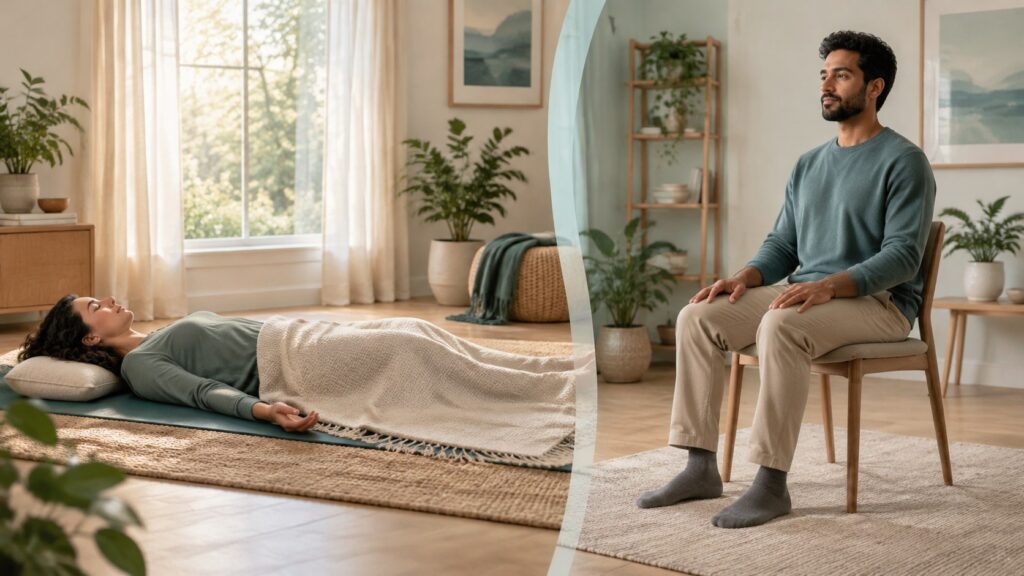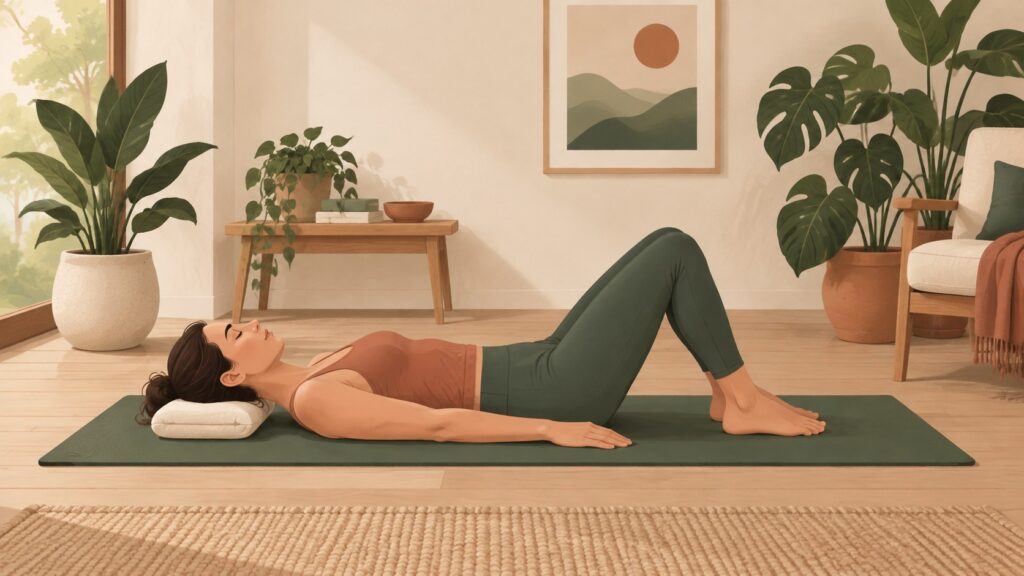
Yes, you can meditate lying down. A reclining position is used in some body-scan practices, and it can be an option when sitting is uncomfortable. The main question is whether the position lets you stay aware without pain or unnecessary effort. Lying down is not automatically less serious than sitting, and falling asleep does not make you a failure. It simply tells you something about the position, timing or purpose of that session.
This guide is for gentle attention practice, not advanced breathing exercises or treatment for a health condition. Choose a position that suits your needs, and ask a health professional about any medical restrictions.
Does meditation have to be done sitting?
No. Meditation describes a range of attention practices rather than one compulsory body shape. In its mindfulness-based stress reduction guidance, Guy’s and St Thomas’ NHS Foundation Trust explains that a body scan can usually be done lying down or sitting up. It suggests sitting if lying down makes you likely to fall asleep.
This does not mean every method has identical instructions. A teacher may use an upright seat for a particular practice. If you are following a course, ask about adaptations instead of silently pushing through discomfort. A chair, floor cushion and reclining position are options to discuss, not a hierarchy of dedication.
Our meditation for beginners guide introduces the broader practice. This page focuses on choosing and using a lying-down position, rather than replacing that foundation.
Lying down or sitting: which should you choose?
On a small screen, swipe the table sideways to read all three columns.
| Your situation | An option to consider | What to check |
|---|---|---|
| Sitting is comfortable and you want to stay alert | A supported chair or cushion | Can you sit without holding yourself rigidly? |
| Sitting is distracting because of discomfort | A comfortable reclining position | Does the position actually reduce discomfort? |
| You repeatedly fall asleep while reclining | Sitting, opening your eyes or practising at another time | Are you simply too tired for an alert session? |
| You have a medical restriction | A position agreed with your health professional | Do not assume lying flat is suitable for everyone. |
A useful choice is one you can adjust. You do not have to promise yourself that you will remain still for a fixed period regardless of how you feel. Changing posture thoughtfully is different from abandoning attention every time the mind wanders.
How to set up a comfortable place
Choose a safe place where you can lie or recline without being interrupted by traffic, machinery or another task needing your attention. A mat, rug or bed can work if it is comfortable for you. The NHS body-scan guidance specifically includes lying on a bed as well as on the floor.
Check the surface before you begin. If the floor creates pressure or a mattress makes you sink uncomfortably, choose something else. A folded blanket or small pillow may help you find support, but no arrangement should be treated as a prescription for pain.
Let your arms rest somewhere comfortable. Your legs do not need to be forced straight or held in a particular position. If changing your knee or head support feels better, make that adjustment. Keep the room comfortable enough that you are not spending the whole practice reacting to cold, heat or glare.
Put your phone out of reach if possible. If you use a recording, choose it before settling down so you are not browsing between instructions. You do not need special equipment to notice a few ordinary sensations.
A short lying-down meditation to try
The following is a simple, optional attention exercise, not a clinical programme. Start briefly rather than setting a demanding target. There is no need to hold your breath, count a prescribed breathing ratio or try to change your body.
- Settle into a comfortable position. Notice whether you want to change your support before beginning. Leave your eyes open, softly focused or closed according to what feels suitable.
- Notice contact. Feel one place where your body meets the surface, such as your heels, hands or the back of your shoulders. There is no particular sensation you must produce.
- Allow ordinary breathing. If breath awareness feels comfortable, notice a few breaths without making them deeper or slower. If it does not, stay with contact or sounds in the room.
- Notice wandering. When you realise you are planning, remembering or judging, acknowledge it and return to your chosen point of attention.
- Finish deliberately. Look around and give yourself time to move. Change position gradually, especially if you feel light-headed.
You can stop sooner than planned. Attention practice is not a contest to ignore discomfort. If you want a different approach, our body-scan meditation guide discusses noticing sensations through the body.
What should you focus on?
A point of attention, sometimes called an anchor, is simply something you return to when you notice distraction. It might be the pressure of a hand against the mat, a sound nearby or the natural movement of breathing. You do not need to find the most spiritual option.
If one focus becomes uncomfortable, choose another or stop. Some people find close attention to breathing unsettling. You can keep your eyes open and notice the room instead. Our discussion of meditating with your eyes open explores that option.
The purpose is not to empty your mind. A session may contain many moments of forgetting and returning. Noticing that you have drifted is part of the exercise, rather than evidence that you cannot meditate.
What if you keep falling asleep?
First decide what you are trying to do. If the aim is alert meditation, sleeping through most of a recording is different from following it with awareness. It is information, not a reason to criticise yourself.
Try a supported sitting position, a shorter session or a time when you feel less sleepy. You can also keep your eyes open. The NHS body-scan guidance offers sitting as an alternative when lying down leads to sleep.
If the aim is winding down before bed, you may prefer a different practice altogether. Our before-bed meditation guide discusses that setting. Do not assume that an alert daytime session and a bedtime routine must have the same ending.
Persistent or unusual daytime sleepiness deserves attention outside meditation. Do not use a new posture as a substitute for getting advice about a symptom that concerns you.
Is lying-down meditation the same as yoga nidra?
Not automatically. Lying down describes a position; yoga nidra names a guided practice with its own instructions. A person can lie down to follow a body scan, listen to sounds or notice ordinary breathing without claiming to be practising yoga nidra.
Similarly, a resting yoga posture and a meditation exercise can overlap without being identical. The instructions and intention matter more than the fact that both involve a mat. Our yoga nidra beginner guide provides related background.
When choosing a recording, read its description. Does it ask you to stay awake, rest, visualise or follow a particular sequence? Knowing the intended practice is more useful than collecting several labels for the same lying-down position.
Can you meditate on your side?
You do not have to lie flat on your back to do a gentle attention exercise. A comfortable side-lying or supported reclining position may be an option, provided it suits your health needs and lets you practise without strain.
This is not a recommendation that a particular position will fix back pain, breathing problems or another condition. If you have restrictions, including pregnancy-related advice, follow individual medical guidance rather than a general online posture suggestion.
Comfort is also something to reassess during practice. A position that felt fine at the start can become uncomfortable. Move when needed instead of treating stillness as a rule that overrides your body.
When should you stop or seek advice?
The NCCIH review of meditation and mindfulness notes that safety research is limited and negative experiences, including anxiety and depression, have been reported. Meditation should not be presented as risk-free or as a replacement for health care.
Stop if practice increases distress, pain, dizziness or uncomfortable breathing. Opening your eyes, sitting up or ending the session is allowed. Seek appropriate help for severe, persistent or worrying symptoms. Do not reinterpret distress as proof that the practice is working.
If body-focused practice brings up difficult memories or emotions, discuss a suitable approach with a qualified professional. You do not need to keep repeating the same exercise to prove determination.
How to judge a session without chasing results
Instead of asking whether you felt perfectly calm, ask practical questions. Was the position comfortable? Could you notice your chosen anchor at least sometimes? Did you know you could stop? Would another position make the next session easier to follow?
Keep the comparison simple. Change one thing, such as your support or the time of day, rather than changing the recording, posture and length at once. This makes it easier to understand what suits you.
Our guide to how long to meditate can help you think about a manageable routine without making duration the main measure of success.
Frequently asked questions
Is it wrong to meditate in bed?
No. Some body-scan guidance includes practising on a bed. If you want to stay alert but keep falling asleep, consider sitting or choosing another time.
Do my legs need to be straight?
No fixed leg position is necessary for this gentle attention exercise. Choose comfortable support and follow any medical advice relevant to you.
Should I close my eyes?
Only if that feels suitable. You can leave your eyes open or softly focused. Closing them is not a requirement for every meditation.
Is falling asleep a sign of failure?
No. It may mean you are tired or that a different position would suit an alert practice better. A bedtime routine may have a different purpose.
Can lying-down meditation treat insomnia?
This guide does not establish a treatment for insomnia. Persistent sleep problems should be discussed with a health professional rather than managed only through meditation.
The bottom line
Lying down is a valid option for some meditation practices, particularly body scans. Choose comfort and awareness rather than forcing a pose. Keep breathing natural, adjust when needed and treat sleepiness or discomfort as information. The right starting point is a practice you can follow safely, not a position you feel obliged to endure.