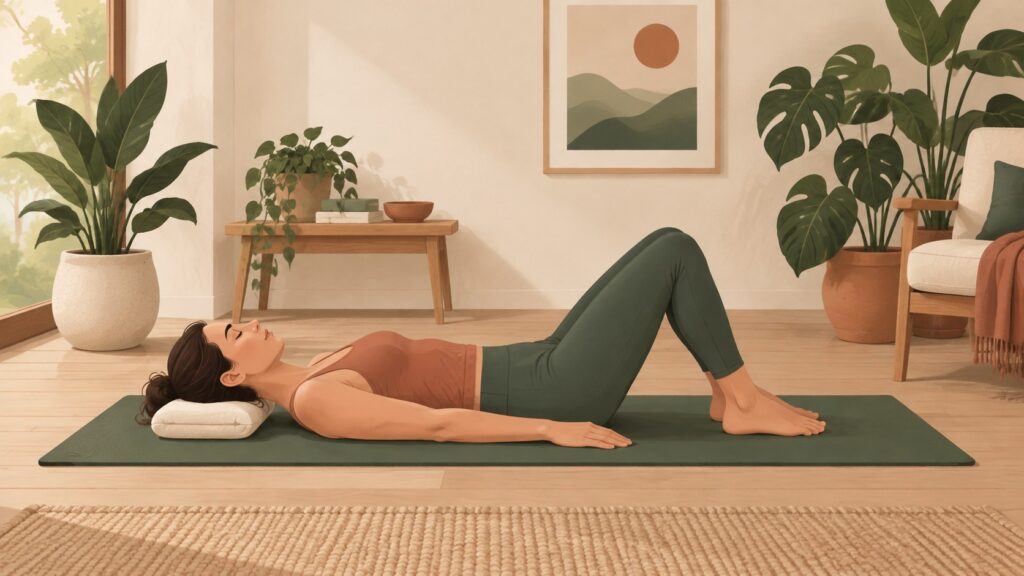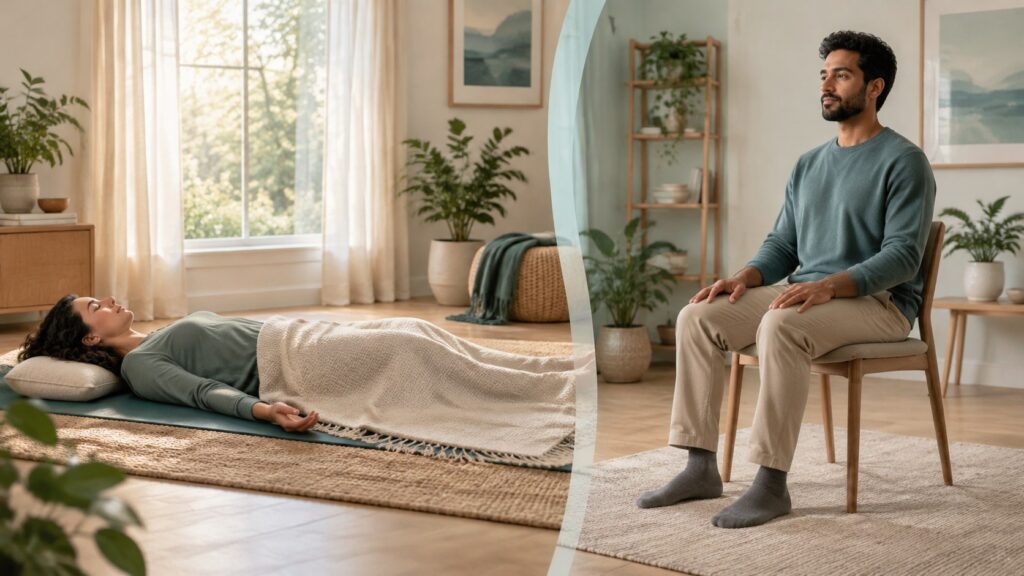
Yoga nidra and meditation overlap, so the choice is not always between two separate practices. Meditation is a broad family of attention and awareness practices. Yoga nidra is usually a structured, guided rest practice, often done lying down, and is commonly described as a form of guided meditation.
If you want to compare them usefully, compare yoga nidra with a particular meditation, such as seated breath awareness. That tells you more than saying that one means lying down and the other means sitting. Meditation can also be practised lying down, walking, or in other positions.
This guide explains the practical differences, where the labels overlap, and how to choose an approach without expecting either one to cure a health problem or replace sleep.
Why the comparison can be confusing
Different teachers and health resources use the word meditation differently. Sometimes it means a specific sitting practice. Sometimes it includes a wide range of methods, including guided relaxation, body awareness, compassion practices, and attention to sound or breath.
The US Department of Veterans Affairs describes meditation as a broad area with many styles, techniques, and goals. NCCIH also uses a broad definition. Under that wider meaning, asking whether yoga nidra or meditation is better is a little like comparing one kind of practice with the category it may belong to.
There is also variation within yoga nidra. A recording may include body awareness, attention to breathing, an intention, imagery, or periods of quiet. Sequences and language differ between teachers and traditions. A single recording is not the complete definition of the practice.
What is yoga nidra?
Yoga nidra is often translated as “yogic sleep.” In ordinary practice, you follow spoken guidance while resting, usually in a supported lying position. The guidance gives attention a sequence to follow rather than asking you to work through physical yoga poses.
The intention is often to rest while remaining aware. That does not mean you must produce a special sensation or prove that you stayed awake throughout. You might feel alert, distracted, drowsy, or deeply rested. The label is not a guarantee that everyone will have the same experience.
A body scan can be one part of yoga nidra, but the two terms are not automatically interchangeable. A short exercise that simply notices sensations from feet to head may be a body scan without including the other parts of a particular yoga nidra method.
For an introduction focused on the practice itself, see our yoga nidra basics guide. This article focuses on the comparison rather than repeating a full guided session.
What does meditation mean here?
To make the comparison clear, the example here is a simple breath-awareness meditation. You settle in a comfortable position, notice ordinary breathing, and return attention when you notice the mind has wandered. The aim is not to stop every thought or make breathing follow a demanding pattern.
That is one example, not the only valid form. A meditation may use sounds, a repeated phrase, kindness, movement, or another focus. Some are guided by a teacher or recording. Others are self-directed. Some have religious or philosophical meaning for the person practising them; others are used in a secular setting.
This variety matters. Guidance, posture, and duration can differ between two meditation sessions as much as between a yoga nidra recording and a sitting session. Read the description of the actual practice rather than relying on its name alone.
Yoga nidra and seated breath awareness compared
On a small screen, swipe the table sideways to read all columns.
| Question | Yoga nidra, commonly | Seated breath awareness, as used here |
|---|---|---|
| What guides attention? | A spoken sequence, often moving through several kinds of awareness. | Returning to a chosen focus, such as natural breathing. |
| What is the usual position? | Supported lying down, with adjustments if needed. | A comfortable seat, though meditation is not limited to sitting. |
| Is a recording required? | Guidance is common, especially when learning. | A guide is optional; a timer may be enough for a familiar practice. |
| Must thoughts disappear? | No. Distraction can occur while following the guide. | No. Noticing and returning are part of the practice. |
| Does it replace sleep or treatment? | No. | No. |
The table describes common formats, not strict boundaries. A guided meditation can be highly structured. A person can meditate lying down. A yoga nidra teacher may offer a supported seated alternative. None of those variations makes the practice automatically better or worse.
The most useful practical differences
Following a sequence or returning to one focus
In yoga nidra, the voice usually leads you from one part of the practice to the next. You listen, notice what is present, and continue with the guidance. If you lose track for a moment, you can rejoin where the recording is rather than mentally rewinding every missed instruction.
In a simple self-directed breath meditation, you decide to return to a relatively steady focus. You may notice wandering many times. That is not evidence that meditation is unsuitable for you. It is also not a reason to force concentration or hold your breath.
The role of physical comfort
A lying practice can appeal when sitting feels tiring, but lying flat is not comfortable or appropriate for everyone. A supported chair, side-lying position, or other adjustment may be needed. Follow any medical advice about positioning and ask a suitably trained teacher when unsure.
A sitting practice does not require crossed legs or a perfectly straight back. A chair can be a sensible option. Comfort should support attention rather than become a test of endurance. Stop or change position if pain develops instead of interpreting pain as progress.
How much instruction you want
Some people prefer a voice that gives a clear route through the session. Others find frequent words distracting and prefer a quieter practice. Neither preference predicts how “advanced” someone is. The useful question is whether the instructions are understandable, comfortable, and suitable for the setting.
Try listening to part of a recording before committing to the full session. Notice its language, pace, and whether it allows choices. You do not have to continue with imagery, breath instructions, or emotional prompts that feel wrong for you.
Which one should a beginner try?
If you want a guided period of rest and can arrange a comfortable, safe position, a beginner yoga nidra recording may be worth exploring. If you want a brief, simple attention practice without following a long sequence, guided or self-directed breath awareness may be easier to fit into your day.
These are starting points, not prescriptions. You can prefer one, alternate between them, or decide that another activity suits you better. There is no need to practise both to make the routine legitimate.
Keep the first experiment modest. Choose an appropriate setting with no responsibility that needs your immediate attention. Do not practise while driving, operating equipment, or doing anything else that requires alertness. Check the recording’s length beforehand so the session does not run into an obligation.
Does one work better for stress or sleep?
There is research on meditation and on yoga nidra, but the evidence does not justify a universal winner. Results depend on the particular method, the people studied, the comparison group, and what outcome was measured. A finding about one guided programme cannot automatically be applied to every recording online.
An integrative review of yoga nidra research included studies with different populations, session lengths, frequencies, and durations. Its authors said these differences made firm conclusions difficult and called for stronger studies. That is a reason to keep expectations realistic, even when a practice feels pleasant.
For everyday choice, ask what you can practise comfortably and what the experience is actually like for you. Feeling rested after a session is meaningful as an experience, but it does not prove that a medical condition has been treated. Persistent sleep difficulty, anxiety, pain, or other symptoms deserve appropriate professional advice.
Do not treat a short yoga nidra session as an equivalent number of hours of sleep. Resting with a recording is not the same as meeting your sleep needs. Claims that a fixed number of minutes replaces a full night’s sleep are not a sensible basis for cutting sleep short.
What if you fall asleep?
Drowsiness can happen in either practice, especially when lying down. If your purpose is bedtime rest, drifting off may not bother you. If your purpose is to practise awareness, you can experiment with a more upright position, a different time, or a shorter session without treating sleepiness as a failure.
Likewise, staying awake through every instruction is not a score. Avoid turning a rest practice into an anxious check of whether you are doing it correctly. If excessive sleepiness is persistent or affects daily life, seek medical advice rather than trying to solve it solely through meditation.
Keep the practice optional and adjustable
Meditation is not comfortable for everyone in every situation. NCCIH notes that adverse experiences have been reported and that research cannot establish definite safety for every person or method. Do not assume that lying still or closing your eyes is always calming.
If you feel distressed, stop. Open your eyes if that helps, notice your surroundings, and return to an ordinary activity. If distress persists or you have concerns related to trauma or a mental health condition, discuss the practice with a qualified health professional. Do not push through because a recording says that discomfort must be released.
Use these practices alongside appropriate care, not in place of it. Continue prescribed treatment and seek individual advice when a health condition affects breathing, positioning, or how you respond to inward attention.
Frequently asked questions
Is yoga nidra a type of meditation?
It is commonly described as a form of guided meditation, though terminology varies. It is clearer to compare its format with a specific meditation than with the whole category.
Must meditation be done sitting up?
No. Meditation includes practices in several positions and formats. Sitting is one option, not the definition of meditation.
Is yoga nidra the same as a body scan?
A body scan may be part of yoga nidra, but a yoga nidra sequence can include other elements. The labels are not always interchangeable.
Can yoga nidra replace sleep?
No. A period of guided rest is not a substitute for meeting your sleep needs or getting help for persistent sleep problems.
Do I need to do both practices?
No. Choose an approach that suits you, or choose neither. There is no requirement to combine them.
The bottom line
Yoga nidra usually offers a guided route through rest and awareness. Meditation is the wider category, with many possible formats. Compare actual instructions, comfort, guidance, and your purpose instead of looking for a universal winner. A suitable practice is one you can approach without forcing an experience or neglecting your health needs.