Kripalu yoga brings postures, breathing and meditation together with an emphasis on compassionate self-observation. Rather than judging a practice only by the shape of a pose, it invites you to notice what is happening in your body and mind while you practise.
The approach is named after Swami Kripalvananda, often called Swami Kripalu. Its teaching combines disciplined practice with an interest in inner experience and the way yoga relates to daily life. Physical movement is part of that inquiry, not its only purpose.
You may encounter gentle or demanding lessons under the same name. Understanding the method’s three stages helps explain its character, but the actual class description remains important when deciding where to begin.
Compassion is part of the practice
Kripalu’s own guide describes self-observation without judgment as a central principle. You might notice tightness, effort, distraction or an emotion without immediately deciding that you are doing yoga badly. The intention is to meet your experience with curiosity and care.
This does not mean ignoring alignment or giving up on learning. It changes the reason for paying attention. You are gathering information about what fits, rather than using every posture as a test of whether you can match an ideal image.
A practical example is choosing a smaller movement because a larger one produces strain. Another is noticing that your attention has wandered and returning to the teacher’s instruction without self-criticism. These are ordinary learning choices, not evidence of spiritual achievement or failure.
Compassion also includes limits. A class cannot require you to endure pain, disclose personal experiences or surrender your judgment in order to participate. A teaching about acceptance should support your ability to choose, not weaken it.
The three stages of Kripalu yoga
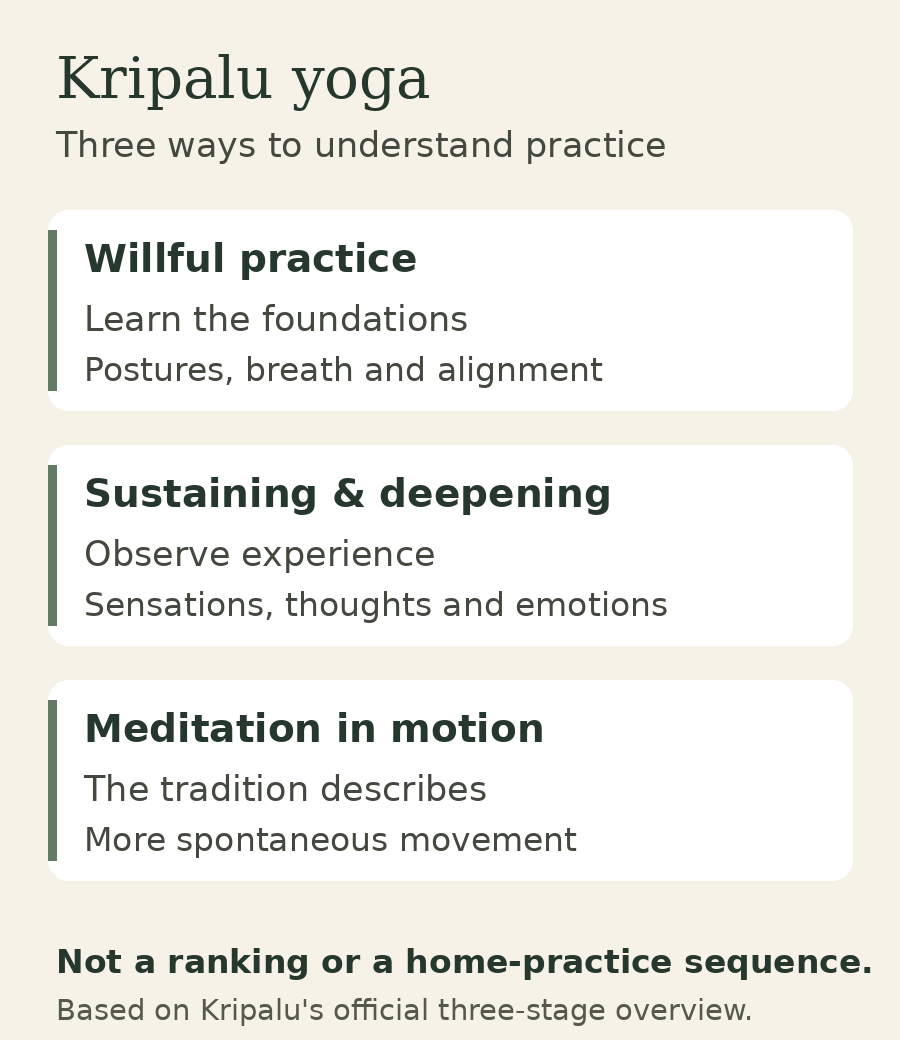
Kripalu’s official overview describes three stages: Willful Practice, Sustaining and Deepening, and Meditation in Motion. Different teachers use slightly different wording, but the broad movement is from learning a structure toward noticing and responding to inner experience.
These are ways of understanding practice, not a simple ranking of bodies or a timetable for advancement. Practitioner Matthew Tift describes them as non-linear, while Yogakripa describes moving among them repeatedly. You do not need to aim for a particular stage in every session.
Stage one: Willful Practice
The first stage emphasizes learning postures, breathing and alignment with attention and effort. This is where clear instruction gives the practice a foundation. You begin to understand what a movement asks of you and which options are suitable.
Willful does not have to mean forceful. It can mean making a deliberate choice to move carefully, remain attentive or take a rest. A foundations class may spend most of its time here, and that is a complete learning experience rather than a lesser version of yoga.
Stage two: Sustaining and Deepening
In the second stage, the emphasis shifts toward observing sensations, thoughts and emotions while sustaining a practice. A posture may be held longer, creating more opportunity to notice your response rather than moving immediately to the next shape.
Longer is not automatically better. The idea of observing a sensation must not become a reason to push through pain or continue after breathing becomes strained. You can leave a posture and still learn from what you noticed.
Teachers may use the phrase witness consciousness. In plain terms, this refers to observing experience without immediately becoming caught up in it. It belongs to the method’s contemplative teaching and does not establish a medical mechanism for treating psychological difficulties.
Stage three: Meditation in Motion
Kripalu describes meditation in motion as allowing movement and breath to arise more organically rather than following only deliberate choreography. Its teaching connects this with prana, a traditional concept of life energy or life force.
That is a philosophical account within the tradition. Prana should not be presented as a clinically measured substance that a posture reliably releases. Nor should the language of surrender be taken to mean abandoning awareness of balance, space or physical safety.
This is a description of the tradition, not a home-practice instruction. Beginners do not need to create spontaneous movements or attempt advanced contemplative practices. Start with a clearly described foundations class and familiar, manageable movements.
Prana, chitta and observing experience
The official guide discusses the relationship between prana and chitta. It uses prana for life energy and chitta for the field of mind, including thoughts, emotions, perceptions and memory. Their relationship helps explain why the method pays attention to both physical experience and awareness.
These terms offer context for the teaching, not a replacement for anatomy or healthcare. If a teacher describes energy moving or a mind becoming clearer, understand whether they are speaking philosophically, describing a personal experience or making a claim that would need scientific evidence.
You do not have to reproduce another person’s sensations. A quiet practice, an ordinary distraction or a lack of dramatic feeling does not make your experience invalid. The useful question is whether you can observe honestly and take care of yourself while learning.
Is Kripalu always gentle?
Like other approaches to physical yoga practice, a compassionate approach can be taught at different physical intensities. The name alone does not tell you how long poses will be held, how much standing work is included or whether a lesson assumes previous experience.
Ask whether the class is intended as gentle, moderate, vigorous or introductory. Then ask what those words mean in that setting. A slower pace may still include sustained effort, and a class described as mindful can still contain movements that are unsuitable for you.
If you are new to yoga, choose a lesson that provides detailed instruction and alternatives. If you already practise another style, mention that background without assuming it prepares you for every breathing exercise or contemplative practice.
Read a Kripalu class description
| Class wording | What to ask |
|---|---|
| Gentle or introductory | Are the foundations explained? Can I use a chair or other support? |
| Moderate or vigorous | How much sustained effort and standing work is included? |
| Meditation in motion | What prior learning is expected? Can I stay with familiar movements? |
No label guarantees suitability. Ask about the actual lesson and keep your right to pause.
What to ask about a Kripalu lesson
Postures, breathing and meditation are core parts of Kripalu’s description. How they are combined depends on the teacher and class. You may be invited to notice sensations, pause between movements or reflect on the quality of effort instead of only watching the next demonstration.
Ask about the structure before joining. Find out whether there is a seated or floor-based portion, whether props are needed and whether alternatives are explained. For online practice, prepare enough clear space and arrange the screen so that following instructions does not require repeated awkward turning.
There is no requirement to speak about emotions publicly. If a reflective prompt does not suit you, you can remain quiet or bring attention back to a neutral feature such as the support beneath your body. Share relevant health or access needs privately.
Effort and surrender need boundaries
Some Kripalu descriptions use strong language about finding an edge, releasing control or raising energy. Read that in the context of a spiritual teaching, not as a command to increase intensity until something dramatic happens.
A useful boundary is being able to breathe comfortably and move with control. Sharp pain, dizziness or difficulty breathing is a reason to stop, not a lesson you have to stay with. A teacher should help you choose a manageable alternative.
The same applies to physical assistance. You can decline hands-on adjustments and change your mind after previously agreeing. Surrender in a contemplative sense does not transfer decision-making about your body to another person.
Strong feelings can arise in many settings, but they are not proof that trauma has been released or a condition has been cured. Seek suitable professional support for distress rather than treating a yoga class as a substitute for psychological or medical care.
Kripalu beyond the class
Kripalu’s official teaching asks how the awareness developed in practice affects relationships, work and service. That is an invitation to apply the same attentive attitude outside the sequence, rather than keeping yoga separate from ordinary choices.
You might notice a habit of rushing and take a moment before responding. You might recognize fatigue instead of treating it as a personal flaw. These are examples of applying the philosophy, not promises that yoga will resolve every difficult situation.
Keep the reflection simple. A useful question after class is what you noticed and whether you responded kindly and sensibly. You do not need a major revelation to find value in a session.
When comparing teachers, ask how they introduce the stages in an ordinary lesson. A clear answer should describe what you will actually do, how choices are offered and where you can pause. Abstract language alone is not enough to judge a class.
Evidence and safety
The National Center for Complementary and Integrative Health notes that yoga research covers many different styles and practices. General findings cannot establish a specific health outcome from Kripalu yoga or show that one teaching stage is medically superior to another.
Yoga is generally considered safe for healthy people when performed properly with qualified guidance, but injuries can occur. Beginners should avoid extreme postures and forceful breathing. Pregnancy, existing injuries, glaucoma, balance problems and other health conditions may require changes or professional advice.
Choose a teacher who explains options, respects consent and separates spiritual ideas from medical promises. Kripalu yoga is best approached as a way of learning through movement and awareness. Begin with clear instruction, keep your boundaries and allow an ordinary, attentive practice to be enough.
This article explains the approach and its vocabulary. It is not a sequence, a breathing prescription or instruction in advanced meditation.