
Kriya yoga is not a religion by itself. It is a set of yoga practices, and in some lineages it is taught inside a spiritual tradition, but you can practise the general parts without joining any religion. The answer depends on who is teaching it and what you are being asked to believe. This guide explains the difference between practice, philosophy and religion, so you can decide with a clear head.
This is general education, not medical advice or religious guidance. If you have a health condition, are pregnant, or feel unsure, speak with your doctor before trying any breathing practice.
Is Kriya yoga a religion?
No. Kriya yoga is a method of practice, not a religion, although it grows out of Indian spiritual traditions. A religion usually has set beliefs, rituals, a community and a claim about ultimate truth. A yoga practice is first of all something you do: breathe, sit, study, reflect. Some teachers place that practice inside a faith. Others teach it as a plain mental discipline.
The word “kriya” means action or practice. In the Yoga Sutras it names three habits: self-discipline, self-study and surrender to something greater than the self. Our guide to Kriya yoga for beginners explains the term in more detail.
What is the difference between a practice, a philosophy and a religion?
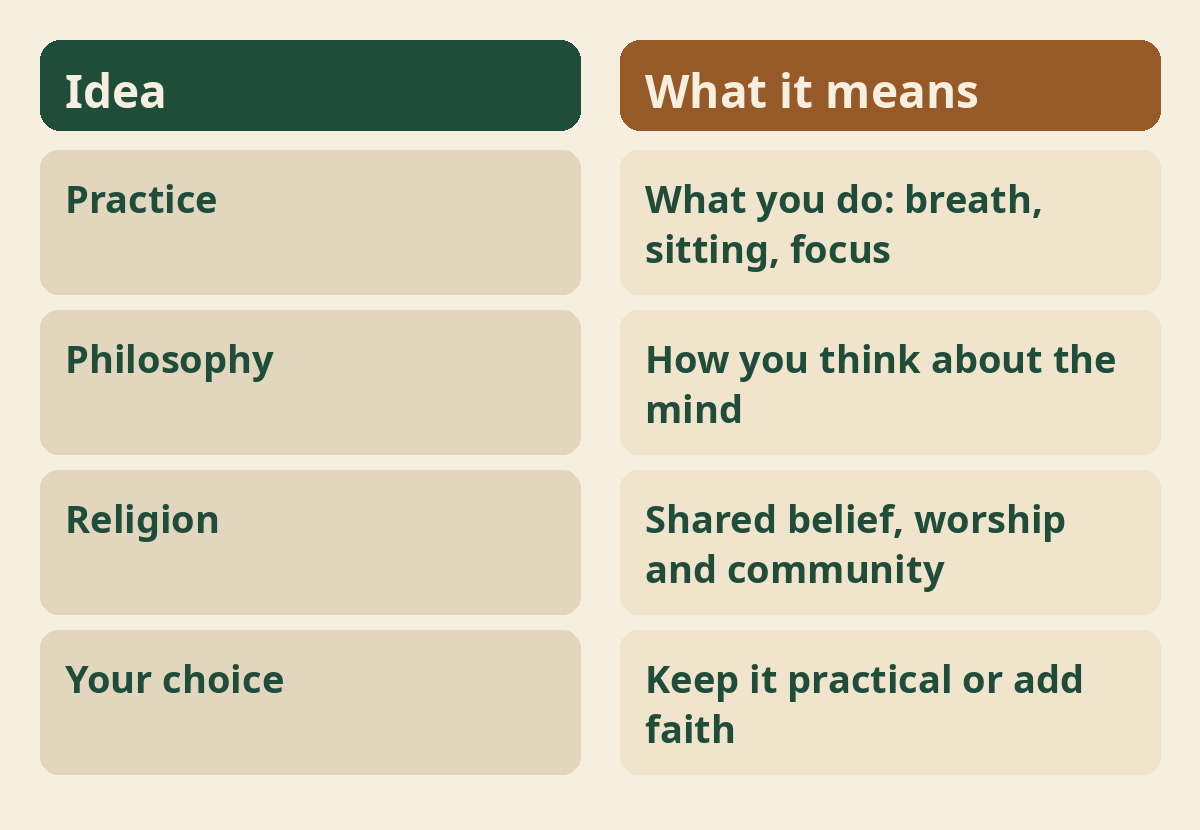
A practice is what you do, a philosophy is how you think about it, and a religion is a shared system of belief and worship. Yoga can include all three, which is why people argue about the label.
- Practice. Breathing, sitting, posture and focus.
- Philosophy. Ideas about the mind, suffering and freedom, such as the eight limbs.
- Religion. Worship, rituals, scriptures and a community of believers.
Most people who take a yoga class are doing the first one. Some are drawn to the second. Only some choose the third.
Where does Kriya yoga come from?
Kriya yoga draws on the yoga tradition of India, and the term appears in the Yoga Sutras attributed to Patanjali. Later teachers used the word for particular sets of techniques. Because the tradition is old and varied, different schools describe it in different ways, some with more spiritual language and some with less.
The Sutras describe an eight-limbed path. If you want the full map, read our guide to the eight limbs of yoga. Notice that the limbs begin with ethics and end with deep meditation. They are a way of training attention and character, and they do not require you to join a faith.
Do you have to be religious to practise Kriya yoga?
You do not have to be religious to practise the general, gentle parts of Kriya yoga. Easy breathing, quiet sitting and thoughtful reading are open to anyone. People of many beliefs, and people with none, practise these every day.
Some teachers and groups do use devotional language, prayers or the idea of a teacher as a spiritual guide. That is their choice, and you can decide whether it suits you. If you prefer a purely practical approach, say so and look for a teacher who offers it.
What does “surrender” mean in Kriya yoga?
In the Yoga Sutras, surrender means letting go of the need to control every result, and it can be understood in a religious or a non-religious way. A believer may read it as trust in God. Another person may read it as accepting that effort has limits. Both readings fit the text.
This is one reason the question of religion is not simple. The same word can be spiritual for one person and purely psychological for another. You do not need to pick a reading before you begin.
Can people of any faith practise it?
Yes. People of many faiths and none practise gentle breathing and meditation. A practice that calms the breath does not ask you to change what you believe. If a group says you must give up your own faith to learn, treat that as a warning sign and think carefully.
A trustworthy teacher respects your beliefs, answers questions honestly and does not pressure you. Our article on whether Kriya yoga is safe for beginners lists other warning signs worth knowing.
How can you tell if a teacher is mixing religion and practice?
Ask what is being taught, what is optional and what you are expected to believe or pay. A clear answer is a good sign. A vague answer or pressure is a reason to wait.
- Is it clear which parts are exercises and which are belief?
- Can you take part without joining a group or ceremony?
- Are questions welcome?
- Is there pressure to pay, commit or keep things secret?
There is nothing wrong with a spiritual tradition. The point is to know what you are joining before you join it.
How to try the practical side without any belief
- Sit on a chair or cushion with a tall spine and loose shoulders.
- Close your eyes or soften your gaze.
- Watch the natural breath for two minutes.
- Breathe in for a count of four and out for four to six, without strain.
- Repeat for five rounds, then sit quietly for a few minutes.
- Stop if you feel dizzy, tense or anxious.
This simple routine uses no belief at all. For more guidance, see our guide to starting a home yoga practice and our note on pranayama for beginners.
What does the research say?
Research on yoga and meditation looks at practices, not beliefs. The National Center for Complementary and Integrative Health summarises findings on yoga effectiveness and safety and on meditation and mindfulness. These pages describe general findings and do not test any single named Kriya technique.
Who should check with a doctor first?
People with heart, lung or blood pressure conditions, pregnant women and anyone who feels unwell should speak with a doctor before breath practice. People who tend toward panic or anxiety may prefer short, gentle sessions. Stop if you feel unwell, and seek advice if symptoms continue.
Why do people ask this question?
People ask because yoga sits where exercise, philosophy and spirituality overlap, and the word “Kriya” sounds unfamiliar. Some have heard of groups that mix practice with strict belief. Others worry that a breathing class might conflict with their own faith. These are fair concerns, and asking about them is a sign of care, not suspicion.
A good rule is to separate the exercise from the explanation. You can try a breathing exercise and decide later what you think about the ideas around it. Nobody has to accept a worldview to sit quietly for five minutes.
How can you keep your own beliefs and still practise?
Treat the practice as a skill, such as steady breathing and attention, and keep your own beliefs as they are. Many people use the same skill to support their own prayer or reflection. Others use it only for calm and focus. Both are valid.
- Choose teachers who respect your background.
- Skip any chant, ritual or phrase you are not comfortable with.
- Say so politely if a class feels too devotional or too secular for you.
- Start with a short, simple practice and see how it feels.
Your comfort matters. A practice you trust is a practice you can keep.
Common myths
- “Kriya yoga is a religion.” It is a set of practices that some traditions place inside a faith.
- “You must believe in something to benefit.” Gentle breathing and sitting need no belief.
- “Yoga and religion cannot mix.” They can, for people who choose it. They need not, for those who do not.
- “A teacher decides what you must believe.” A good teacher does not.
Where to read next
If you want the history behind these ideas, Ranjana Sinha’s book The Journey of Yoga Through Time follows how yoga grew and changed. For a calm starting point, Begin Where You Are is written for beginners. Our guide to Kriya yoga and raja yoga explains how the terms relate.
Frequently asked questions
Is Kriya yoga a religion?
No. It is a set of practices. Some traditions teach it within a spiritual or religious framework, but the general parts need no religion.
Do I need to be Hindu to practise Kriya yoga?
No. People of many faiths and none practise gentle breathing and meditation. Some lineages use religious language, but you can choose a teacher who does not.
Can a Christian or Muslim practise Kriya yoga?
Many people of different faiths practise the gentle, practical parts. It is a personal choice, and a good teacher respects your beliefs.
Is yoga a religion or a philosophy?
Yoga is mainly a practice with an accompanying philosophy. Some people link it to religion, and others do not.
Does Kriya yoga require a guru?
General breathing and meditation do not. Some traditions teach their specific techniques through a teacher.
What should I ask a Kriya teacher before joining?
Ask what is taught, what is optional, what it costs and what you are expected to believe. Clear answers are a good sign.
The bottom line
Kriya yoga is a practice, not a religion. You can keep it simple and secular, or follow it within a tradition if you choose. Ask clear questions, go gently and keep your own beliefs.

