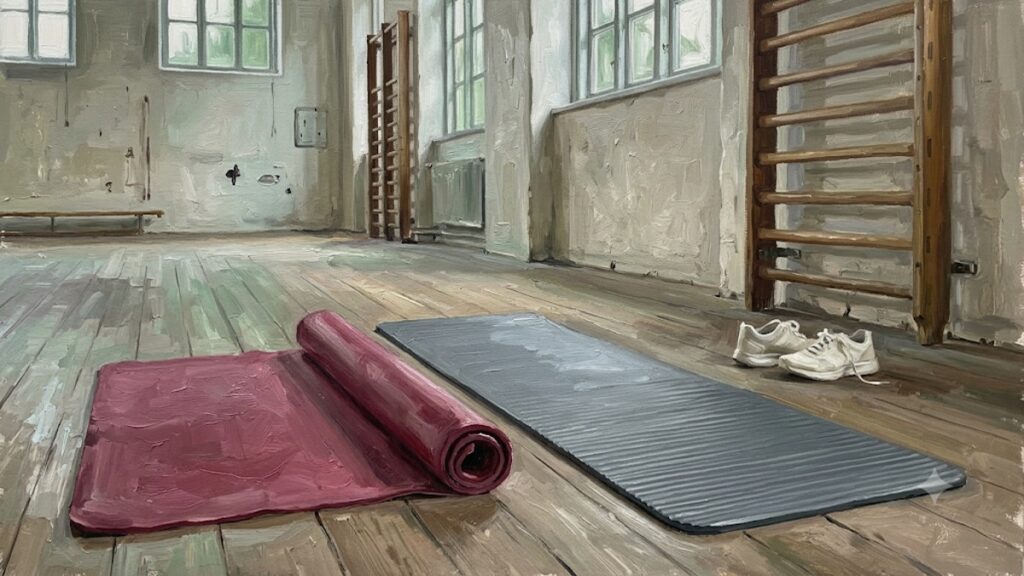
You already own a mat for floor exercises, and a yoga class is about to start. Do you need another one? Perhaps not, but the word mat is not enough to decide. A surface that feels pleasant while lying down may feel different when you stand, turn or place weight through your hands.
Yoga mats commonly emphasise bare-hand and bare-foot grip. Exercise mats cover a wider range of designs for floor work and general training. The categories overlap, and the actual product instructions matter more than a simple thin-versus-thick rule.
This is an equipment comparison, not a workout plan or a promise that one mat prevents injury. The named products below illustrate differences in construction and intended use; they are not a buying shortlist.
The usual difference
A yoga mat is usually chosen for traction during postures and transitions, together with enough cushioning for contact with the floor. An exercise mat may put more emphasis on padding, a larger movement area or a surface designed for a particular kind of training.
Decathlon’s buying guide makes the familiar distinction between yoga grip and exercise cushioning. Verywell Fit’s tested-mat guide also starts with the activity, then considers thickness, grip, dimensions and portability.
Neither description makes every yoga mat suitable for every yoga class or every exercise mat suitable for shoes. Read the exact model’s stated uses before treating two rectangular surfaces as interchangeable.
At a glance
| Check | Yoga mat | Exercise mat |
|---|---|---|
| Main aim | Pose grip and floor contact | Varies with training type |
| Feel | Often relatively firm | Firm or softly padded |
| Footwear | Often barefoot use | Check model rules |
| Size | Check your movement space | Check your movement space |
| Best test | Grip and steady support | Fit for the stated task |
Why thickness does not settle it
It is easy to find advice saying that yoga mats are thin and exercise mats are thick. That can describe many products, but it is not a reliable boundary.
Yo Gorilla Mats provides a useful counterexample within its own range: its comparison lists a 6 mm exercise mat and an 8 mm yoga mat, with some exercise sizes also 8 mm. The yoga version is therefore not automatically the thinner one.
REI discusses the trade-off between cushioning and standing stability. A softer, more padded surface may feel comfortable during floor contact yet less steady for balance. This is a reason to compare the actual feel, not to reject every thick mat.
Our yoga mat thickness guide looks at that decision in more detail. Thickness, compression and surface texture are separate questions. Two mats with the same measurement can behave differently.
Check grip in two places
First consider contact between your body and the top of the mat. Does the surface suit bare hands and feet, or is it primarily described for shoes? Then consider contact between the underside and the floor.
A mat that stays still on the floor can still feel slippery to the hands. A top surface that feels grippy does not help if the whole mat slides or bunches underneath you. Check the complete setup on a level, clear floor.
Verywell Fit evaluates grip during use and with sweaty hands, rather than judging only by the appearance of the texture. Its approach is a reminder that a photograph cannot establish performance. Read what the maker says about moisture and follow its care instructions.
Do not use a difficult balance, fast transition or unfamiliar movement as a grip test. Stop if the surface slips, rolls or shifts. An ordinary, familiar movement in a safe setting is enough to notice a problem without trying to prove the mat can handle everything.
Exercise mat does not mean shoes allowed
Footwear is one of the clearest reasons to read beyond the category name. Some exercise mats are made for shoe-based training; others explicitly are not.
Yo Gorilla Mats says its exercise range is designed for shoes and its yoga range for barefoot use. In contrast, AIREX’s Xtrema exercise-mat page tells users to go barefoot or wear socks, with no sneakers. It also describes that firm model as suitable for yoga, Pilates and functional training.
These are product-specific instructions, not a disagreement to solve by picking one brand’s rule for the whole market. Ask whether your exact mat permits the footwear and activity you intend to use.
If you alternate between a yoga class and training in shoes, choose a model that explicitly supports both or use separate suitable surfaces. Do not assume a shoe-friendly label proves good bare-hand grip, either.
Floor work and standing work ask different questions
If most of your session is seated, kneeling or lying down, pressure against the floor may be an important comfort question. If it includes standing balances and frequent transitions, a predictable foundation and hand-and-foot traction may take priority.
That does not make one kind of movement better than the other. It explains why the thickest or softest option is not automatically the most useful all-purpose mat.
Start with the activity you actually do. A teacher can help identify whether the mat is the problem or whether a movement needs a different support, modification or alternative. Do not buy extra padding as a way to keep pushing through pain.
Can one mat do both jobs?
Sometimes. AIREX’s Xtrema example is marketed across several activities, and Verywell Fit discusses exercise mats that can also be used for yoga. Shared use is therefore possible, but it needs to be checked at model level.
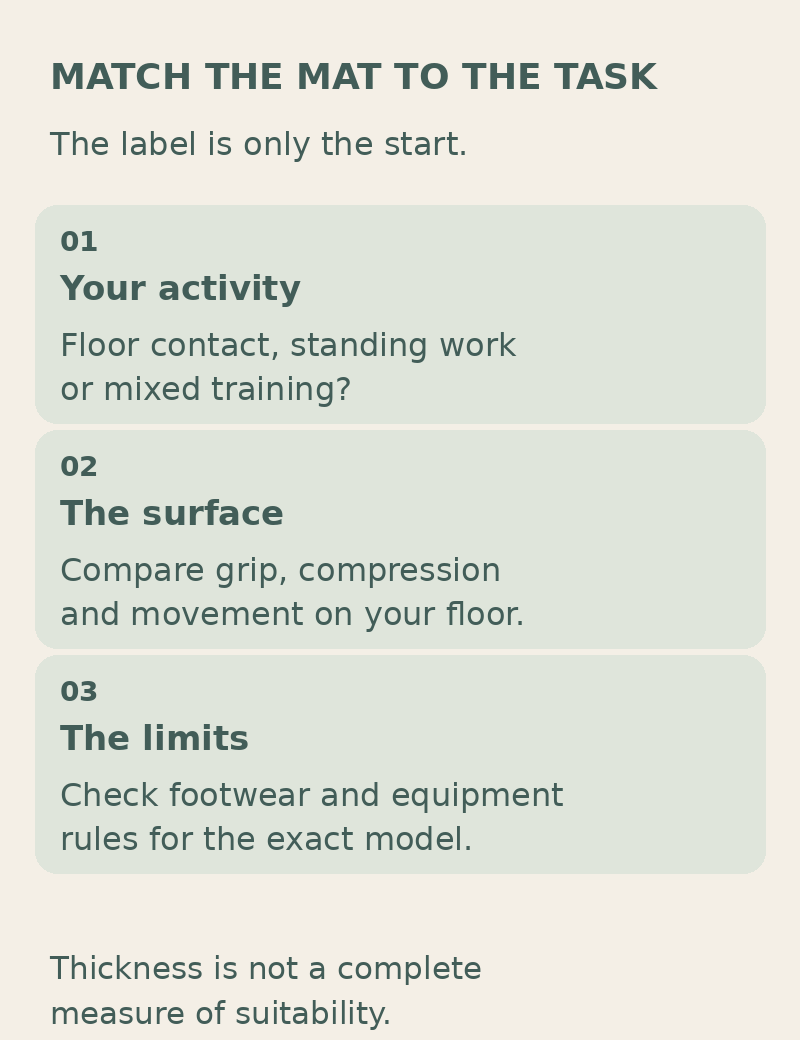
List your requirements: bare-hand grip, the amount of floor contact, permitted footwear, movement area and the floor beneath the mat. If a product fits those requirements and feels suitable in use, the marketing category need not decide the answer.
Equally, you do not need to force one mat to serve incompatible purposes. A soft floor-work mat you already like may remain useful for that task while a different surface suits a class with more standing work.
Measure the space, not only your height
Decathlon recommends considering both the available room and the activities involved. A mat can be long enough for lying down but too narrow for the movements you plan. A larger mat also needs clear space around it.
Compare listed length and width, how the edges lie and whether the mat can be stored without becoming an obstruction. If you carry it to class, check the actual weight and rolled size rather than assuming the thinner-looking one is lighter.
A larger mat is not a reason to crowd a shared studio. Check the class space and any equipment guidance before arriving with an oversized training surface.
Do not confuse a personal mat with gym flooring
A surface intended for contact with your body should not be assumed suitable under heavy equipment or dropped weights. Those are separate uses to confirm with the manufacturer and the facility.
Even a product advertised for strength training needs its own instructions checked. Ask what loads and equipment it permits instead of taking the word exercise as permission for any gym use. This comparison does not recommend jumping or dropping weights on either category.
Care and current condition matter
Cleaning instructions belong to the product. Do not transfer a cleaner, soaking method or drying treatment between mats simply because both are foam or both are sold for exercise.
Look for damage, persistent slipperiness, curling edges and areas that no longer provide the support you expect. Stop using an unsafe setup while you address it. A mat’s original description does not establish its condition after months of use.
Keep health needs separate
A thicker mat is not treatment for wrist, knee or back pain. NCCIH advises qualified instruction and individual guidance for people with conditions or needs that call for changes to yoga practice.
If you have an injury, a health condition or pregnancy-related needs, check with your healthcare professional and tell the teacher about relevant advice. Stop for pain, numbness, tingling or dizziness. Equipment choice should support a suitable practice, not replace that decision.
Common questions
Can I use my exercise mat for yoga?
Possibly, if the model permits it, gives suitable hand-and-foot traction and stays steady on your floor. Extra cushioning alone is not enough.
Are yoga mats always thinner?
No. Manufacturer ranges include exceptions. Compare actual thickness and compression rather than relying on the category name.
Do I need to replace a mat that already works?
No. If it is in good condition and suits the intended activity and product instructions, a different label is not a reason to replace it.
The useful comparison
Start with your activity, then compare grip, compression, dimensions and permitted use. A yoga mat often prioritises bare-hand and bare-foot traction; an exercise mat can mean several different designs. The right choice is the specific surface that fits the task.