
One teacher asks you to meditate on a question. Another asks you to set questions aside and return to a sound. A third calls quiet, receptive attention contemplation. If the vocabulary feels inconsistent, you are noticing something real: these words do not have one fixed relationship everywhere.
A useful comparison begins with context. Meditation can involve steady attention, awareness, reflection or other methods. Contemplation can mean sustained reflection in everyday language, but it can also name a wider field of practices or a particular form of religious prayer.
The aim here is to understand the labels, not rank spiritual traditions or prescribe a practice. Ask what a teacher means before assuming meditation means no thinking and contemplation means thinking hard.
There is no universal dividing line
The APA Dictionary of Psychology defines meditation using the language of extended contemplation or reflection, focused attention and insight. That alone should make us cautious about presenting the words as opposites.
NCCIH also describes meditation as a variety of practices. Its examples include focus on a sensation, sound, image or repeated phrase, as well as mindfulness approaches involving awareness of present experience.
These definitions serve different purposes. A psychology dictionary, a health-information page and a teacher within a religious tradition are not necessarily organising the subject in the same way. A comparison should identify whose usage it is describing.
A practical map of the terms
| Context | Meditation | Contemplation |
|---|---|---|
| Broad use | A family of practices | May mean sustained reflection |
| Some classes | Notice and return attention | Explore a question or meaning |
| Traditions | May include reflection | May be receptive prayer |
| Study | Can be one practice studied | Can be a wider field |
| Ask first | What is the method? | What does this term mean here? |
This is a map of possible usage, not a set of official categories. The same activity may be described with both words.
The familiar attention-versus-reflection comparison
In an introductory discussion, it can help to distinguish noticing experience from deliberately exploring its meaning. A sound-focused exercise might ask you to notice hearing and return when distracted. A reflective exercise might ask what careful listening means in an ordinary conversation.
The first instruction directs attention toward what is happening. The second invites you to consider a topic. That is a useful distinction between two tasks, but it does not define all meditation and all contemplation.
For example, you might read a short passage about patience and consider how you understand it. Or you might follow a guided awareness practice without trying to develop an interpretation. Those examples explain different instructions; neither is automatically more advanced or more valuable.
Meditation can include deliberate thought
Venerable Thubten Chodron’s teaching provides a clear Buddhist example. She distinguishes stabilising meditation from analytical, or checking, meditation. The latter involves exploring a topic’s meaning to deepen understanding.
In that account, reflection is part of meditation, not something that must be excluded before meditation begins. She also discusses combining the methods. This is enough to show why the slogan meditation is not thinking is too broad.
It would be equally misleading to turn her explanation into a definition of every Buddhist school. Keep the attribution attached: this is one teacher’s explanation within her teaching context. A different course may use different translations or classifications.
If you encounter the word analytical, ask what the teacher intends. It need not mean an endless argument with yourself or a demand to solve a philosophical problem during every session.
Contemplation can mean receptive prayer
Religious uses can shift the comparison in another direction. In a Vatican audience on contemplative prayer, Pope Francis describes a loving, receptive attention directed toward Jesus that does not require many words.
The same address distinguishes the broader contemplative dimension of life from contemplative prayer. It gives examples such as attending to nature, music, a book or art before discussing the specifically Christian relationship of prayer.
That example matters because contemplation is sometimes reduced to active reasoning. In this Catholic account, its meaning is not simply thinking harder about a topic. Its religious purpose also should not be removed and replaced with a generic wellbeing claim.
You do not have to adopt a belief to understand how a tradition uses a word. You can describe the distinction respectfully while recognising that the practice has its own commitments and setting.
Contemplative practice can be the umbrella
Brown University’s Contemplative Studies programme uses a broad working definition centred on sustained attention. It discusses contemplative experience in religious settings and in non-religious activities such as music, art, writing and attentive observation of the natural world.
Concordia University’s resource on contemplative teaching similarly describes a varied field. Its examples include meditation, focused thought, reflective writing, listening, movement and the arts, with spiritual, secular and blended contexts.
In that kind of discussion, meditation can be one part of contemplative practice. The words are not competing products from which you must choose one. Nor does every instance of reading, walking or making art automatically become a formal contemplative practice merely because it feels pleasant.
The purpose and manner of engagement matter. Ask how the activity is being framed rather than classifying it only from the posture or equipment.
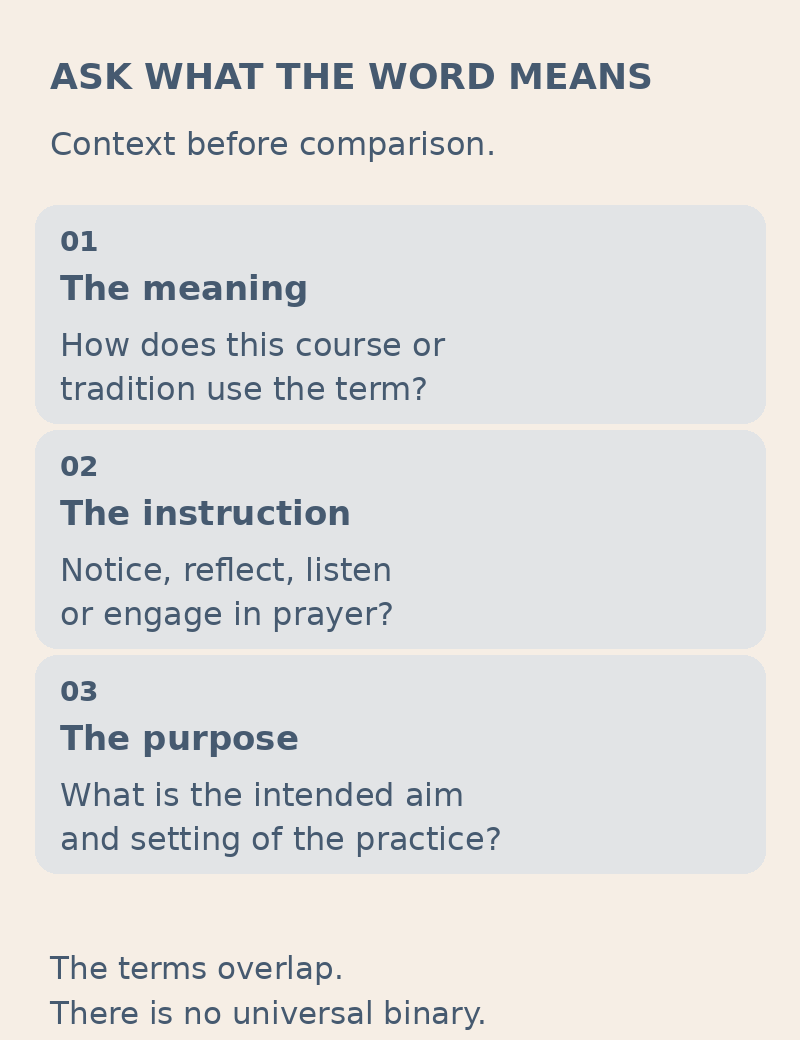
Three questions that make a class clearer
First, what does the word mean in this course or tradition? A teacher should be able to explain whether contemplation names reflection, receptive attention, prayer or a broader approach.
Second, what are you actually being asked to do? Notice a sound, consider a passage, attend to a question or engage in a religious practice? Clear instructions tell you more than a label alone.
Third, what is the purpose? A secular attention class, a discussion of personal values and a faith-based practice can have different aims. It is reasonable to ask about that before joining.
These questions also help when comparing apps or recordings. Two sessions with the same title may offer different activities. Two with different titles may give very similar instructions.
Reflection does not have to become endless self-analysis
An ordinary question can remain ordinary. You might consider what made a recent conversation clear, then leave the question there. You do not need to investigate painful memories or force a major revelation to make reflection count.
Writing is optional, and it is not the dividing line. Our meditation and journaling comparison explains the separate question of whether you want a written record. Reflection can happen without a notebook, and a notebook can simply record an attention practice.
If an exercise becomes repetitive, distressing or difficult to step away from, pause rather than treating intensity as proof of depth. A general article cannot determine whether a particular practice fits your circumstances.
No clinical winner follows from the names
Research about one defined meditation programme does not establish that everything called contemplation is less effective, or that meditation is the better response to a particular health problem.
NCCIH notes limitations in meditation research and the possibility of negative experiences. It advises against replacing conventional care or postponing a health appointment because of meditation or mindfulness practice.
Seek suitable professional advice for persistent or concerning mental health symptoms. Ask about an instructor’s training and experience, and stop an exercise that makes you feel worse. A spiritual or reflective label does not remove the need for individual care.
Common questions
Is contemplation just another word for meditation?
Sometimes the words overlap closely, but not always. A particular tradition or course may give them different meanings.
Does meditation mean having no thoughts?
That is not a sound definition of the whole category. Some practices train attention, while others deliberately involve reflection.
Is contemplation always religious?
No. Universities also discuss secular contemplative practices. Some specific forms of contemplation are explicitly religious and should be understood in that context.
The useful distinction
Compare the instructions and purpose before comparing the names. Sometimes the difference is noticing versus reflecting; sometimes meditation includes contemplation, or contemplation is the wider term. Understanding the context is more useful than forcing one universal rule.