You sit down after a crowded day. Would it help to close the notebook and pay attention, or open it and put your thoughts into words? Meditation and journaling offer different things to do with the same busy mind. You do not have to declare one better before exploring what each involves.
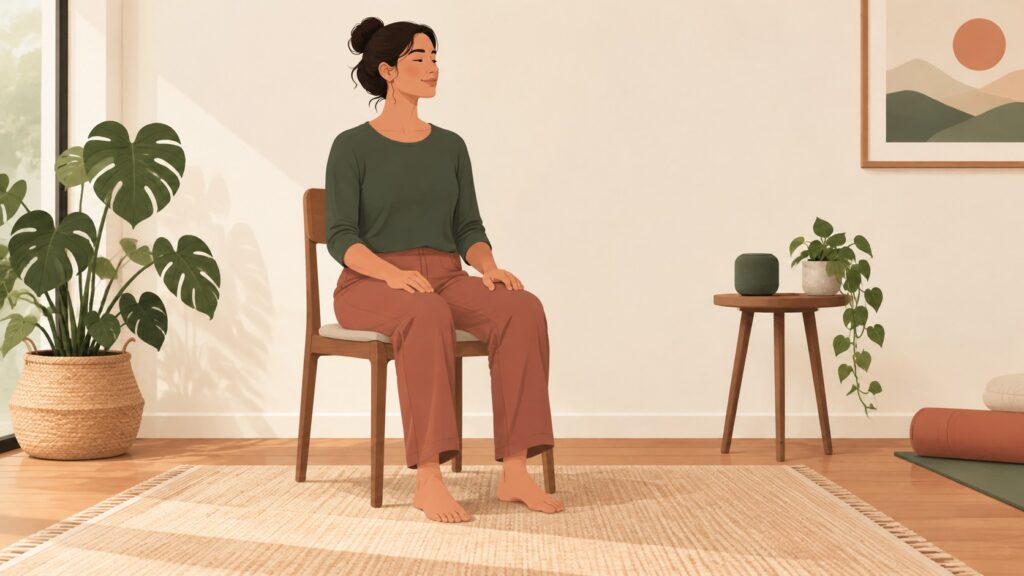
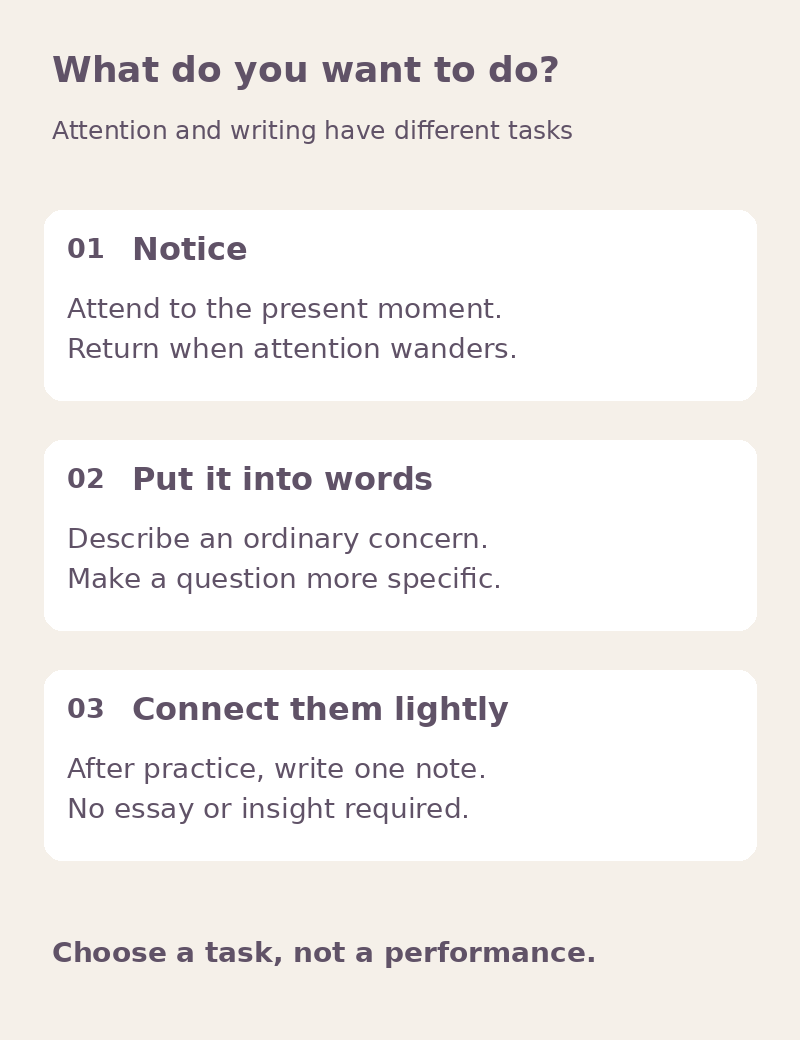
In a basic mindfulness meditation, you notice present experience and return attention when it wanders. In reflective journaling, you write about experience, perhaps describing an event, naming a concern or considering a next step. One can happen without making a written record; the other produces something you can read again. Neither requires an impressive insight every time.
What do the two words mean?
NCCIH describes meditation as a family of practices rather than one technique. Some focus on breathing, a sound, a visual image or a repeated phrase. Mindfulness practices involve awareness of the present moment without judgment. This comparison focuses mainly on that familiar attention-based approach, not every contemplative tradition.
The University of Rochester Medical Center describes journaling as writing down thoughts and feelings to understand them more clearly. A journal can contain sentences, lists or drawings. It need not follow a strict structure, and spelling is not the point. A private note about an ordinary day can count.
Those definitions leave room for overlap. You can pay close attention while writing, and you can reflect on a meditation afterwards. But writing about an experience is a different task from noticing it as it happens. Keeping the distinction clear helps you choose rather than expecting every notebook session to feel like meditation.
| Question | Meditation | Journaling |
|---|---|---|
| Main task | Notice and return attention | Describe or explore in words |
| Thoughts | Notice without following every story | Choose a thought to write about |
| Record | No written record required | Leaves an entry to revisit |
| Tools | A workable setting and guidance | Paper, pen or a digital note |
| Useful aim | Practise being attentive | Make a concern more specific |
Meditation is not an empty-mind test
The NHS explains that mindfulness is not about making thoughts disappear. It involves noticing thoughts as mental events that come and go. Its description of mindfulness meditation includes returning attention when the mind wanders, rather than treating wandering as evidence that you cannot do it.
For example, you notice a sound, then realise you have started planning tomorrow. In an attention practice, you can recognise that planning happened and return to the sound. You do not need to finish the plan or argue with yourself before returning. The point is the change in attention, not a perfect blank space.
If a recording leaves you unsure what you are meant to notice, look for clearer beginner guidance. Different practices use different anchors. A breath-focused exercise is not the only form of meditation, and difficulty with one approach does not establish that all meditation will suit you or that none will.
Journaling gives the thought somewhere to go
Writing allows a different response to the same planning thought. You might record the task, explain why it is on your mind and decide what needs doing next. Rochester’s guidance identifies prioritising concerns and noticing patterns as possible uses of a journal.
Consider a neutral example: you keep remembering an unfinished email. A short entry could separate the facts from the questions: the message needs a reply; one detail is missing; the next step is to ask for it. This is an illustration of organising a thought, not a promise that writing solves every worry.
A notebook also preserves a record. You can return later to see what you wrote, correct a misunderstanding or notice that a concern keeps recurring. Meditation does not require that record. Neither approach is incomplete simply because it lacks the other’s feature.
Ordinary journaling is not the same as therapy
Research about expressive writing often studies a particular exercise with a specified topic and schedule. It is not automatically research about every gratitude list, diary, planning page or meditation log. Similarly, evidence about a structured mindfulness programme does not necessarily describe an unguided minute at home.
Harvard Health’s discussion of expressive writing says it is not a cure-all and does not help everyone. Its examples include writing about difficult emotional experiences, which is a different undertaking from noting what happened at lunch. You do not need to use painful memories as material to make a journal legitimate.
UC Irvine’s report of research on expressive writing also warns against a one-size-fits-all approach. Its findings concerned particular groups and a particular exercise; they should not be used to predict an individual’s response from their background. The useful lesson is to avoid assuming that verbal expression is equally helpful for everyone.
Choose according to the task in front of you
If you want to practise noticing without immediately explaining everything, a clearly guided attention exercise may match that intention. If you want to describe a situation, collect questions or make an ordinary decision more specific, a page of writing may fit the task better.
This is a practical distinction, not a clinical ranking. Neither source material nor personal preference establishes that journaling is universally better for an anxious mind, or meditation universally better for someone who thinks too much. People and circumstances differ, and a familiar activity can feel different on another day.
It is also reasonable to choose neither at a particular moment. A conversation, an everyday task or a break from self-analysis may be what you want. Turning wellbeing activities into an obligation to investigate yourself all evening can miss the point of choosing deliberately.
A small, ordinary experiment
For an everyday exploration, choose a neutral moment rather than a difficult memory. You could briefly listen to nearby sounds and notice when attention moves elsewhere. Separately, you could write a few lines about what you noticed during an ordinary part of the day. These are optional examples, not a treatment programme or a required dose.
Afterwards, compare the experience rather than grading your performance. Was the instruction clear? Did the writing make the topic more specific? Did either activity feel manageable? An entry can be short and a meditation can include wandering. Neither needs a dramatic emotional result to have been a genuine attempt.
Rochester recommends making journaling easy and leaving room for the format that feels right. The NHS similarly describes mindfulness in everyday activities, including noticing sensations during a walk. You do not need to build an elaborate ritual before understanding the basic difference.
Can you use both?
Yes, but combining them does not have to mean doing two complete routines. One simple option is to make a brief note after an attention practice: what did you notice, and what instruction would you like explained? That note records the session without requiring you to analyse every thought that passed through it.
PositivePsychology.com’s review describes several kinds of journaling used alongside mindfulness work, including gratitude and reflective writing. It also notes that research does not clearly establish one best journaling format and that mixed programmes make individual effects hard to isolate.
Use that as a reason for modest expectations. A combined routine is a personal arrangement, not proof of extra neurological benefits or a superior path. You can keep writing and meditation separate if switching between them feels distracting. There is no requirement to turn every meditation into an essay.
Keep the record private on your terms
Rochester explicitly says you do not have to share your journal. If you choose to share something with a trusted person, you can select only the part you want them to see. The possibility of rereading does not create an obligation to publish, send or explain your entries.
Before using a shared notebook, device or app, consider who else could access it. For ordinary reflection, you can omit names and identifying details that are not needed. This is a practical privacy choice, not a reason to make your writing vague for yourself.
Know when to pause and ask for help
NCCIH notes both limitations in meditation research and the possibility of negative experiences. The NHS says mindfulness is not right for everyone and can make some people feel worse. More practice is not automatically the answer when an activity is distressing.
Harvard Health also notes that expressive writing can be upsetting, particularly when people are not ready to explore a difficult event. Do not push yourself into trauma-focused writing because an online prompt says honesty requires it. If either practice increases distress, stop and seek suitable support rather than forcing the exercise.
Neither meditation nor journaling should replace needed mental health care. NCCIH advises against using meditation to delay conventional care. For persistent or concerning symptoms, speak with a qualified health professional. For general background, our meditation guide and mindfulness and meditation comparison explain the terms further.
Sources
- NCCIH: meditation and mindfulness effectiveness and safety
- University of Rochester Medical Center: journaling for emotional wellness
- NHS: mindfulness
- Harvard Health: expressive writing and its limits
- UC Irvine: writing therapy is not for everyone
- PositivePsychology.com: journaling and mindfulness formats