A class asks you to follow a breathing pattern. Another asks you to notice breathing without changing it. Both may happen in a quiet room with your eyes open or closed, yet the instructions are doing different things. That difference is more useful than trying to decide which practice is more powerful.
Breathwork is a broad label for practices that deliberately work with breathing. Meditation is a family of attention and awareness practices, some of which use breathing as a focus. They overlap, but they are not interchangeable. A breath-focused meditation need not involve controlling the breath, and a breathing exercise need not include a meditation.
The simplest distinction: change or notice?
In a breathing exercise, the instruction may ask you to change the pace, depth or pattern of breathing. The NHS stress-breathing guide, for example, describes gentle, regular breathing without forcing it. Other activities sold as breathwork can be much more demanding. The label alone does not tell you what a session contains.
In a basic breath-awareness meditation, the task can be to notice breathing as it happens and return attention when the mind wanders. You may observe a sensation at the nose or the movement of the body without trying to produce a particular number of breaths. Here, breathing is the object of attention, not necessarily something to adjust.
NCCIH describes meditation as a range of practices. A sound, a visual image or a repeated phrase can also be a focus. This article mainly compares deliberate breathing exercises with that familiar attention-based form of meditation. It does not try to reduce every contemplative tradition to a single definition.
| Question | Breathwork | Meditation |
|---|---|---|
| Main task | Work deliberately with breathing | Practise attention or awareness |
| Breath pattern | May be intentionally changed | May simply be observed |
| Focus | Breathing is central | Breath, sound or another focus |
| Range | Gentle to demanding methods | Many different approaches |
| Good question | What will I be asked to change? | What will I be asked to notice? |
Breathwork is not one standard technique
Cleveland Clinic’s overview includes several breathing practices and also describes combining breathwork with meditation. That variety matters. Two sessions using the same word on their booking pages may have very different instructions, levels of effort and reasons for being offered.
A comfortable breathing exercise described by the NHS is not the same undertaking as a session involving rapid breathing or repeated breath holds. Do not transfer the safety assumptions of the first to the second. A reassuring name, soft music or a relaxed-looking instructor does not explain what you will actually be doing.
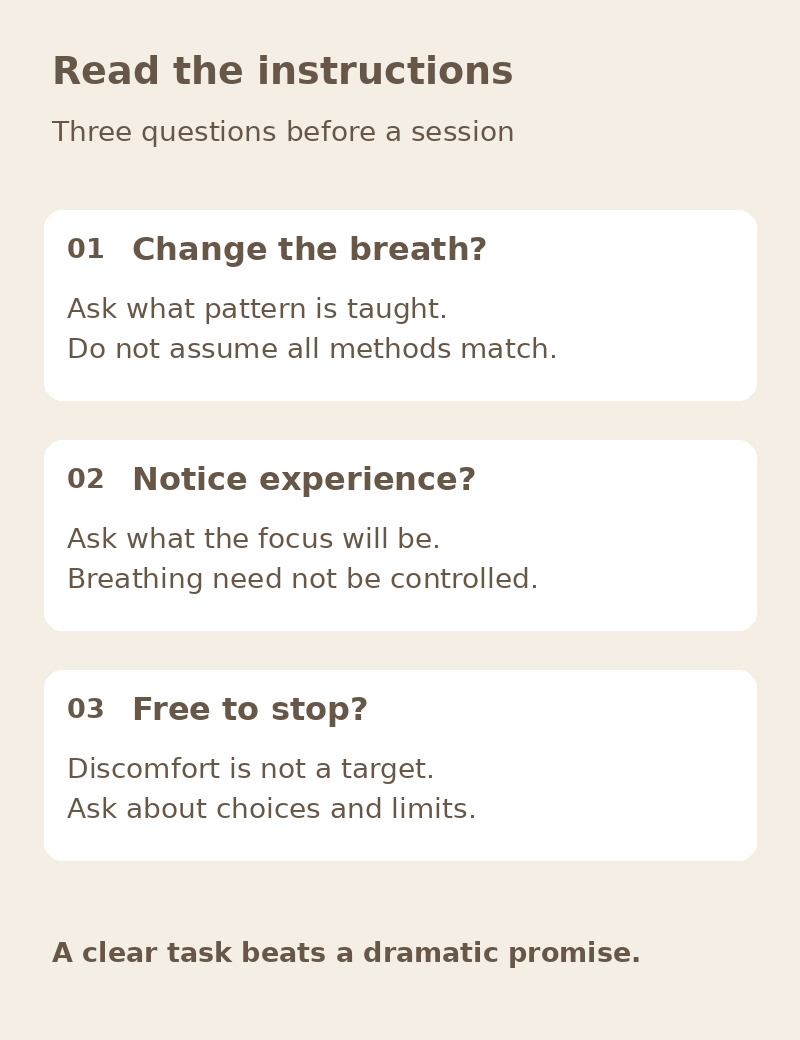
Before joining, ask for the method in ordinary language. Will you be asked to breathe quickly, breathe more deeply than feels natural, hold your breath or continue despite discomfort? Who should not take part, and can you stop or choose an alternative? A clear description lets you make a more informed choice than a promise of transformation.
Meditation does not require a blank mind
Attention can wander during meditation. Returning to the chosen focus is part of the task, rather than proof that you have failed. If you notice that you have been planning dinner instead of attending to a sound, recognising the change and returning is already a different action from continuing the plan.
You do not need to make breathing unusually slow or impressive to make a meditation legitimate. If the guidance is breath awareness, repeatedly correcting every inhalation may turn it into a different exercise. Follow clear instructions rather than assuming that stronger control means better attention.
Equally, not every meditation uses the breath. If focusing on breathing feels uncomfortable, a different focus or approach may be worth discussing with a qualified teacher. You can also decide to stop. Meditation is not a test of how long you can tolerate a practice that makes you feel worse.
Why the two often appear together
A teacher may begin with a comfortable breathing exercise, then invite you to leave the breath alone and notice it. The first part changes a pattern; the second shifts the task toward awareness. Knowing when that transition happens helps prevent confusion about whether you should still be counting or controlling.
Cleveland Clinic explicitly describes breathwork and meditation as practices that can be separate or combined. A combined class is therefore not a contradiction. It is simply worth asking which part is being taught, rather than expecting every instruction to do the same job.
Combining them does not establish that the session is more effective or that it suits everyone. You can prefer one activity, explore them separately or choose neither. A personal preference is useful information about your experience, but it is not a clinical comparison.
Which one should you choose?
Start with the task you want to understand. If you are curious about deliberately changing a comfortable breathing pattern, look for clear, low-pressure guidance that describes the method and its limits. If you want to practise noticing experience and returning attention, an introductory meditation may fit that intention more directly.
Consider the instructions as well as the setting. Are they easy to understand? Can you ask questions? Does the teacher allow you to keep your eyes open, change position or stop? These practical details may matter more to your first experience than whether the class uses the fashionable word breathwork or the familiar word meditation.
There is no reliable universal winner in this comparison. NCCIH notes limitations in meditation research, and its relaxation-techniques review covers varied methods and conditions. Evidence about a particular programme cannot establish that every breathing session is better than every meditation, or the reverse.
Keep health claims in proportion
Relaxation exercises are often discussed in connection with stress. That does not make every breathwork method a treatment for an anxiety disorder, and it does not mean everyone will feel calm. NCCIH reports that some people experience increased anxiety, intrusive thoughts or fear of losing control during relaxation techniques.
The same caution applies to meditation. NCCIH describes both research findings and possible negative experiences. Do not use meditation to postpone needed care. If symptoms are persistent, troubling or affecting daily life, speak with an appropriate health professional instead of trying to select a cure from a comparison article.
Some breathing exercises also have a specific clinical setting. The American Lung Association discusses pursed-lip and belly breathing in relation to lung disease and pulmonary rehabilitation. That is not a reason to replace an individual care plan with a general wellness class. If you have a respiratory or other medical condition, ask your clinician about the proposed method.
Fast breathing is not evidence of deeper progress
MedlinePlus explains that hyperventilation means rapid, deep breathing and can lower the level of carbon dioxide in the blood. It can be associated with dizziness, weakness and feeling unable to think clearly. Feeling unusual during an exercise is not proof that it is beneficial or that you should push through.
Rapid breathing can also have a medical cause. MedlinePlus warns that a first episode may be a medical emergency. Do not assume that unexplained rapid breathing or breathlessness is merely anxiety, and do not try to diagnose it through a breathing video. Seek urgent medical help for sudden or severe breathing difficulty or other alarming symptoms.
For an ordinary wellness session, discomfort is a reason to stop and reassess, not a target. This comparison intentionally does not prescribe rapid breathing, breath holds or fixed breathing ratios. Those details require more context than the broad label breathwork provides.
Questions to take to a teacher
Ask whether the session is mainly a breathing exercise, attention practice or a combination. Ask what breathing changes are expected and whether any are optional. If a health condition, pregnancy or a history of distress during inward-focused exercises is relevant, discuss it with your clinician and the teacher before taking part.
You can also ask what to do when attention wanders or when the exercise does not feel calming. A useful answer should make room for ordinary variation rather than blame your effort or insist that discomfort proves the method is working. You do not need to buy into dramatic claims to learn a simple distinction.
For more background, our meditation guide explains the attention side, and our mindfulness and meditation comparison separates two other commonly mixed terms. The basic takeaway remains straightforward: breathwork often changes breathing; meditation trains attention and awareness; a session can do both, provided the instructions make that clear.