
A studio offers both yin and hatha, and both descriptions promise a slower pace. How do you choose? The useful difference is usually how the session spends its time. Yin commonly involves longer stays in a small number of positions, often on the floor. A general hatha class may introduce a wider mix of standing, seated and lying postures, with instruction between them.
There is overlap. Hatha has a broad meaning as well as a modern timetable meaning, so yin and hatha are not two entirely separate traditions with a hard boundary. Compare the lesson, the positions and the support, rather than treating either name as a promise of an easy hour.
Why the labels overlap
The University of Southern California’s yoga style guide uses hatha as a broad term for physical yoga, while explaining that a contemporary hatha listing often describes an unrushed class with instruction. Cleveland Clinic likewise distinguishes the broad category from a modern class combining postures and breathwork.
Yin teacher Bernie Clark places his approach within the hatha yoga tradition. His account of the name describes the influence of Paulie Zink, Paul Grilley and Sarah Powers. That is a teacher’s account of the method’s development, not a reason to reduce all hatha history to one modern class format.
For a student, the practical point is simple: a timetable may separate the names to distinguish teaching approaches, even though the practices share a wider background. Neither name identifies a universal sequence. A studio description should explain what its own teacher actually offers.
| Feature | Yin | Hatha listing |
|---|---|---|
| Pace | Fewer changes, longer stays | Varied poses with pauses |
| Positions | Often seated or lying | Often standing and floor work |
| Attention | Sensation and relative stillness | Learning poses and breath awareness |
| Support | Props may change the position | Props depend on the lesson |
| Ask first | Can I leave a hold early? | How often do we change levels? |
What happens in a yin class?
Cleveland Clinic describes yin as a slow, floor-based practice with positions held for several minutes and props available to help with positioning. The long stays distinguish it from a class where the main experience is moving through many different shapes.
In his explanation of yin, Clark describes entering a position without forcing, finding relative stillness, staying for a suitable time and leaving slowly. He explicitly says that the appropriate duration depends on the person and the posture. His description is not a requirement that every beginner complete a particular number of minutes.
Stillness also does not mean being trapped. Clark allows changes when sensations become too intense and warns against seeking the greatest range of movement. Before attending, ask how the teacher introduces holds, offers other positions and helps students decide when to stop.
What happens in a hatha class?
A hatha-labelled session often has more variety. Cleveland Clinic describes a mix of standing and seated postures, detailed instruction and holds lasting several breaths. USC describes time to settle into each posture without rushing and less emphasis on an aerobic outcome.
These descriptions are useful examples, not a binding timetable for every studio. One teacher may include balances and a fair amount of standing. Another may spend much of the session seated or lying down. Breathing, relaxation or meditation may also be included, but ask how much time each receives.
If you want to learn the names, setups and transitions of common yoga postures, a clearly described introductory hatha course is worth considering. Check whether it builds week by week or allows drop-in attendance. Knowing the format helps you arrive with realistic expectations.
Longer does not automatically mean gentler
Fewer transitions can sound appealing when you are tired of rushing. Yet remaining in one position may be demanding in a different way from moving between several. A quiet room and a slow voice do not establish how a particular posture will feel in your body.
Do not treat the class duration, a timer or another student’s stillness as a target you must match. Clark’s own description says to reduce the intensity or come out when sensations become too much. You do not need to earn permission to change position by first becoming uncomfortable.
The reverse assumption also fails: a hatha class is not necessarily strenuous simply because it includes standing work. It may provide frequent pauses and clear alternatives. Compare the actual demands rather than ranking all stillness as easy and all movement as hard.
Floor access and transitions matter
Before choosing a floor-based class, think about reaching the floor, changing sides and getting up again. A description that says seated and lying postures may not explain how those positions are connected. Ask about the transitions as well as the destination.
The same question applies to hatha. Several rounds of standing-to-floor movement may be fine for one person and a barrier for another. If you need chair-based options, cannot kneel comfortably or want to avoid weight on your hands, explain that concrete need to the provider.
USC’s first-class guidance encourages students to tell the teacher about injuries and physical limitations and to rest when something is too advanced. This is useful for either listing. Agree on an available resting position before the session starts, rather than trying to negotiate it while the group moves on.
Props do not identify the whole practice
Bolsters, blankets and blocks can appear in either class. Cleveland Clinic includes props in its yin description, while also explaining their use to adapt yoga more generally. The presence of a cushion in a photograph cannot tell you how long a position lasts or what the teacher intends.
Ask what equipment is supplied and whether its use will be demonstrated. Support can change a position, but a pile of props is not a guarantee of individual suitability. You still need a way to ask questions, make a change or choose a different position.
Yin is also not simply another name for restorative yoga. Cleveland Clinic distinguishes yin’s stretching emphasis from restorative practice’s emphasis on full support and relaxation. If your goal is a restful class without a stretching focus, ask specifically about that difference rather than choosing from the photographs.
Breathing and attention are not exclusive to either
Both class descriptions may mention breath and awareness. In a hatha lesson, attention may move between an explanation, a physical action and the breath. In yin, the quieter pace may leave more time to notice sensations or the experience of staying with one position.
Neither pattern guarantees that your mind will become quiet. A newcomer may prefer more explanation; another may find long pauses easier to follow. These are reasons to explore teaching styles, not evidence that one student is better at yoga.
Ask whether breathing is simply observed or whether a separate breathing technique is taught. You should not have to force a breath pattern to match the room. If an instruction feels difficult or confusing, return to ordinary breathing and ask the teacher for help.
Health questions need more than a style name
NCCIH recommends qualified instruction and notes that yoga injuries can occur. It advises pregnant people, older adults and people with health conditions to discuss individual needs with their health care provider and instructor. New students should avoid extreme practices and forceful breathing.
Do not select yin because someone promises to repair your connective tissue, or hatha because a listing claims to treat every complaint. A general explanation of a method is not evidence of a treatment benefit for your condition. Claims about energy or traditional frameworks should not be confused with established medical results.
Stop rather than pushing through pain, numbness, dizziness or difficulty breathing. Seek appropriate care for concerning or persistent symptoms. A supportive teacher should welcome a request to change position; neither a long hold nor keeping up with a group is more important than communicating what you need.
Make a useful first-class comparison
- Does the listing explicitly welcome people new to yoga?
- Which positions are used, and how are transitions taught?
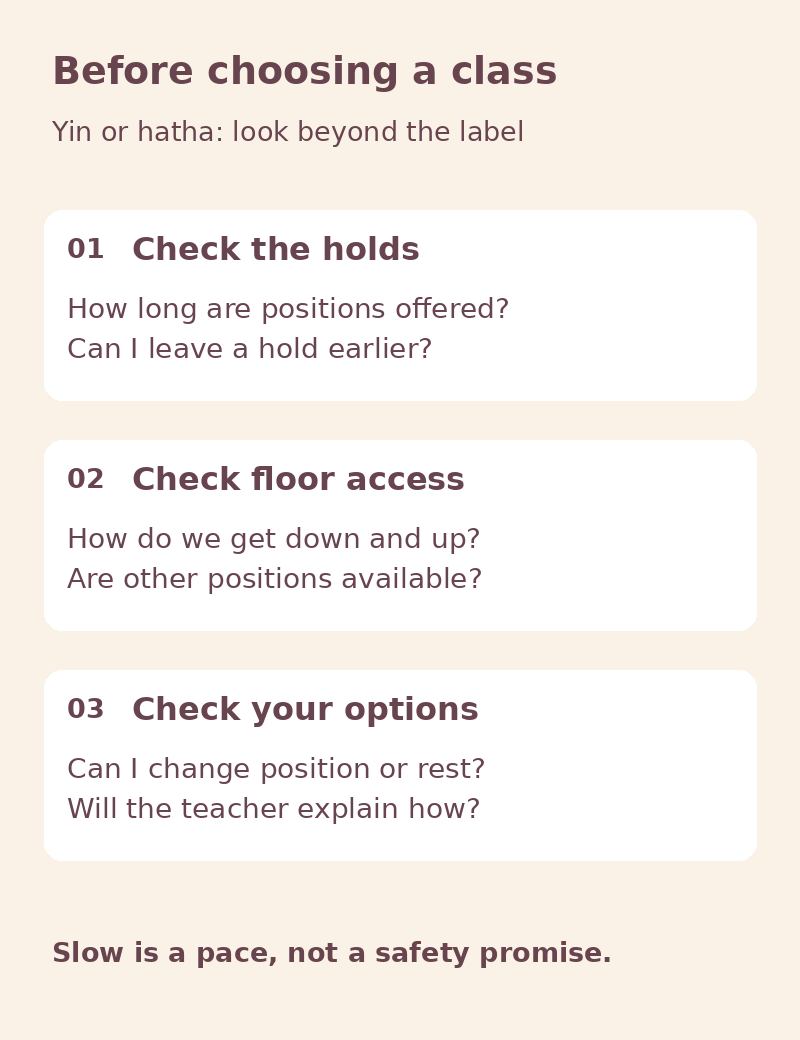
- How long are holds usually offered, and can I leave earlier?
- What alternatives are available for kneeling, wrist loading or floor work?
- Will props and ways out of positions be demonstrated?
- What experience does the instructor have with the needs I have described?
Choose introductory hatha if you are interested in learning a range of postures with explanation and the specific course matches your needs. Explore beginner-friendly yin if longer, relatively still positions appeal to you and the teacher can explain how to adapt them. You can try both without making either your permanent identity.
After class, ask yourself something more useful than whether you reached a deep shape: could you follow the teaching, breathe comfortably, ask for help and change course? Our hatha yoga guide and yin yoga guide offer background. For the quieter styles, see our yin and restorative comparison.