A short phrase repeated before a difficult conversation may be called a mantra, an affirmation or simply a reminder. In everyday English, those labels often overlap. Within a religious tradition or a research paper, however, the distinctions can matter.
A traditional mantra is a sacred utterance with a particular context. A personal affirmation is usually a statement someone uses to encourage or remind themselves of something. Repeating both does not make them the same practice, and evidence about one cannot automatically be transferred to the other.
This comparison explains the vocabulary without prescribing a sacred formula, promising a health benefit or asking you to adopt a belief. The useful question is what the words mean in the setting where you encounter them.
What is a mantra?
The APA Dictionary of Psychology includes a sacred utterance in Hinduism and Buddhism in its definition of mantra. Britannica likewise describes sacred syllables, words or verses, while explaining that modern English also uses mantra to mean a watchword or slogan.
Those are different uses of one word. A business team can call a repeated motto its mantra without claiming it is a religious teaching. Confusion begins when the casual meaning is treated as a complete description of traditional practice.
Traditional contexts can involve devotion, ritual, meditation and spiritual understanding. The source, pronunciation, sound and meaning may matter in different ways. A definition that reduces every mantra to a positive thought leaves much of that context out.
What is an affirmation?
For this everyday comparison, an affirmation means a statement used for encouragement or as a reminder of a quality, belief or direction. For example, someone might write, “I can approach this conversation with care.” That is a contemporary example, not a quotation from a yoga text.
The phrase is meaningful because of what it says. You can ask whether it is honest, relevant and useful to you. It does not become a traditional mantra merely because you repeat it quietly or place it beside a meditation cushion.
There is a separate research meaning of self-affirmation, discussed below. That term often refers to reflection on important personal values, rather than repeating a flattering sentence. Keeping these meanings separate prevents a familiar misunderstanding.
A side-by-side comparison
| Question | Mantra | Affirmation |
|---|---|---|
| Context | May be sacred or traditional | Often everyday self-talk |
| Purpose | Depends on the teaching | Support or reminder |
| Wording | Learn from its source | Can be personally chosen |
| Meaning | More than a slogan | Consider what it says |
| Evidence | Check the exact practice | Check the exact exercise |
The mantra column describes traditional use, not every casual English use of the word. Neither column is a promise of an outcome or a ranking of people who prefer one approach.
Why sacred context should stay visible
Shiva Tigunait’s Himalayan Institute article explicitly distinguishes popular positive affirmations from mantra as sacred sound in the Vedic and tantric traditions it describes. Its explanation belongs to that spiritual framework.
We can acknowledge that framework without presenting its spiritual claims as established medical mechanisms. Nor should one teacher’s explanation be turned into a rule for every Hindu, Buddhist or other community.
Britannica describes varied religious uses and notes that some mantras have no apparent ordinary lexical meaning. That does not make them meaningless to the people who use them. Sacred significance, devotional relationship and teaching context are not the same thing as a dictionary translation.
Before adopting a traditional practice, ask where it comes from and how it is taught. Do not assume an isolated sound online comes with everything needed to understand its use.
Sound versus meaning is too simple
A common comparison says a mantra is only about sound and an affirmation is only about meaning. That can seem tidy, but it is not a reliable universal rule.
Some mantra traditions attach importance to pronunciation and sound while also involving remembrance, understanding or devotion. Our guide to japa meditation discusses repetition alongside its source and purpose, rather than treating it as mechanical sound production.
Likewise, repeating a secular sentence for attention is not necessarily an attempt to persuade yourself that every word is already true. A phrase might name an intention. Ask what you are being invited to do instead of inferring the entire method from its label.
Research self-affirmation is another distinction
Stanford’s report on school-based self-affirmation research describes students choosing important values, such as relationships, creativity or humour, and writing about why those values mattered to them.
That exercise is different from repeatedly declaring that you are successful, fearless or perfect. A study about reflecting on values is not evidence that any positive sentence will produce the same result.
The Stanford report also stresses context. The intervention was designed for students facing stereotype-related threat, and the researchers cautioned against applying it indiscriminately in every school. Supportive teachers, resources and opportunities still mattered.
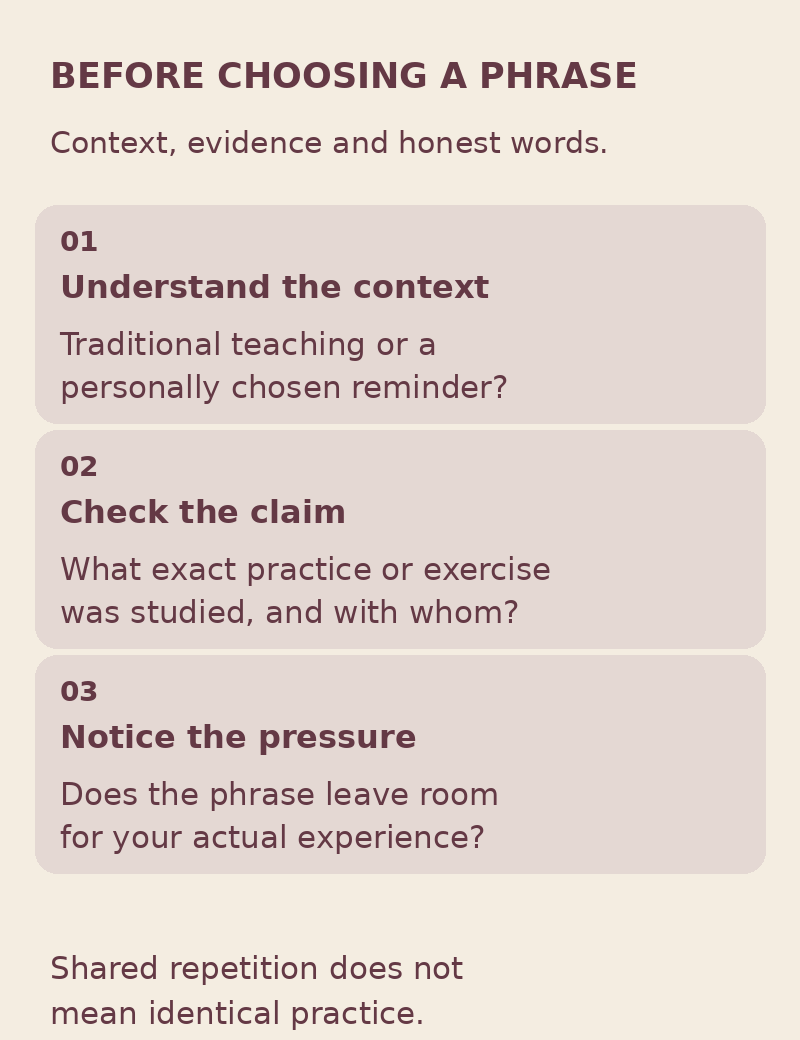
For a reader comparing mantras and affirmations, the lesson is about reading evidence carefully. Check the actual exercise, participants, setting and outcome before accepting a broad claim about the power of words.
Positive statements can sometimes feel worse
A study by Joanne Wood and colleagues examined positive self-statements. Its experiments found that participants with low self-esteem who repeated a particular positive statement, or focused on its truth, could feel worse than comparison participants.
That result is a caution against promising that positive words always help. It does not show that every affirmation harms everyone, or that a specific spiritual mantra has been tested by the same experiment.
If a sentence feels false or turns into an argument with yourself, you do not have to repeat it more forcefully. You can change a personally chosen phrase, stop the exercise or choose another activity. Discomfort is not proof that a method is breaking through a hidden barrier.
Examples without borrowed authority
Consider the difference between “I never feel nervous” and “I can prepare one point before I speak.” The first demands an absolute emotional state. The second names a modest action. These are illustrative wording choices, not scientifically validated prescriptions.
Similarly, “Everything will work out exactly as I want” promises control over circumstances. “I can ask for help with the next step” leaves room for uncertainty and other people’s choices.
You may find neither sentence useful, and that is acceptable. A phrase is optional. It should not become another standard you must meet or a reason to blame yourself when events are difficult.
Is an affirmation the same as sankalpa?
Not automatically. Our sankalpa guide introduces resolve or intention within yoga and explains why the teacher’s framework matters. A short statement can look similar on paper while serving a different purpose.
Calling every intention a mantra, every affirmation a sankalpa and every repeated sentence meditation makes the labels less useful. You do not need a Sanskrit name for an ordinary reminder. Plain language can be both accurate and respectful.
Choosing what fits your purpose
If you want to learn a traditional practice, begin with a suitable teacher or reliable teaching source. Ask about its context, wording and expectations rather than assembling a method from unrelated fragments.
If you want a secular reminder, say so clearly. Choose ordinary words you understand, without claiming an ancient source or guaranteed result. You can connect the reminder with a practical action, but repeating it does not replace taking that action.
If you are evaluating a class or app, ask what it means by mantra or affirmation. Does it explain its sources? Does it distinguish spiritual teaching from research? Does it allow you to decline an exercise without pressure?
Health and safety limits
NCCIH describes meditation as a varied group of practices and notes limits in safety research. Negative experiences can occur. A repeated phrase is not automatically suitable for everyone because it is described as natural, spiritual or positive.
Pause an exercise that increases distress or feels destabilising, and seek suitable advice for persistent or concerning symptoms. Do not replace medical or mental-health care, delay an appointment or change treatment because of a mantra or affirmation.
This article does not identify a clinical winner. A claim that either approach cures illness, guarantees confidence or makes unwanted events your fault goes beyond what is supported here.
Common questions
Can a personal motto be called a mantra?
Yes, in casual English. Be clear that this does not make it a traditional sacred practice.
Must an affirmation begin with I am?
That is not a requirement of this comparison. The meaning and honesty of the statement matter more than adopting a formula.
Does repeating a sentence prove it will work?
No. Repetition alone does not establish a spiritual, psychological or medical outcome.
The useful distinction
Look beyond the repeated words. A traditional mantra has a teaching context; a personal affirmation has a statement to consider; research self-affirmation may involve a different exercise altogether. Keep the source, purpose and evidence attached to the practice you actually mean.