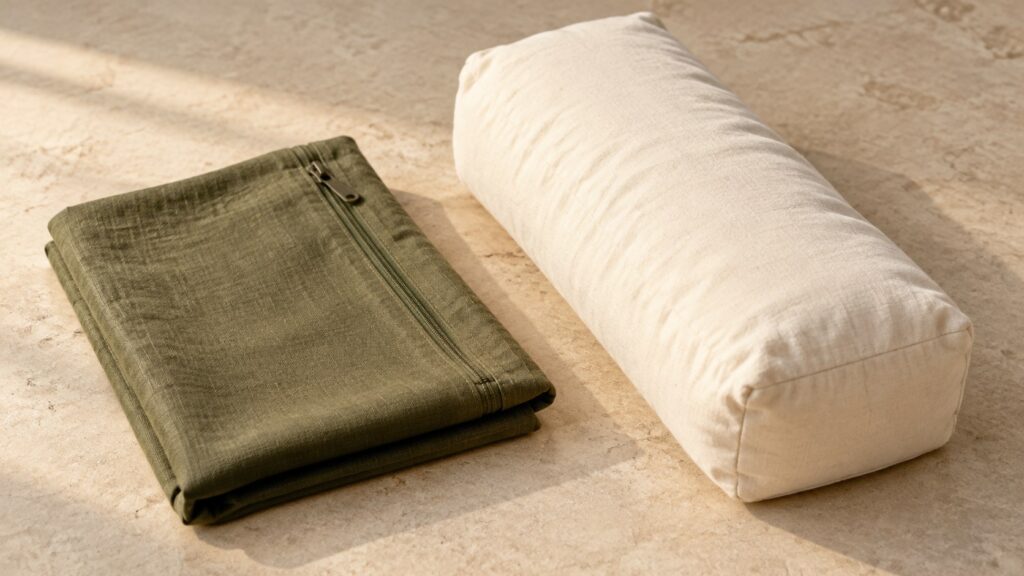
A yoga bolster cover is the fabric layer around a filled support cushion. Some covers are designed to come off for washing or replacement; others should stay in place during cleaning.
That distinction matters more than the presence of a zipper. Before removing anything, identify the exact bolster and read its care instructions. A cover can affect the fit and structure of the whole prop.
This guide explains how to check compatibility, distinguish cover care from inner-cushion care, and avoid common replacement problems. It does not assume that all cotton covers wash alike or that one spare cover fits every bolster.
Start by identifying what you have
Find the brand, model, shape, and care label. If an order record or product name is available, use it to locate the matching instructions instead of relying only on appearance.
A bolster may have an outer textile cover, an inner case that contains the filling, and the filling itself. Those layers have different jobs and may require different care.
Do not confuse opening an outer cover with opening the filled inner case. If you cannot tell which layer contains loose material, stop and check the manufacturer’s explanation before continuing.
For the broader role of these props, see our guide to yoga bolsters and blankets. Here the focus is the cover, not instructions for supported poses.
Not every cover should be removed
Hugger Mugger’s dedicated care page says that its bolster covers are not designed for regular removal or machine washing and should remain on during cleaning.
By contrast, Manduka’s Equa rectangular bolster page gives separate instructions for its microfiber cover and inner cushion. Inner Space Yoga also provides directions for removing and replacing its cotton covers.
These examples show why a universal instruction to unzip every bolster is unreliable. Read the guidance for the exact model and version you own.
If a generic FAQ and a dedicated product page disagree, ask the manufacturer which applies. Do not choose the more convenient method simply because it appears somewhere on the same website.
Replacement cover or protective layer?
A replacement cover is intended to take the place of an existing outer cover. A separate protective layer may sit over a prop whose original cover remains in place.
Those are different arrangements. A loose household pillowcase may provide a surface layer, but it is not automatically a fitted replacement and may move or bunch during use.
Check the product description for cover only. A photograph of a fully shaped bolster can show a cover on an insert even when the listing does not include the filled cushion.
Do not assume that buying a cover gives you a complete support prop. Likewise, a spare cover will not repair a collapsed inner cushion or damaged filling.
Match the shape before the color
Round, rectangular, and narrow bolsters need different cover shapes. A similar length is not enough if the cross-section or depth differs.
For a rectangular bolster, record length, width, and height. For a round one, identify length and diameter, while checking how the seller describes its measurements.
Measure the filled bolster in its ordinary shape without compressing it to force a preferred number. Keep the units clear and compare like with like.
A model-specific replacement is a useful starting point, but still check the exact name and size. Brands may sell several shapes or generations with similar names.
What dimensions do and do not prove
Dimensions help narrow compatibility, but they do not describe every detail of the fit. Seam allowances, fabric stretch, zipper opening, shape, and the condition of the filled cushion can also matter.
Check whether a listing gives the size of the cover laid flat, the size of the finished bolster, or the model it is intended to fit. Those are not necessarily equivalent measurements.
Do not add an arbitrary amount to every dimension in the hope of compensating for washing. Follow the maker’s sizing instructions rather than creating a universal shrinkage allowance.
If compatibility remains unclear, ask the seller before removing tags or washing the cover. A guess that is close on paper can still leave an unusable fit.
Fabric, closures, and handles
Common cover descriptions include cotton and microfiber, but the fabric name does not settle the entire care routine. Construction and the manufacturer’s instructions matter too.
- Zipper: check where it sits, how far it opens, and whether it can close without pulling hard on the fabric.
- Drawstring: learn how the cord is secured and how to prevent it disappearing into its casing during washing.
- Seams: look for a shape that aligns with the inner cushion rather than twisting around it.
- Handle: check its intended use and condition. Do not assume it can support a person or act as an exercise strap.
Inner Space Yoga specifically advises securing its drawstring before washing. That is an example of a construction detail that would be missed by treating all covers as simple zippered bags.
Choose a texture that is comfortable against clothing and skin. Stop using a cover that causes irritation rather than assuming repeated exposure is part of adjusting to yoga equipment.
Keep washing instructions product-specific
Manduka’s Equa rectangular bolster page instructs users to machine wash the microfiber cover cold, hang dry it, and avoid fabric softener. It tells users to spot clean the inner cushion and air dry it before storage.
Sunshine Yoga’s listed cotton replacement cover permits cold machine washing and low-heat tumble drying. Yoga Studio’s round cotton cover gives cold washing and hang-drying instructions, with separate first-wash advice about color.
These differences are useful evidence against one-size-fits-all rules. Do not transfer a dryer setting from one cover to another simply because both are cotton.
Read the label before washing, including detergent restrictions, color separation, drying method, and whether the cover should be removed at all. If information is missing or inconsistent, ask before experimenting.
Do not wash the entire bolster by default
A washable cover does not mean a washable inner cushion. The cover’s instructions apply to that layer, not automatically to the filling beneath it.
Before cleaning, separate the tasks: what can be removed, what can be washed, what may only be spot cleaned, and what needs professional or manufacturer advice.
Do not soak a filled cushion because its cover looks dirty. Loose fills and structured inners can respond differently to moisture and cleaning, and drying the outside does not establish that the interior is dry.
If a spill reaches the inner, use the instructions for that inner. Do not hide a damp or damaged cushion beneath a fresh cover and put it back into use.
Removing and refitting a removable cover
Only proceed when removal is permitted. Work on a clean, dry surface and note how the cover is oriented before taking it off.
- Open the closure fully. Do not drag the inner through a partly closed zipper or pull against a tied cord.
- Ease the fabric away. Follow the manufacturer’s method rather than using the zipper pull as a handle.
- Clean the correct layer. Keep outer-cover and inner-cushion care separate.
- Dry as directed. Make sure the parts are fully dry before reassembly.
- Align the shape. Match corners, end panels, and seams before gradually drawing the cover into place.
- Close without force. Keep fabric and inner material clear of the closure.
Some makers describe gently compressing the inner during refitting. Use only the method intended for your product, and stop if the cover will not fit without excessive pulling.
If the washed cover no longer fits
First check orientation: a twisted rectangular cover or misplaced end panel can look too small even before shrinkage is considered. Open it again and line up the shape.
Next confirm that the cover is the correct model and that the washing and drying instructions were followed. Do not force a zipper across an overfilled opening.
A tight fit is not an invitation to cut seams, stretch damp fabric over the inner, or remove filling from an unrelated product. Ask the manufacturer about the specific problem before altering the bolster.
Some product instructions do discuss filling adjustments, but that advice belongs to those designs. Changing another bolster’s filling could change its shape and support in ways a cover guide cannot assess.
Storage and shared equipment
Store spare covers clean and fully dry, with the matching model noted somewhere you can find it. Similar-looking covers can become difficult to distinguish once labels or packaging are separated.
Keep closures and fabric away from sharp objects that can snag them. Check seams, handles, and zipper function before returning a cover to use.
For shared equipment, follow a clear cleaning and handling procedure. A fresh outer cover does not establish that every underlying layer is clean or dry.
Do not use fragrance to conceal a persistent odor without checking its cause and the care guidance. If a prop remains damp, damaged, or unsuitable, keep it out of use while you seek advice.
Frequently asked questions
Does a zipper mean the cover is washable?
No. Check the exact bolster’s instructions. Some covers should stay in place for cleaning.
Can one cover fit every rectangular bolster?
No. Shape, dimensions, construction, and model compatibility all matter.
Can I wash the inner with the outer cover?
Do not assume so. A washable outer layer does not establish that the filled cushion can be washed.
Should I force a tight zipper?
No. Check orientation and fit, and ask the maker if the cover will not close normally.
Does a replacement cover include the bolster?
Often it does not. Read whether the listing is cover only or includes a filled cushion.
The bottom line
Choose a yoga bolster cover by exact compatibility and care requirements before color or appearance. Confirm whether removal is permitted, keep inner and outer cleaning separate, and refit only when fully dry. Clear model-specific instructions are more useful than universal laundry shortcuts.
Sources and further reading
- Inner Space Yoga: Wash and replace covers
- Kakaos: Bolster care instructions
- Yoga Studio: Replacement round bolster cover
- Sunshine Yoga: Rectangular bolster cover and care
- Hugger Mugger: Bolster and cushion care
- Manduka: Equa rectangular bolster care
About the author: Ranjana Sinha
Ranjana Sinha is a yoga teacher with an MSc in Yoga and an M.PEd in physical education. She previously worked as an assistant professor of physical education and yoga and has taught at Kaivalyadhama Institute. Read more about Ranjana.
This article is general education, not medical advice. Speak with a health professional about your individual needs.