
You are on your mat in a new class. The teacher stands at the front, facing you, and says, “Lift your right arm.” The arm you see moving is on the other side from your right hand. For a moment your brain stalls. Do you copy what you see, or do you follow the words?
This is one of the most common small confusions in a yoga class, and it has a simple answer once you know what the teacher is doing.
The short answer
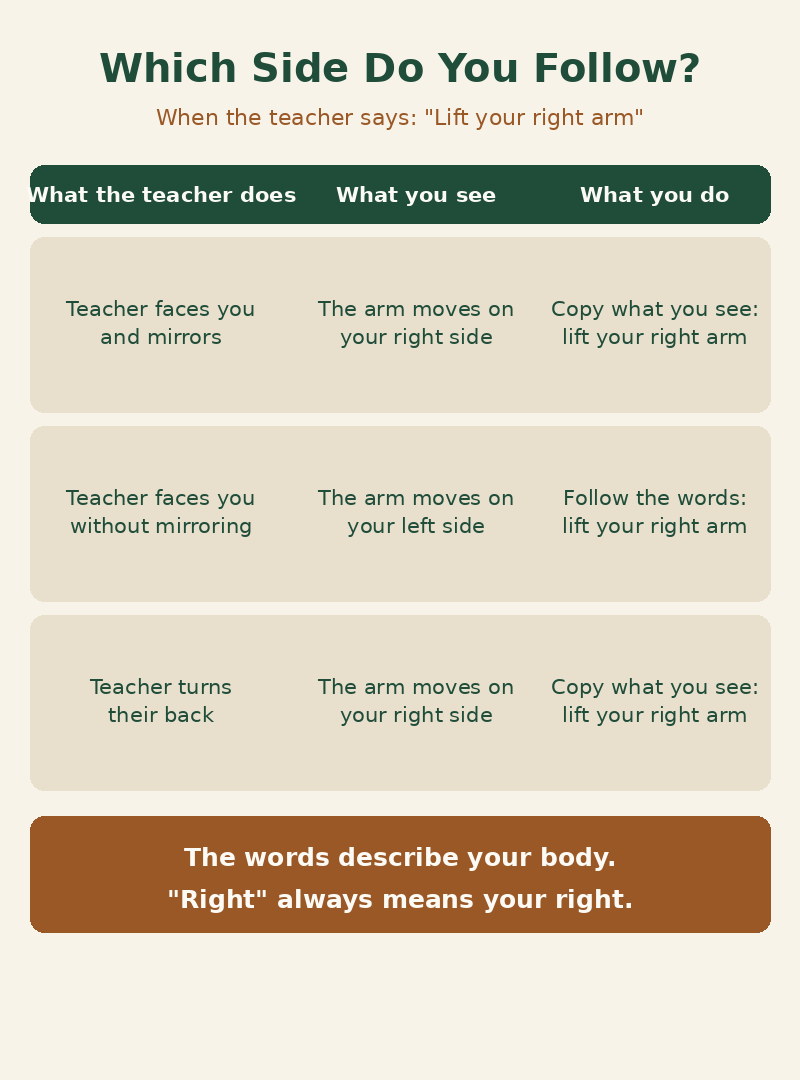
Follow the words first. When a teacher says “right,” that means your right side, not the side you happen to see moving.
Then check the demonstration. Many teachers deliberately move the arm or leg you see on your right side, so what you see and what you hear match. If the teacher’s movement lines up with your own right side, simply copy what you see.
If the words and the picture disagree, the words win. Your teacher is cueing your body, not theirs.
What mirroring is
When a teacher faces the class and deliberately practices on the opposite side from their own cue, that is called mirroring. Teacher trainer Nam Chanterrwyn of the American Yoga Council explained the idea to Yoga Journal: if he lifts his left arm to cue students to lift their right, students can simply match what they see, the way you would follow someone standing across from you in a dance. You do not have to mentally flip anything.
Mirroring is a deliberate kindness from the teacher. It is hard to do well, because the teacher must constantly translate their own left and right into yours. Teachers do it so you can spend less time decoding directions and more time noticing your breath and your body.
Why some teachers do not mirror
Not every teacher mirrors, and that is normal too. Some find it difficult to do accurately, especially in a fast class. Some feel it confuses certain students more than it helps. Neurodivergent yoga teacher Kirstie MacDonald Scott told Yoga Journal she avoids mirroring because it scrambled her own brain as a student; in slower classes she prefers to say “lift one arm,” let everyone choose, and then switch sides.
Other teachers simply turn their back to the class for a pose or two, so everyone’s left and right line up the same way. Some skip “left” and “right” altogether and use the room instead: “reach toward the window,” “step your front foot forward,” or “lift your top arm.”
All of these are ordinary, workable conventions. There is no single rule every teacher follows.
Situations that change the picture
A few common setups change what following looks like:
- A mirror at the front of the studio. If everyone, including the teacher, faces the mirror, the teacher will usually demonstrate on the same side as the cue. Watch the teacher’s reflection just as you would watch your own.
- Mats or chairs in a circle. In a circle there is no shared “front,” so teachers usually demonstrate on the same side and talk students through it.
- Mostly lying-down classes. In a reclining or restorative class you often cannot see the teacher at all. Here the words carry everything, so listen for “right” and “left” and move your own body accordingly.
- Fast-flowing classes. In a quick vinyasa there may be no time for detailed cues. Do your best, keep breathing, and copy a neighbor who looks settled.
What to do when you are not sure
If you lose track mid-pose, pause for one breath and look. Watch the teacher for a moment, or glance at a nearby student who seems comfortable, and rejoin when you are ready. Nobody minds.
If it happens often, ask the teacher before class: “Do you mirror when you demonstrate?” It is a normal question, and teachers who work with beginners hear it regularly. Our guides to your first yoga class and to class etiquette cover more of these small practical questions.
And if you end up doing a pose on the “wrong” side, nothing bad happens. Almost every yoga sequence repeats on both sides, so you will simply do the other side when everyone else switches. Finish the pose, breathe, and carry on.
Does it matter which side you start on?
For a beginner, no. Teachers pick a starting side for practical reasons, and the sequence almost always repeats on the other side within a few minutes. Some yoga traditions customarily begin on the right, but that is a custom, not a rule your body needs. If you start on the left while the class starts on the right, you have lost nothing.
What about videos and online classes?
The same rules apply, because a teacher on a screen is usually facing you, just like a teacher at the front of the room. Many online teachers mirror for exactly the same reason studio teachers do. With a recording you also have options a live class does not offer: you can pause, rewind a few seconds, or turn your mat so the screen sits where you can see it without twisting your neck.
If left and right keep mixing you up
Plenty of adults hesitate over left and right under pressure, especially when they are also balancing, breathing and listening at the same time. It says nothing about your ability or your intelligence.
A few small tricks help. Wear a watch or a ring on one hand and quietly learn which one. Notice a landmark on your mat, like the logo corner, and fix it as your reference point. When a cue comes, move slowly: a half-second of patience beats a full-speed guess.
The bottom line
Follow the spoken cue, and let your own right and left be the reference. When the demonstration matches what you see, copy it. When it does not, trust the words, take your time and remember that both sides will come around. After a class or two with the same teacher, their style will feel familiar and the confusion fades on its own.
Frequently asked questions
What if I do the pose on the wrong side?
Nothing bad happens. Sequences repeat on both sides, so you simply do the other side when the class switches.
Should I watch the teacher or listen?
Listen first. The words describe your body. Use the demonstration as support, and copy it only when it matches your own right and left.
Is it rude to ask the teacher whether they mirror?
Not at all. It is a normal practical question, and teachers who work with beginners hear it often.
Do all teachers mirror?
No. Some mirror, some turn their back, and some use room cues like “front foot” or “toward the window.” All of these are ordinary ways to teach.
Source note: teacher quotes and mirroring background are from “Mirroring for Yoga Teachers,” Yoga Journal, 17 September 2026, with teachers Brett Larkin, Nam Chanterrwyn, Amy Ippoliti, Kirstie MacDonald Scott and Malaika DosRemedios. This article adapts that reporting for students.