
If your knees are stiff and painful from osteoarthritis, you have probably heard two kinds of advice: do strengthening exercises, or try yoga. Both show up in treatment guidelines. But until recently, almost no study had put the two head to head. A trial published in April 2025 in JAMA Network Open did exactly that, and its results are more useful than a simple “yoga wins” or “yoga loses” headline.
Here is what the study found, including the parts that usually get left out.
The short answer
In this trial, yoga was not better than strengthening exercise for reducing knee pain over 12 weeks. It was also not worse. Both groups improved by a similar, meaningful amount, and the difference between them was small enough that the researchers could call yoga “noninferior” to strengthening, a statistical way of saying it held its own within a preset margin.
Some secondary measures, including stiffness, daily function, depression scores and quality of life, leaned modestly toward yoga at later check-ins. The researchers themselves say to read those as exploratory, not proof.
What the study actually was
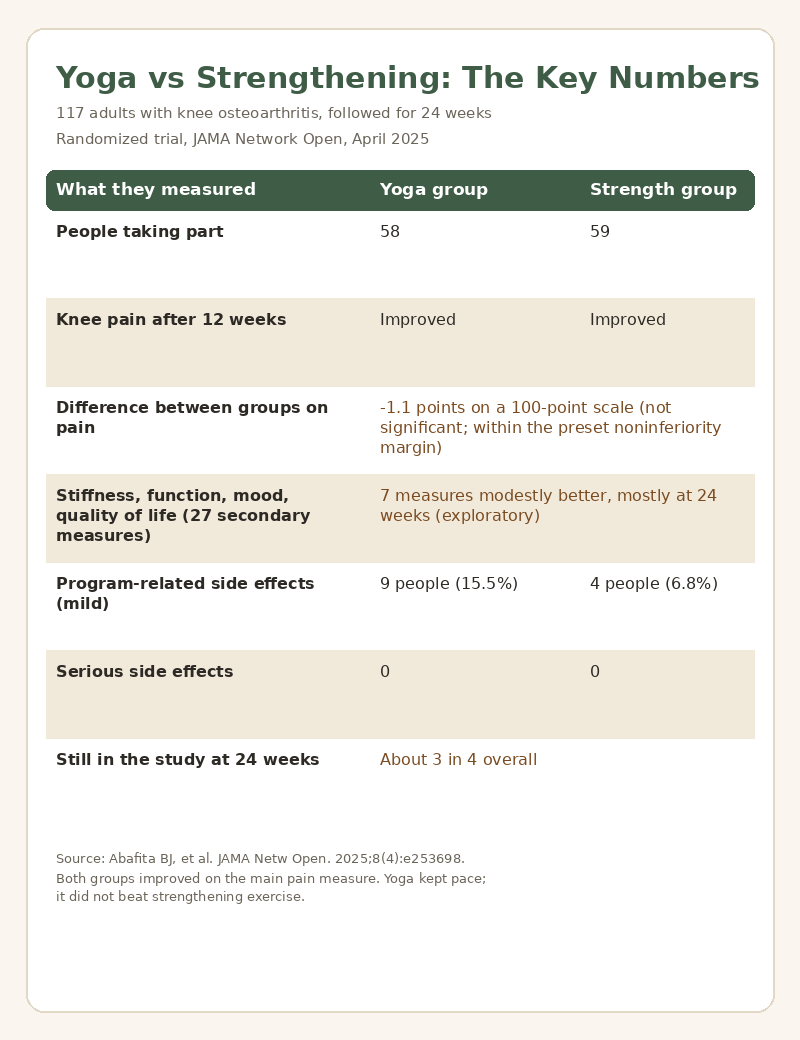
This was a randomized clinical trial run in Southern Tasmania, Australia, and published online on 8 April 2025. The researchers recruited 117 adults aged 40 and over who had knee osteoarthritis and at least moderate knee pain (a score of 40 or more on a 100-point pain scale). Participants were randomly split into two groups: 58 did yoga and 59 did strengthening exercises. The average age was about 62, and 73% were women.
Both programs ran for 24 weeks. For the first 12 weeks, everyone had two supervised one-hour group sessions and one one-hour home session each week. For the following 12 weeks, they continued with three home sessions a week. Group sessions were led by physiotherapists and yoga teachers, with about 10 participants per instructor.
One detail matters for reading this study: the yoga program was designed specifically for people with arthritis. It was not a general community yoga class, and the authors say directly that their results do not tell us what a regular drop-in class would do for someone with knee osteoarthritis.
The main result: a draw on pain
The trial’s primary question was simple: after 12 weeks, does one group have less knee pain than the other, measured on a 0-to-100 scale?
The answer was no. The difference between the two groups was -1.1 points, with a confidence interval from -7.8 to 5.7. In plain terms, the two programs landed so close together that statistics cannot tell them apart on pain. Both groups improved, and both improvements were large enough to matter to patients.
Before the trial started, the researchers had set a “noninferiority margin” of 10 points: if yoga’s pain reduction came within 10 points of strengthening’s, they would consider it not meaningfully worse. The result stayed well inside that margin, so yoga met the noninferiority standard. That is the honest headline: yoga kept pace with the standard exercise program on the main measure; it did not beat it.
What else they measured
The researchers tracked 27 secondary outcomes over 12 and 24 weeks, covering pain, stiffness, physical function, walking speed, quality of life, depression and more. Seven of those 27 showed statistically significant differences in favor of yoga, mostly at the 24-week mark:
- Knee pain, function and stiffness on the WOMAC index, a standard osteoarthritis questionnaire
- Participants’ own global rating of their knee
- A timed fast walk test
- Depression scores at 12 weeks
- Overall quality of life at 24 weeks
The researchers are careful here, and so should we be. When you measure 27 things, a few will look significant by chance, and the authors label these secondary results exploratory. They are hints worth following up, not established findings. It is also fair to note that participants stuck with the home yoga routine a bit more than the home strengthening routine in the second half of the trial (about 70% of prescribed sessions versus 60%), which may partly explain the later differences.
The part that often gets skipped: harms
More people in the yoga group reported side effects linked to the exercise program. Over 24 weeks, 9 participants in the yoga group (15.5%) had an adverse event considered probably or possibly related to the intervention, compared with 4 (6.8%) in the strengthening group. None were serious, and the most common issue, a temporary flare-up of knee pain, happened at similar rates in both groups. Two people in each group withdrew because of side effects.
The authors suggest the higher rate in the yoga group may come from participants being less familiar with yoga poses than with standard gym-style exercises. Overall side effects of any kind were reported by 37.9% of the yoga group and 27.1% of the strengthening group, and most were unrelated to the programs.
This is not a reason to avoid yoga. It is a reason to learn it from someone qualified, tell the teacher about your knees, and treat new pain that lasts more than a couple of days as a signal to ease off and ask, not to push through.
The study’s limits
- Smaller than planned. Recruitment during COVID-19 left 117 participants instead of the planned larger sample, though the authors say the study still had over 90% power to detect a meaningful difference.
- One place. Everyone lived in one Australian state, which limits how well the results travel.
- No blinding. Participants knew which program they were in, and most outcomes were self-reported, so expectations could have colored the answers.
- A special program. The yoga was designed for arthritis and taught in small supervised groups. Results do not extend to general community classes, online videos, or more athletic yoga styles.
- Six months only. We do not know how the two approaches compare beyond 24 weeks.
What this means if you have creaky knees
Exercise is recommended by all major guidelines as a first-line treatment for knee osteoarthritis, as the trial’s authors point out. This study adds something practical: a supervised, arthritis-aware yoga program was a legitimate alternative to a standard strengthening program, not a lesser one. If you enjoy yoga more than gym exercises, that preference is now backed by reasonable evidence, and preference matters because the best exercise program is the one you will actually keep doing, as the adherence numbers in this trial show.
Sensible next steps if you are considering yoga with knee osteoarthritis:
- Talk to your doctor or physiotherapist first, especially if your pain is severe, your knee swells, locks or gives way, or you have had a recent injury or surgery.
- Look for gentle, beginner or therapeutic classes, and tell the teacher about your knees before the first class. Our guide to yoga for sensitive knees and knee-friendly standing practice cover what that looks like in ordinary classes.
- If kneeling is a problem, that is common and workable; see yoga without kneeling.
- Expect progress over weeks, not days. In the trial, both groups improved gradually over 12 weeks.
What this study does not mean
It does not show that yoga treats or cures osteoarthritis. It does not prove every yoga class is safe for arthritic knees; the studied program was built and supervised for that purpose. And it does not mean strengthening exercises are pointless: they improved pain just as much, remain a guideline-backed option, and many people do both. If you are weighing yoga against structured physical therapy more broadly, our earlier research note on yoga versus physical therapy for chronic low back pain covers a related trial.
Frequently asked questions
Is yoga as good as strengthening exercise for knee osteoarthritis?
In this trial, yes on the main measure: yoga was not superior to strengthening exercise for knee pain over 12 weeks, but it was noninferior, meaning it reduced pain by a similar, clinically meaningful amount. Some secondary measures at 24 weeks favored yoga modestly, but the authors consider those exploratory.
Is yoga safe for arthritic knees?
Mostly, with care. No serious side effects occurred in this trial, but more yoga participants (15.5%) than strengthening participants (6.8%) reported mild program-related side effects, usually temporary pain flare-ups. Working with a qualified teacher who knows about your condition, and easing off when new pain persists, keeps risk low.
What kind of yoga was studied?
A program designed specifically for people with arthritis, taught in small groups by trained instructors, with two supervised sessions and one home session per week for 12 weeks, then home practice. The authors caution that the results do not describe general community yoga classes.
Should I switch from strengthening exercises to yoga?
The trial compared the two but did not rank one as the winner for everyone. Both improved pain and function. If you prefer yoga, this evidence supports it as a reasonable alternative; if strengthening works for you, there is no need to switch. Discuss the choice with your doctor or physiotherapist.
Sources
- Abafita BJ, Singh A, Aitken D, et al. Yoga or Strengthening Exercise for Knee Osteoarthritis: A Randomized Clinical Trial. JAMA Network Open, 2025;8(4):e253698. doi:10.1001/jamanetworkopen.2025.3698 (full text read 25 November 2026)
- PubMed record for the trial
- NCCIH: Yoga, Effectiveness and Safety (checked 23 November 2026)